Éxodo 8
Isaac Leeser Tanakh · Toca un versículo para ver sus referencias cruzadas.
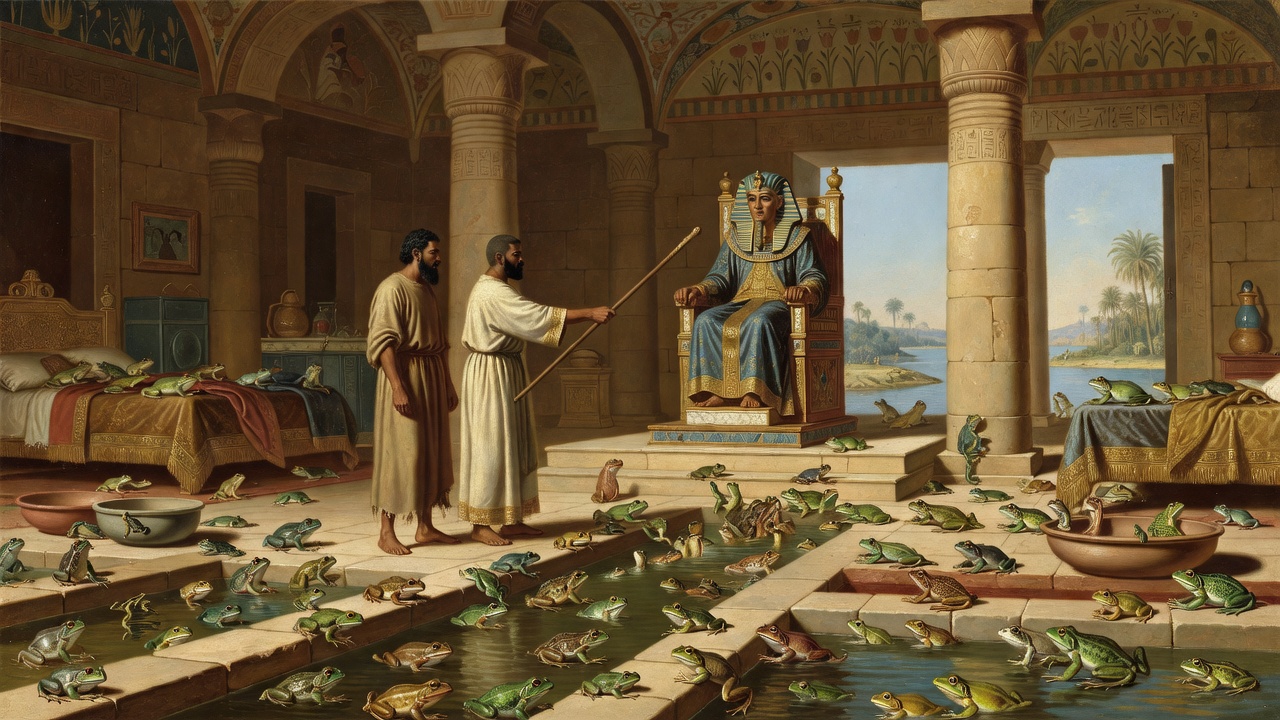
The Second Plague: Frogs
1(7:26) And the Lord said unto Moses, Go in unto Pharaoh, and say unto him, Thus hath said the Lord, Let my people go, that they may serve me. 2(7:27) And if thou refuse to let them go, behold, I will smite all thy borders with frogs: 3(7:28) And the river shall bring forth frogs abundantly, and they shall go up and come into thy house, and into thy sleeping-chamber, and upon thy bed, and into the house of thy servants, and among thy people, and into thy ovens, and into thy kneading-troughs; 4(7:29) And upon thee, and upon thy people, and upon all thy servants, shall the frogs come up. 5(8:1) And the Lord said unto Moses, Say unto Aaron, Stretch forth thy hand with thy staff over the streams, over the rivers, and over the ponds, and cause the frogs to come up over the land of Egypt. 6(8:2) And Aaron stretched out his hand over the waters of Egypt; and the frogs came up, and covered the land of Egypt. 7(8:3) And the magicians did so with their secret arts, and brought up the frogs over the land of Egypt. 8(8:4) Then did Pharaoh call for Moses and Aaron, and said, Entreat the Lord, that he may take away the frogs from me, and from my people; and I will let the people go, that they may sacrifice unto the Lord. 9(8:5) And Moses said unto Pharaoh, Arrogate thyself glory over me: for what time shall I entreat for thee, and for thy servants, and for thy people, to destroy the frogs from thee and from thy houses, that they may remain in the river only? 10(8:6) And he said, For tomorrow; and he said, Be it according to thy word; in order that thou mayest know that there is none like unto the Lord our God. 11(8:7) And the frogs shall depart from thee, and from thy houses, and from thy servants, and from thy people; only in the river shall they remain. 12(8:8) And Moses and Aaron went out from Pharaoh; and Moses cried unto the Lord on account of the frogs which he had inflicted on Pharaoh. 13(8:9) And the Lord did according to the word of Moses; and the frogs died out of the houses, out of the courts, and out of the fields. 14(8:10) And they gathered them together in many heaps; and the land stank. 15(8:11) But when Pharaoh saw that there was a respite, he hardened his heart, and hearkened not unto them; as the Lord had spoken.
The Third Plague: Gnats
16(8:12) And the Lord said unto Moses, Say unto Aaron, Stretch out thy staff, and smite the dust of the earth, and it shall become lice throughout all the land of Egypt. 17(8:13) And they did so; and Aaron stretched out his hand with his staff, and smote the dust of the earth, and the lice were thus on man, and on beast; all the dust of the land became lice throughout all the land of Egypt. 18(8:14) And the magicians did so with their secret arts to bring forth the lice, but they could not; so were the lice upon man and upon beast. 19(8:15) Then said the magicians unto Pharaoh, This is a finger of God; but Pharaoh's heart remained hardened, and he hearkened not unto them; as the Lord had spoken.
The Fourth Plague: Flies
20(8:16) And the Lord said unto Moses, Rise up early in the morning, and place thyself before Pharaoh; lo, he goeth forth to the water; and say unto him, Thus hath said the Lord, Let my people go, that they may serve me. 21(8:17) For if thou wilt not let my people go, behold, I will send against thee, and against thy servants, and against thy people, and into thy houses various wild beasts: and the houses of the Egyptians shall be full of the wild beasts, and also the ground whereon they dwell. 22(8:18) And I will distinguish on that day the land of Goshen, in which my people abideth, so that no wild beasts shall be there; to the end thou mayest know that I am the Lord in the midst of the earth. 23(8:19) And I will put a distinction between my people and thy people; tomorrow shall this sign be. 24(8:20) And the Lord did so; and there came a grievous multitude of beasts into the house of Pharaoh, and into the house of his servants; and in all the land of Egypt, the land was laid waste by reason of the wild beasts. 25(8:21) And Pharaoh called for Moses and for Aaron, and said, Go ye, sacrifice to your God in the land. 26(8:22) And Moses said, It is not proper to do so; for the abomination of the Egyptians must we sacrifice to the Eternal our God: lo, if we should sacrifice the abomination of the Egyptians before their eyes, would they not stone us? 27(8:23) A three days' journey will we go into the wilderness, and sacrifice to the Lord our God, just as he may say unto us. 28(8:24) And Pharaoh said, I will surely let you go, that ye may sacrifice to the Eternal your God in the wilderness; only do not go very far away: entreat for me. 29(8:25) And Moses said, Behold, I am going out from thee, and I will entreat the Lord, and the wild beasts shall depart from Pharaoh, from his servants, and from his people, tomorrow; only let not Pharaoh deal deceitfully any more, so as not to let the people go to sacrifice to the Lord. 30(8:26) And Moses went out from Pharaoh, and entreated the Lord. 31(8:27) And the Lord did according to the word of Moses; and he removed the wild beasts from Pharaoh, from his servants, and from his people; there remained not one. 32(8:28) But Pharaoh hardened his heart at this time also, and he did not let the people go.
¿Sabías que…?
Tres plagas sobre Egipto
- Las ranas de este capítulo suben del Nilo, un nombre que el Antiguo Testamento no usa. El Easton's Bible Dictionary dice que el río aparece como Sihor, “la corriente negra”, o simplemente “el río”, y que el Nilo Blanco y el Nilo Azul se unen en Jartum, luego recorren 1.800 millas y entran al Mediterráneo por dos brazos. Aarón extiende su vara sobre los ríos, los canales y los estanques, y las ranas cubren la tierra de Egipto.Fuentes: Nile · el propio texto bíblico
- Cuando las moscas llenan las casas de los egipcios y arruinan la tierra, el capítulo dice que no se hallará ninguna en Gosén, donde viven los israelitas, como distinción entre los dos pueblos. El Easton's Bible Dictionary describe Gosén como un distrito al este del Nilo, al parecer no lejos de la residencia real, llamado también tierra de Ramsés porque Pitom y Ramsés quedaban dentro de sus límites, y también vincula el distrito con Zoán, o Tanis. La misma entrada la llama “lo mejor de la tierra”.Fuentes: Goshen · el propio texto bíblico
- Moisés y Aarón hablan con el faraón en persona. El Easton's Bible Dictionary (1897) sitúa al faraón del Éxodo en Zoán, escenario de las entrevistas con ellos registradas en Éxodo, pero deja su identidad como una cuestión abierta entre Menephtah, llamado allí el decimocuarto y mayor hijo sobreviviente de Ramsés II, y Seti II, y añade que algunos creen que las evidencias favorecen a Seti II.Fuentes: Pharaoh (of the Exodus) · el propio texto bíblico
Notas escritas con ayuda de IA a partir de fuentes abiertas (Theographic Bible Metadata, CC BY-SA 4.0; Easton’s Bible Dictionary, dominio público) y revisadas antes de publicarse.
Lugares de este capítulo
- Nile · Hoy: Nile River · 31.465, 30.367 · versículos 3, 9, 11
- Egypt · 30.129, 31.308 · versículos 5, 6, 7, 16, 17, 21, 24
- Goshen · Hoy: Goshen 1 · 30.799, 31.834 · versículo 22
Solo aparecen lugares identificados con alta confianza (90 % o más según las fuentes académicas reunidas por OpenBible). Mapa de la época: DARE (Digital Atlas of the Roman Empire), CC BY 4.0; mapa actual: © colaboradores de OpenStreetMap; lugares: OpenBible.info (CC BY 4.0).
Créditos y licencia de esta traducción
Isaac Leeser Tanakh
The Isaac Leeser Tanakh (Jewish Bible)
Public Domain
Language: English
Dialect: archaic British
Translation by: Isaac Leeser
2020-10-14
Títulos de sección adaptados de la Berean Standard Bible (dominio público); no forman parte del texto bíblico de esta traducción.
Fuente: http://ebible.org/englee/ · eBible.org