1 Reyes 1
Isaac Leeser Tanakh · Toca un versículo para ver sus referencias cruzadas.

Acerca de este libro
Sobre 1 Reyes
- El Easton's Bible Dictionary (1897) considera incierta la autoría de los libros de Reyes. Una tradición según la cual Jeremías los escribió queda, a juicio de Easton, respaldada por pasajes casi idénticos a partes de Jeremías y por sucesos que Jeremías conocía personalmente; sin embargo, Easton estima más probable que Esdras, después del cautiverio, compilara los libros a partir de documentos anteriores, quizá escritos por David, Salomón, Natán, Gad e Iddo. Easton sitúa la composición entre el 561 a. C., cuando Evil-merodac liberó a Joaquín del cautiverio, y el 538 a. C., el decreto de Ciro.Fuentes: Easton: Kings, The Books of
- Easton afirma que estos libros contienen los anales del reino desde la subida de Salomón al trono hasta que Nabucodonosor y los babilonios lo sometieron, un período que estima en unos 453 años. 1 Reyes comienza mientras David está muriendo: Adonías, su cuarto hijo, que había pasado a ser el heredero presunto del trono tras la muerte de Amnón y Absalón, se hace proclamar rey, pero Natán y Betsabé persuaden a David de que entronice a Salomón de inmediato. Salomón, hijo de David y Betsabé, cuya historia se registra en 1 Reyes 1-11, llegó al trono, sugiere Easton, hacia los dieciséis o dieciocho años.Fuentes: Easton: Kings, The Books of · Adonijah · Solomon
- En las Escrituras hebreas, los dos libros de Reyes formaban originalmente un solo libro; la Septuaginta fue la primera en dividirlos y, con la Vulgata, los numera como el tercer y el cuarto libros de Reyes, siendo los libros de Samuel el primero y el segundo. Easton observa que Crónicas da mayor relieve al oficio sacerdotal o levítico, mientras que Reyes da mayor relieve al oficio real, y que en la división de las Escrituras en tres partes hecha por los judíos estos libros se cuentan entre los Profetas. La narración remite a fuentes anteriores: el libro de los hechos de Salomón y las crónicas de los reyes de Judá y de Israel.Fuentes: Easton: Kings, The Books of
- Tras la muerte de Salomón, las diez tribus se rebelaron e invitaron a Jeroboam, hijo de Nebat, a ser su rey; Easton lo llama el primer rey de esas tribus y sitúa su reinado entre 976 y 945 a. C. Había huido a Egipto bajo la protección de Sisac I y luego trasladó su residencia de Siquem, su primera capital, a Tirsa, que siguió siendo la residencia principal de los reyes de Israel hasta que Omri compró a Semer el monte de Shomeron por dos talentos de plata y edificó Samaria. La narración posterior incluye a Acab, hijo de Omri y séptimo rey de Israel, cuya esposa era Jezabel: al culto del becerro introducido por Jeroboam añadió el culto de Baal, y fue severamente amonestado por el profeta Elías.Fuentes: Jeroboam · Tirzah · Samaria · Ahab
Notas escritas con ayuda de IA a partir de fuentes abiertas (Theographic Bible Metadata, CC BY-SA 4.0; Easton’s Bible Dictionary, dominio público) y revisadas antes de publicarse.
Abishag Cares for David
1Now king David was old, stricken in years; and they covered him with clothes, but he could not become warm. 2Wherefore his servants said unto him, Let them seek out for my lord the king a young virgin, and let her stand before the king, and let her be an attendant on him; and let her lie in thy bosom, that my lord the king may become warm. 3So they sought for a fair maiden throughout all the territory of Israel; and they found Abishag the Shunammite, and brought her to the king. 4And the maiden was exceedingly fair; and she became an attendant on the king, and ministered to him; but the king knew her not.
Adonijah Usurps the Kingdom
5And Adoniyah the son of Chaggith exalted himself, saying, I shall be king: and he procured himself a chariot and horsemen, and fifty men who ran before him. 6And his father had never grieved him in all his life by saying, Why hast thou done so? and he also was of a very goodly form; and his mother had born him after Abshalom. 7And he had conferences with Joab the son of Zeruyah, and with Ebyathar the priest: and they, following Adoniyah, helped him. 8But Zadok the priest, and Benayahu the son of Yehoyada', and Nathan the prophet, and Shim'i, and Re'i, and the mighty men that belonged to David, were not with Adoniyah. 9And Adoniyah slaughtered sheep and oxen and fatted cattle by the stone Zocheleth, which is by 'En-rogel; and he invited all his brothers the king's sons, and all the men of Judah the king's servants; 10But Nathan the prophet, and Benayahu, and the mighty men, and Solomon his brother, he invited not.
Nathan and Bathsheba before David
11And Nathan spoke unto Bath-sheba' the mother of Solomon, saying, Hast thou not heard that Adoniyah the son of Chaggith is become king, and [that] David our lord knoweth it not? 12And now come, let me, I pray thee, give thee counsel, that thou mayest save thy own life, and the life of thy son Solomon. 13Go and get thee in unto king David, and say unto him, Didst not thou, my lord, O king, swear unto thy hand-maid, saying, Assuredly, Solomon thy son shall reign after me, and only he shall sit upon my throne? why then is Adoniyah become king? 14And, lo, while thou shalt be yet speaking there with the king, I myself will come in after thee, and confirm thy words. 15And Bath-sheba' went in unto the king into the chamber, and the king was very old; and Abishag the Shunammite was ministering unto the king. 16And Bath-sheba' bowed, and prostrated herself unto the king: and the king said, What wouldst thou? 17And she said unto him, My lord, thou thyself didst swear by the Lord thy God unto thy hand-maid, Assuredly, Solomon thy son shall reign after me, and only he shall sit upon my throne. 18And now, behold, Adoniyah is become king; and now, my lord, O king, thou knowest it not: 19And he hath slaughtered oxen and fatted cattle and sheep in abundance, and hath invited all the sons of the king, and Ebyathar the priest, and Joab the captain of the army; but Solomon thy servant hath he not invited. 20And as for thee, my lord, O king, the eyes of all Israel are upon thee, to tell them, who shall sit on the throne of my lord the king after him. 21Otherwise it would come to pass, when my lord the king sleepeth with his fathers, that I and my son Solomon may be counted offenders. 22And, lo, while she was yet speaking with the king, Nathan the prophet also came in. 23And they told the king, saying, Behold, here is Nathan the prophet: and when he was come in before the king, he prostrated himself before the king with his face to the ground. 24And Nathan said, My lord, O king, hast thou then said, Adoniyah shall reign after me, and he shall sit upon my throne? 25For he is gone down this day, and hath slaughtered oxen and fatted cattle and sheep in abundance, and hath invited all the king's sons, and the captains of the army, and Ebyathar the priest: and, behold, they are eating and drinking before him, and they say, Long live king Adoniyah. 26But as for me, me thy servant, and Zadok the priest, and Benayahu the son of Yehoyada', and thy servant Solomon, hath he not invited. 27Can it be that this hath been done by order of my lord the king, and thou hast not informed thy servant, who should sit on the throne of my lord the king after him?
David Renews His Oath to Bathsheba
28Then answered king David, and said, Call me Bath-sheba'; and she came into the king's presence, and stood before the king. 29And the king swore and said, As the Lord liveth, that hath redeemed my soul out of all distress, 30Even as I have sworn unto thee by the Lord the God of Israel, saying, Assuredly Solomon thy son shall reign after me, and only he shall sit upon my throne in my stead: even so will I certainly do this day. 31Then did Bath-sheba' bow herself with her face to the earth, and prostrate herself unto the king; and she said, May my lord, the king David, live for ever!
Solomon Anointed King
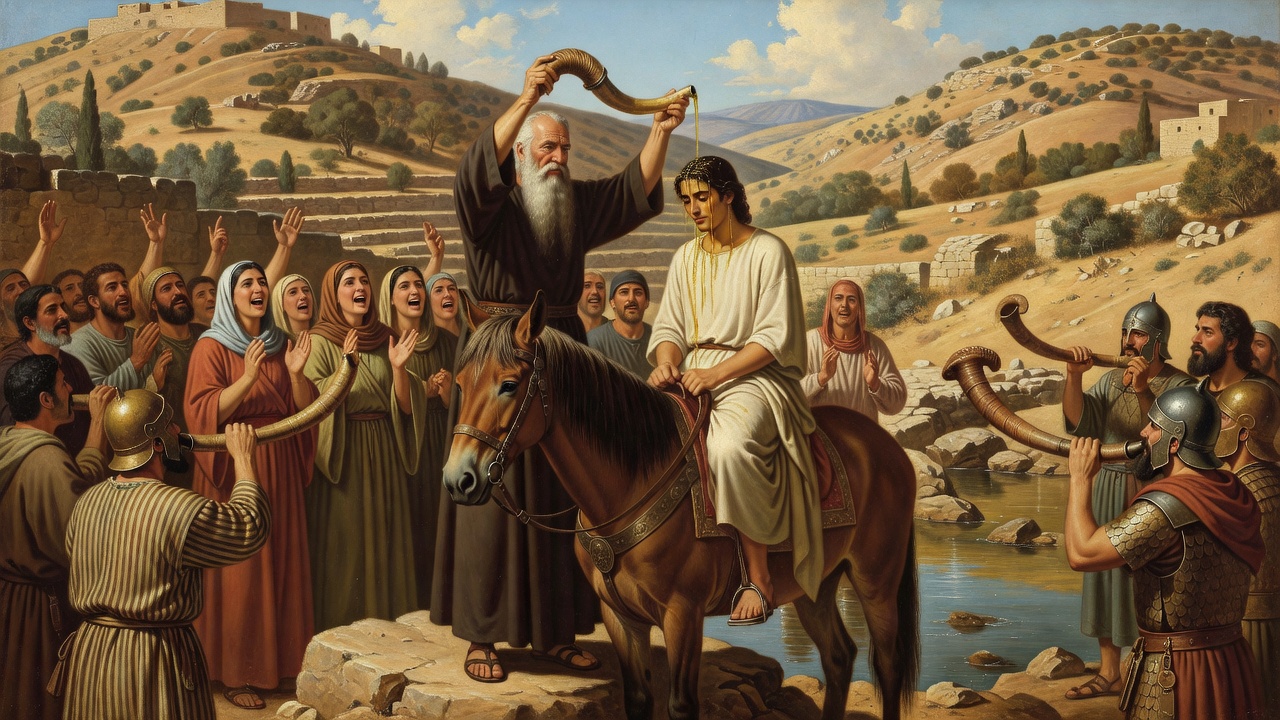
32And king David said, Call unto me Zadok the priest, and Nathan the prophet, and Benayahu the son of Yehoyada'. And they came before the king. 33And the king said unto them, Take with you the servants of your lord, and cause Solomon my son to ride upon my own mule, and conduct him down to Gichon: 34And let Zadok the priest with Nathan the prophet anoint him there as king over Israel; and blow ye with the cornet, and say, Long live king Solomon. 35Then shall ye go up after him, and he shall come and sit upon my throne; and he shall be king in my stead: and him have I ordained to be ruler over Israel and over Judah. 36And Benayahu the son of Yehoyada' answered the king, and said, Amen: May thus say the Eternal the God of my lord the king. 37As the Eternal hath been with my lord the king, even so may he be with Solomon, and may he make his throne greater than the throne of my lord the king David. 38Thereupon Zadok the priest, and Nathan the prophet, and Benayahu the son of Yehoyada', and the Kerethites, and the Pelethites, went down, and caused Solomon to ride upon king David's mule, and conducted him to Gichon. 39And Zadok the priest took the horn of oil out of the tabernacle, and anointed Solomon. And they blew with the cornet; and all the people said, Long live king Solomon. 40And all the people went up after him, and the people blew on flutes, and rejoiced with great joy, so that the earth was rent at their noise.
Adonijah Learns of Solomon’s Kingship
41And Adoniyah and all the guests that were with him heard it as they had just finished eating: and when Joab heard the sound of the cornet, he said, Wherefore is this noise of the city in an uproar? 42And while he was yet speaking, behold, Jonathan the son of Ebyathar the priest came in: and Adoniyah said [unto him], Come in; for thou art a worthy man, and must bring good tidings. 43And Jonathan answered and said to Adoniyah, Alas, no; our lord king David hath made Solomon king; 44And the king hath sent with him Zadok the priest, and Nathan the prophet, and Benayahu the son of Yehoyada', and the Kerethites, and the Pelethites, and they have caused him to ride upon the king's mule; 45And Zadok the priest and Nathan the prophet have anointed him as king on the Gichon; and they are come up from there rejoicing, and the city hath been set in commotion. This is the noise that ye have heard. 46And Solomon hath also sat on the kingly throne. 47And also the king's servants are come to bless our lord king David, saying, May God make the name of Solomon more famous than thy name, and make his throne greater than thy throne: and the king hath bowed himself upon the bed. 48And also thus hath the king said, Blessed be the Lord the God of Israel, who hath given [me] this day one who sitteth on my throne, while my eyes see it. 49And all the guests that were with Adoniyah were terrified, and rose up, and went, every man, on his own way. 50And Adoniyah was afraid because of Solomon; and he arose, and went, and caught hold on the horns of the altar. 51And it was told unto Solomon, saying, Behold, Adoniyah feareth king Solomon; and, behold, he hath caught hold on the horns of the altar, saying, Let king Solomon swear unto me today that he will not slay his servant with the sword. 52And Solomon said, If he will become a worthy man, there shall not a hair of his fall to the earth; but if any wrong shall be found on him, then shall he die. 53So king Solomon sent, and they brought him down from the altar; and he came and bowed himself to king Solomon; and Solomon said unto him, Go to thy house.
¿Sabías que…?
La sucesión al trono de David
- Siendo el hijo mayor sobreviviente de David tras la muerte de Amnón y Absalón, Adonías reclamó la sucesión real respaldado por el comandante militar Joab y el sacerdote Abiatar. Sin embargo, David eligió a su hijo menor Salomón, quien contaba con el apoyo del profeta Natán, el sacerdote Sadoc y Benaía.Fuentes: Adonijah · Solomon · el propio texto bíblico
- Montar en la propia mula del rey constituía una proclamación pública decisiva de autoridad real. Por orden expresa de David, Salomón fue llevado al manantial de Gijón, donde Sadoc lo ungió como rey con aceite sagrado del tabernáculo en medio del sonido de cuernos y la aclamación popular.Fuentes: Gihon · Zadok · el propio texto bíblico
- Al enterarse de la coronación pública de Salomón, Adonías huyó aterrorizado y buscó asilo sujetándose a los cuernos del altar de los sacrificios. Salomón le otorgó clemencia condicional, perdonándole la vida siempre que demostrara ser un hombre digno.Fuentes: Adonijah · el propio texto bíblico
Notas escritas con ayuda de IA a partir de fuentes abiertas (Theographic Bible Metadata, CC BY-SA 4.0; Easton’s Bible Dictionary, dominio público) y revisadas antes de publicarse.
Lugares de este capítulo
- Shunem · Hoy: Sulam · 32.606, 35.334 · versículo 3
- Serpent’s Stone · Hoy: within 100 m of Bir Ayub · 31.767, 35.236 · versículo 9
- Gihon · Hoy: Gihon Spring · 31.773, 35.236 · versículos 33, 38, 44, 45
- Jerusalem · 31.777, 35.234 · versículo 40
Solo aparecen lugares identificados con alta confianza (90 % o más según las fuentes académicas reunidas por OpenBible). Mapa de la época: DARE (Digital Atlas of the Roman Empire), CC BY 4.0; mapa actual: © colaboradores de OpenStreetMap; lugares: OpenBible.info (CC BY 4.0).
Créditos y licencia de esta traducción
Isaac Leeser Tanakh
The Isaac Leeser Tanakh (Jewish Bible)
Public Domain
Language: English
Dialect: archaic British
Translation by: Isaac Leeser
2020-10-14
Títulos de sección adaptados de la Berean Standard Bible (dominio público); no forman parte del texto bíblico de esta traducción.
Fuente: http://ebible.org/englee/ · eBible.org