Job 8
KJV Cambridge Paragraph Bible · Toca un versículo para ver sus referencias cruzadas.
Bildad: Job Should Repent
1Then answered Bildad the Shuhite, and said,
2How long wilt thou speak these things?
And how long shall the words of thy mouth be like a strong wind?
3Doth God pervert judgment?
Or doth the Almighty pervert justice?
4If thy children have sinned against him,
And he have cast them away for their transgression;
5If thou wouldest seek unto God betimes,
And make thy supplication to the Almighty;
6If thou wert pure and upright;
Surely now he would awake for thee,
And make the habitation of thy righteousness prosperous.
7Though thy beginning was small,
Yet thy latter end should greatly increase.
8For inquire, I pray thee, of the former age,
And prepare thyself to the search of their fathers:
9(For we are but of yesterday, and know nothing,
Because our days upon earth are a shadow:)
10Shall not they teach thee, and tell thee,
And utter words out of their heart?
11Can the rush grow up without mire?
Can the flag grow without water?
12Whilst it is yet in his greenness, and not cut down,
It withereth before any other herb.
13So are the paths of all that forget God;
And the hypocrite’s hope shall perish:
14Whose hope shall be cut off,
And whose trust shall be a spider’s web.
15He shall lean upon his house, but it shall not stand:
He shall hold it fast, but it shall not endure.
16He is green before the sun,
And his branch shooteth forth in his garden,
17His roots are wrapped about the heap,
And seeth the place of stones.
18If he destroy him from his place,
Then it shall deny him, saying, I have not seen thee.
19Behold, this is the joy of his way,
And out of the earth shall others grow.
20Behold, God will not cast away a perfect man,
Neither will he help the evil doers:
21Till he fill thy mouth with laughing,
And thy lips with rejoicing.
22They that hate thee shall be clothed with shame;
And the dwelling place of the wicked shall come to nought.
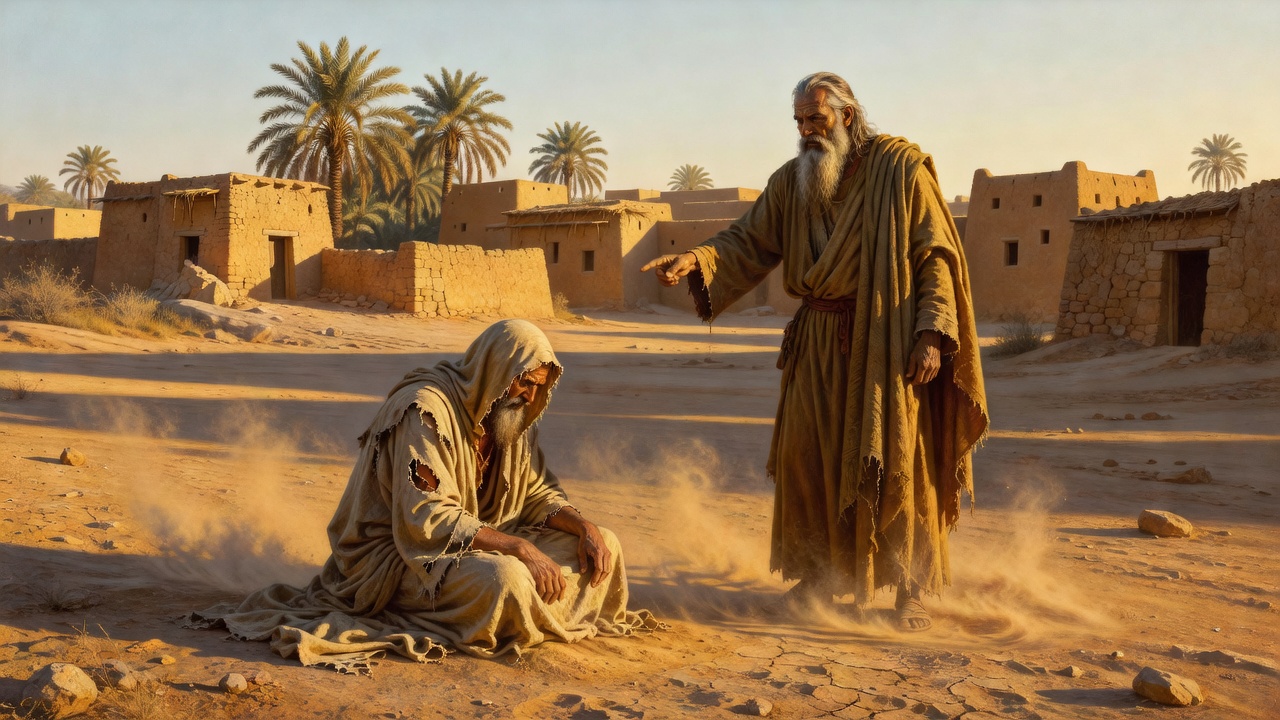
¿Sabías que…?
El llamado de Bildad a la sabiduría antigua
- Bildad es identificado como suhita, lo que probablemente lo vincula con Súa, una región árabe poblada por los descendientes de Abraham y Cetura. En este capítulo, pronuncia el primero de sus tres discursos severos a Job, afirmando que la justicia divina es absoluta e inalterable.Fuentes: Bildad · el propio texto bíblico
- En lugar de recurrir a su propia experiencia, Bildad apela al conocimiento acumulado de las generaciones pasadas, comparando los días humanos con una sombra pasajera. Para ilustrar la ruina del impío, utiliza metáforas de la naturaleza como juncos que se marchitan sin agua y la fragilidad de una telaraña.Fuentes: el propio texto bíblico
Notas escritas con ayuda de IA a partir de fuentes abiertas (Theographic Bible Metadata, CC BY-SA 4.0; Easton’s Bible Dictionary, dominio público) y revisadas antes de publicarse.
Créditos y licencia de esta traducción
KJV Cambridge Paragraph Bible
The King James Version or Authorized Version of the Holy Bible, Cambridge Paragraph Bible edition
Public Domain
Language: English
Letters patent issued by King James with no expiration date means that to print this translation in the United Kingdom or import printed copies into the UK, you need permission. Currently, the Cambridge University Press, the Oxford University Press, and Collins have the exclusive right to print this Bible translation in the UK. This royal decree has no effect outside of the UK, where this work is firmly in the Public Domain. Please see http://www.cambridge.org/about-us/who-we-are/queens-printers-patent and https://en.wikipedia.org/wiki/King_James_Version#Copyright_status for more information.
2026-09-26
Títulos de sección adaptados de la Berean Standard Bible (dominio público); no forman parte del texto bíblico de esta traducción.
Fuente: http://ebible.org/engkjvcpb/ · eBible.org