Ezequiel 19
KJV Cambridge Paragraph Bible · Toca un versículo para ver sus referencias cruzadas.
A Lament for the Princes of Israel
1Moreover take thou up a lamentation for the princes of Israel, 2and say, What is thy mother? A lioness: she lay down among lions, she nourished her whelps among young lions. 3And she brought up one of her whelps: it became a young lion, and it learned to catch the prey; it devoured men. 4The nations also heard of him; he was taken in their pit, and they brought him with chains unto the land of Egypt. 5Now when she saw that she had waited, and her hope was lost, then she took another of her whelps, and made him a young lion. 6And he went up and down among the lions, he became a young lion, and learned to catch the prey, and devoured men. 7And he knew their desolate palaces, and he laid waste their cities; and the land was desolate, and the fulness thereof, by the noise of his roaring. 8Then the nations set against him on every side from the provinces, and spread their net over him: he was taken in their pit. 9And they put him in ward in chains, and brought him to the king of Babylon: they brought him into holds, that his voice should no more be heard upon the mountains of Israel.
10Thy mother is like a vine in thy blood, planted by the waters: she was fruitful and full of branches by reason of many waters. 11And she had strong rods for the sceptres of them that bare rule, and her stature was exalted among the thick branches, and she appeared in her height with the multitude of her branches. 12But she was plucked up in fury, she was cast down to the ground, and the east wind dried up her fruit: her strong rods were broken and withered; the fire consumed them. 13And now she is planted in the wilderness, in a dry and thirsty ground. 14And fire is gone out of a rod of her branches, which hath devoured her fruit, so that she hath no strong rod to be a sceptre to rule. This is a lamentation, and shall be for a lamentation.
¿Sabías que…?
Un lamento por los príncipes de Israel
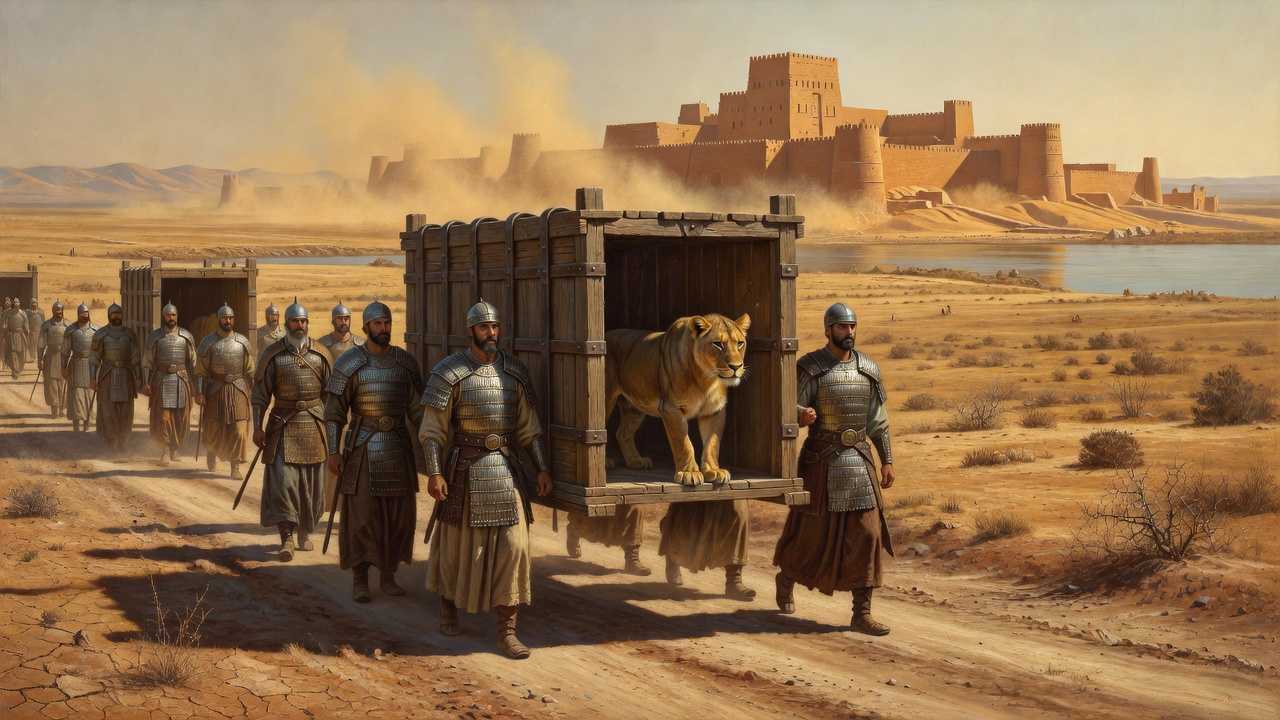
- Ezequiel presenta este canto fúnebre como una alegoría de una leona que cría a sus cachorros. El primer cachorro aprende a desgarrar presas, pero es capturado con garfios y llevado a Egipto, mientras que el segundo es atrapado en una red, metido en una jaula y llevado cautivo ante el rey de Babilonia.Fuentes: el propio texto bíblico · Egypt · Babylon
- La segunda mitad del lamento compara la dinastía real con una vid frondosa plantada junto a aguas abundantes, que daba ramas fuertes aptas para cetros de gobernantes. Describe cómo la vid es arrancada con furor, secada por el viento del este, consumida por el fuego y trasplantada a un desierto árido.Fuentes: el propio texto bíblico
Notas escritas con ayuda de IA a partir de fuentes abiertas (Theographic Bible Metadata, CC BY-SA 4.0; Easton’s Bible Dictionary, dominio público) y revisadas antes de publicarse.
Lugares de este capítulo
Solo aparecen lugares identificados con alta confianza (90 % o más según las fuentes académicas reunidas por OpenBible). Mapa de la época: DARE (Digital Atlas of the Roman Empire), CC BY 4.0; mapa actual: © colaboradores de OpenStreetMap; lugares: OpenBible.info (CC BY 4.0).
Créditos y licencia de esta traducción
KJV Cambridge Paragraph Bible
The King James Version or Authorized Version of the Holy Bible, Cambridge Paragraph Bible edition
Public Domain
Language: English
Letters patent issued by King James with no expiration date means that to print this translation in the United Kingdom or import printed copies into the UK, you need permission. Currently, the Cambridge University Press, the Oxford University Press, and Collins have the exclusive right to print this Bible translation in the UK. This royal decree has no effect outside of the UK, where this work is firmly in the Public Domain. Please see http://www.cambridge.org/about-us/who-we-are/queens-printers-patent and https://en.wikipedia.org/wiki/King_James_Version#Copyright_status for more information.
2026-09-26
Títulos de sección adaptados de la Berean Standard Bible (dominio público); no forman parte del texto bíblico de esta traducción.
Fuente: http://ebible.org/engkjvcpb/ · eBible.org