Cantares 7
JPS TaNaKH 1917 · Toca un versículo para ver sus referencias cruzadas.
Admiration by the Bridegroom
1(7-2) How beautiful are thy steps in sandals, O prince's daughter! The roundings of thy thighs are like the links of a chain, the work of the hands of a skilled workman. 2(7-3) Thy navel is like a round goblet, wherein no mingled wine is wanting; thy belly is like a heap of wheat set about with lilies. 3(7-4) Thy two breasts are like two fawns that are twins of a gazelle. 4(7-5) Thy neck is as a tower of ivory; thine eyes as the pools in Heshbon, by the gate of Bath-rabbim; thy nose is like the tower of Lebanon which looketh toward Damascus. 5(7-6) Thy head upon thee is like Carmel, and the hair of thy head like purple; the king is held captive in the tresses thereof. 6(7-7) How fair and how pleasant art thou, O love, for delights! 7(7-8) This thy stature is like to a palm-tree, and thy breasts to clusters of grapes. 8(7-9) I said: 'I will climb up into the palm-tree, I will take hold of the branches thereof; and let thy breasts be as clusters of the vine, and the smell of thy countenance like apples; 9(7-10) And the roof of thy mouth like the best wine, that glideth down smoothly for my beloved, moving gently the lips of those that are asleep.'
The Bride
10(7-11) I am my beloved's, and his desire is toward me. 11(7-12) Come, my beloved, let us go forth into the field; let us lodge in the villages. 12(7-13) Let us get up early to the vineyards; let us see whether the vine hath budded, whether the vine-blossom be opened, and the pomegranates be in flower; there will I give thee my love. 13(7-14) The mandrakes give forth fragrance, and at our doors are all manner of precious fruits, new and old, which I have laid up for thee, O my beloved.
¿Sabías que…?
Poesía de Amor y Paisaje
- El poema describe la belleza de la mujer utilizando destacados puntos geográficos de la región. Sus ojos son comparados con los estanques de Hesbón, cerca de la puerta de Bat-rabim al este del Jordán, mientras que su perfil se asemeja a una torre majestuosa en la cordillera del Líbano que mira hacia Damasco.Fuentes: el propio texto bíblico · Heshbon · Bath-rabbim · Lebanon
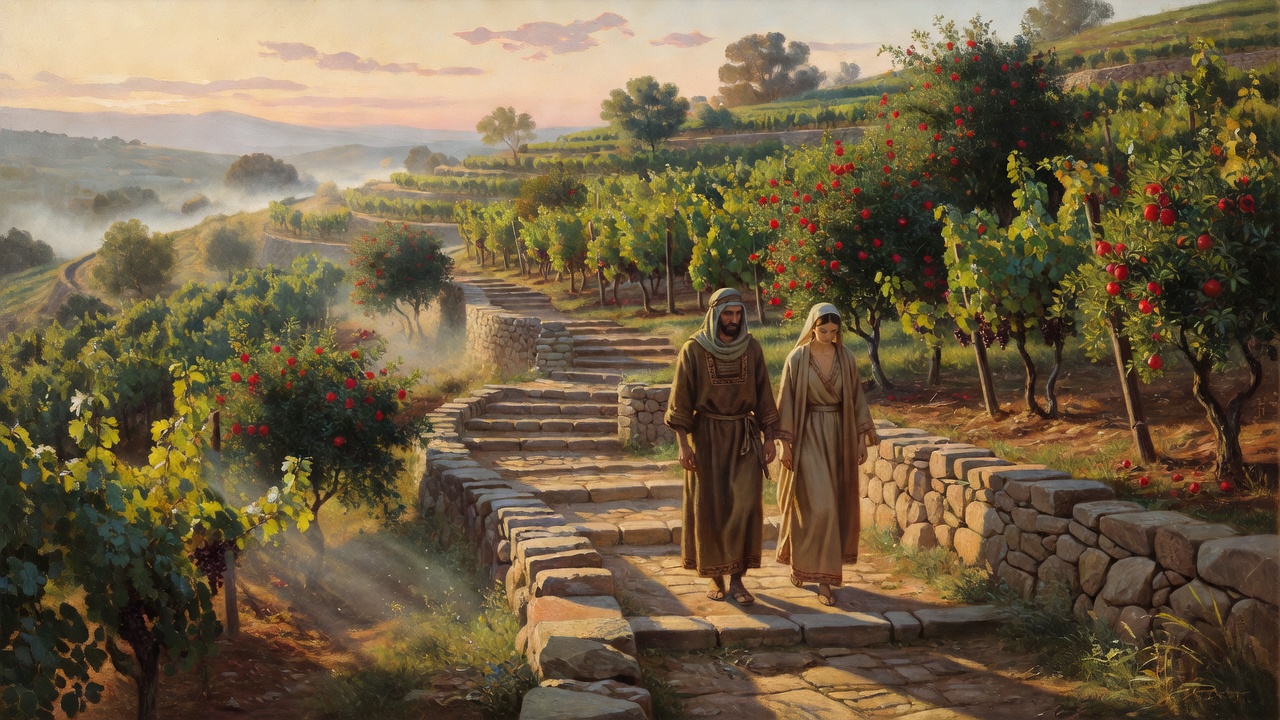
- El capítulo concluye con una invitación al campo durante el despertar de la primavera. Los amantes salen a observar los brotes de las vides, la floración de los granados y el aroma de las mandrágoras, reflejando la estrecha relación en la poesía hebrea antigua entre la intimidad romántica y la naturaleza.Fuentes: el propio texto bíblico
Notas escritas con ayuda de IA a partir de fuentes abiertas (Theographic Bible Metadata, CC BY-SA 4.0; Easton’s Bible Dictionary, dominio público) y revisadas antes de publicarse.
Lugares de este capítulo
- Bath-rabbim · Hoy: in Tell Hesban · 31.801, 35.809 · versículo 4
- Damascus · 33.511, 36.306 · versículo 4
- Lebanon · 33.540, 35.584 · versículo 4
- Mount Carmel · 32.672, 35.023 · versículo 5
Solo aparecen lugares identificados con alta confianza (90 % o más según las fuentes académicas reunidas por OpenBible). Mapa de la época: DARE (Digital Atlas of the Roman Empire), CC BY 4.0; mapa actual: © colaboradores de OpenStreetMap; lugares: OpenBible.info (CC BY 4.0).
Créditos y licencia de esta traducción
JPS TaNaKH 1917
The Jewish Bible (Old Testament) in English, published by the Jewish Publication Society in 1917
Public Domain
Language: English
Dialect: American
Translation by: Jewish Publication Society
This copy of the Old JPS TaNaKH by the Jewish Publication Society is brought to you courtesy of eBible.org . For the new JPS TaNaKH (1972, 1978, 1980), please see jps.org .
2023-09-19
Títulos de sección adaptados de la Berean Standard Bible (dominio público); no forman parte del texto bíblico de esta traducción.
Fuente: http://ebible.org/engjps/ · eBible.org