Isaías 9
JPS TaNaKH 1917 · Toca un versículo para ver sus referencias cruzadas.
Unto Us a Child Is Born
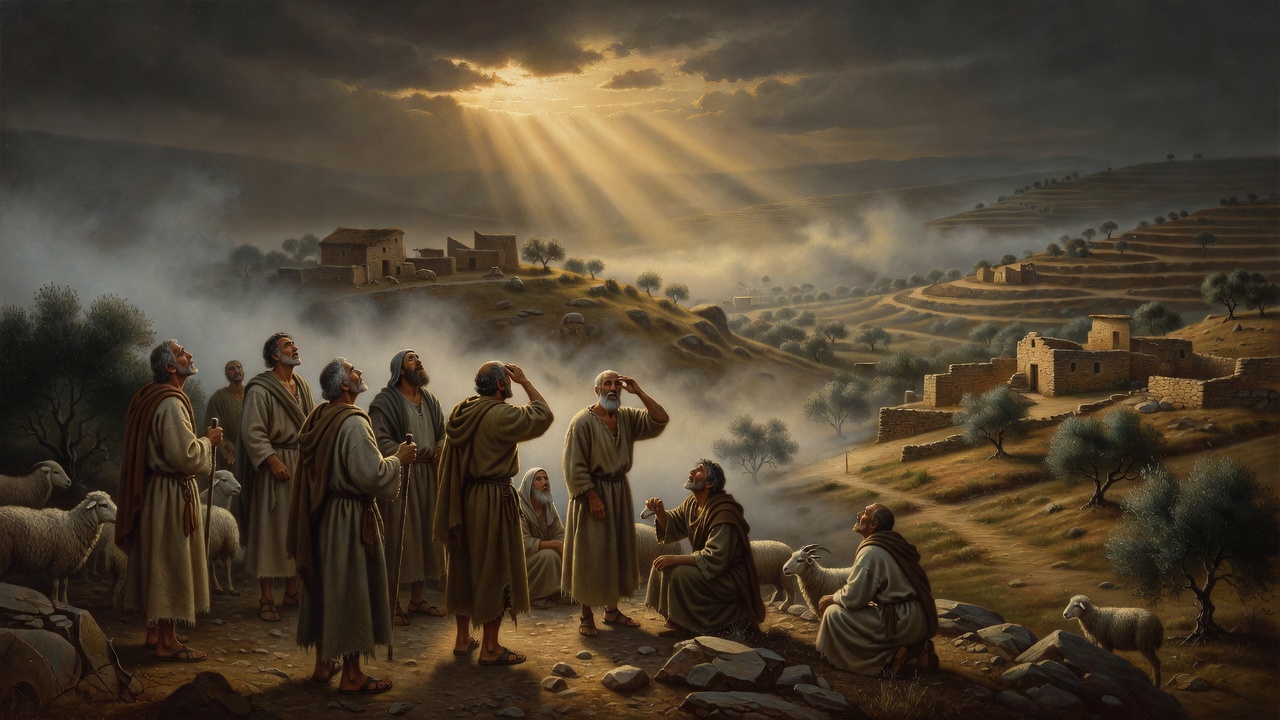
1(8-23) For is there no gloom to her that was stedfast? Now the former hath lightly afflicted the land of Zebulun and the land of Naphtali, but the latter hath dealt a more grievous blow by the way of the sea, beyond the Jordan, in the district of the nations. 2(9-1) The people that walked in darkness have seen a great light; they that dwelt in the land of the shadow of death, upon them hath the light shined. 3(9-2) Thou hast multiplied the nation, Thou hast increased their joy; they joy before Thee according to the joy in harvest, as men rejoice when they divide the spoil. 4(9-3) For the yoke of his burden, and the staff of his shoulder, the rod of his oppressor, Thou hast broken as in the day of Midian. 5(9-4) For every boot stamped with fierceness, and every cloak rolled in blood, shall even be for burning, for fuel of fire. 6(9-5) For a child is born unto us, a son is given unto us; and the government is upon his shoulder; and his name is called Pele-joez-el-gibbor-Abi-ad-sar-shalom; 7(9-6) That the government may be increased, and of peace there be no end, upon the throne of David, and upon his kingdom, to establish it, and to uphold it through justice and through righteousness from henceforth even for ever. The zeal of the LORD of hosts doth perform this.
Judgment against Israel’s Pride
8(9-7) The Lord sent a word into Jacob, and it hath lighted upon Israel. 9(9-8) And all the people shall know, even Ephraim and the inhabitant of Samaria, that say in pride and in arrogancy of heart: 10(9-9) 'The bricks are fallen, but we will build with hewn stones; the sycamores are cut down, but cedars will we put in their place.' 11(9-10) Therefore the LORD doth set upon high the adversaries of Rezin against him, and spur his enemies; 12(9-11) The Arameans on the east, and the Philistines on the west; and they devour Israel with open mouth. For all this His anger is not turned away, but His hand is stretched out still.
Judgment against Israel’s Hypocrisy
13(9-12) Yet the people turneth not unto Him that smiteth them, neither do they seek the LORD of hosts. 14(9-13) Therefore the LORD doth cut off from Israel head and tail, palm-branch and rush, in one day. 15(9-14) The elder and the man of rank, he is the head; and the prophet that teacheth lies, he is the tail. 16(9-15) For they that lead this people cause them to err; and they that are led of them are destroyed. 17(9-16) Therefore the Lord shall have no joy in their young men, neither shall He have compassion on their fatherless and widows; for every one is ungodly and an evil-doer, and every mouth speaketh wantonness. For all this His anger is not turned away, but His hand is stretched out still.
Judgment against Israel’s Unrepentance
18(9-17) For wickedness burneth as the fire; it devoureth the briers and thorns; yea, it kindleth in the thickets of the forest, and they roll upward in thick clouds of smoke. 19(9-18) Through the wrath of the LORD of hosts is the land burnt up; the people also are as the fuel of fire; no man spareth his brother. 20(9-19) And one snatcheth on the right hand, and is hungry; and he eateth on the left hand, and is not satisfied; they eat every man the flesh of his own arm: 21(9-20) Manasseh, Ephraim; and Ephraim, Manasseh; and they together are against Judah. For all this His anger is not turned away, but His hand is stretched out still.
¿Sabías que…?
Una gran luz y el juicio sobre el norte
- Los territorios tribales del norte pertenecientes a Zabulón y Neftalí se hallaban en Galilea, nombre derivado de una palabra que significa circuito. Debido a que los habitantes originales permanecieron mucho tiempo en la zona junto a los israelitas, se la conoció como Galilea de las naciones o de los gentiles.Fuentes: Galilee · el propio texto bíblico
- La alusión al día de Madián evoca la histórica liberación de la opresión ejercida por los madianitas, un pueblo nómada de las regiones desérticas al norte de la península arábiga.Fuentes: Midian · el propio texto bíblico
- La advertencia profética se dirige al reino del norte mediante su capital Samaria —edificada por el rey Omri en la cima de un monte aislado en las colinas de Israel— y su tribu principal Efraín, describiendo intensas discordias civiles entre tribus hermanas como Manasés y Efraín.Fuentes: Samaria · Ephraim · Manasseh (son of Joseph) · el propio texto bíblico
Notas escritas con ayuda de IA a partir de fuentes abiertas (Theographic Bible Metadata, CC BY-SA 4.0; Easton’s Bible Dictionary, dominio público) y revisadas antes de publicarse.
Lugares de este capítulo
- Galilee · 32.760, 35.527 · versículo 1
- Jordan · Hoy: Jordan River · 31.761, 35.558 · versículo 1
- Midian · 28.495, 35.012 · versículo 4
- Samaria · 32.276, 35.195 · versículo 9
- Philistia · 31.664, 34.546 · versículo 12
- Syria · Hoy: Aram · 33.511, 36.306 · versículo 12
Solo aparecen lugares identificados con alta confianza (90 % o más según las fuentes académicas reunidas por OpenBible). Mapa de la época: DARE (Digital Atlas of the Roman Empire), CC BY 4.0; mapa actual: © colaboradores de OpenStreetMap; lugares: OpenBible.info (CC BY 4.0).
Créditos y licencia de esta traducción
JPS TaNaKH 1917
The Jewish Bible (Old Testament) in English, published by the Jewish Publication Society in 1917
Public Domain
Language: English
Dialect: American
Translation by: Jewish Publication Society
This copy of the Old JPS TaNaKH by the Jewish Publication Society is brought to you courtesy of eBible.org . For the new JPS TaNaKH (1972, 1978, 1980), please see jps.org .
2023-09-19
Títulos de sección adaptados de la Berean Standard Bible (dominio público); no forman parte del texto bíblico de esta traducción.
Fuente: http://ebible.org/engjps/ · eBible.org