Deuteronomio 21
JPS TaNaKH 1917 · Toca un versículo para ver sus referencias cruzadas.
Atonement for an Unsolved Murder
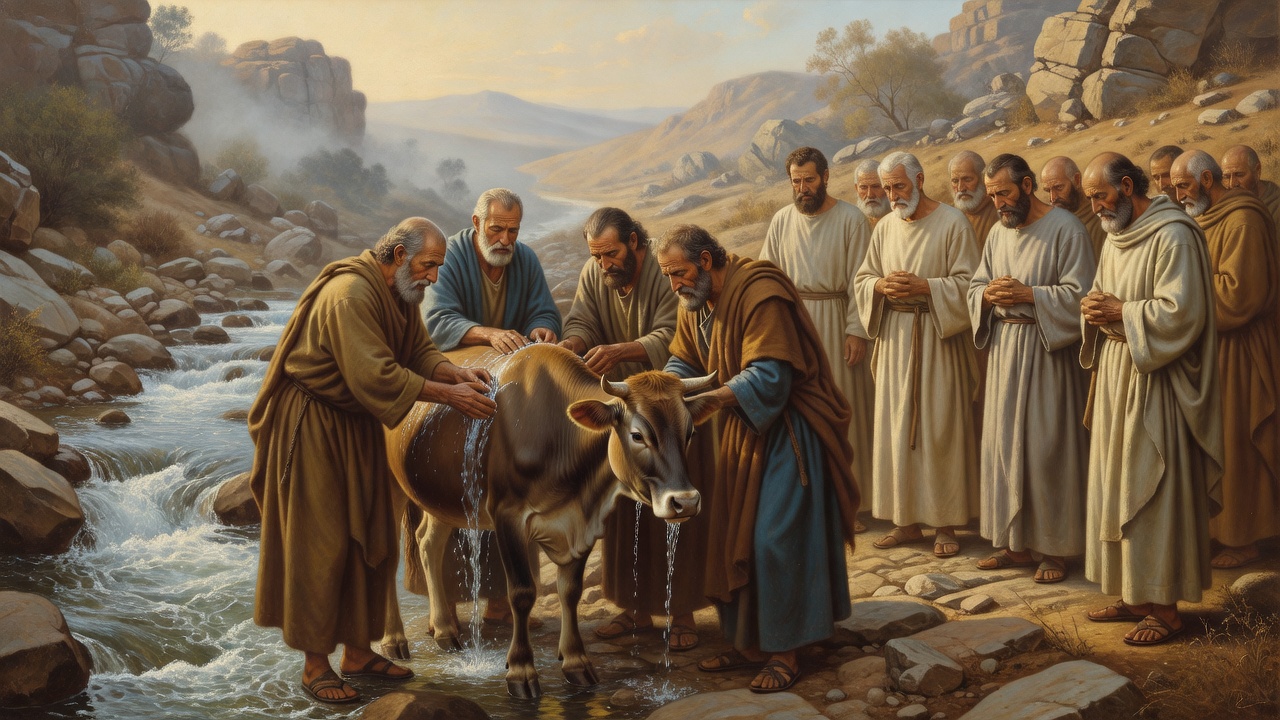
1If one be found slain in the land which the LORD thy God giveth thee to possess it, lying in the field, and it be not known who hath smitten him; 2then thy elders and thy judges shall come forth, and they shall measure unto the cities which are round about him that is slain. 3And it shall be, that the city which is nearest unto the slain man, even the elders of that city shall take a heifer of the herd, which hath not been wrought with, and which hath not drawn in the yoke. 4And the elders of that city shall bring down the heifer unto a rough valley, which may neither be plowed nor sown, and shall break the heifer's neck there in the valley. 5And the priests the sons of Levi shall come near — for them the LORD thy God hath chosen to minister unto Him, and to bless in the name of the LORD; and according to their word shall every controversy and every stroke be. 6And all the elders of that city, who are nearest unto the slain man, shall wash their hands over the heifer whose neck was broken in the valley. 7And they shall speak and say: 'Our hands have not shed this blood, neither have our eyes seen it. 8Forgive, O LORD, Thy people Israel, whom Thou hast redeemed, and suffer not innocent blood to remain in the midst of Thy people Israel.' And the blood shall be forgiven them. 9So shalt thou put away the innocent blood from the midst of thee, when thou shalt do that which is right in the eyes of the LORD.
Marrying a Captive Woman
10When thou goest forth to battle against thine enemies, and the LORD thy God delivereth them into thy hands, and thou carriest them away captive, 11and seest among the captives a woman of goodly form, and thou hast a desire unto her, and wouldest take her to thee to wife; 12then thou shalt bring her home to thy house; and she shall shave her head, and pare her nails; 13and she shall put the raiment of her captivity from off her, and shall remain in thy house, and bewail her father and her mother a full month; and after that thou mayest go in unto her, and be her husband, and she shall be thy wife. 14And it shall be, if thou have no delight in her, then thou shalt let her go whither she will; but thou shalt not sell her at all for money, thou shalt not deal with her as a slave, because thou hast humbled her.
Inheritance Rights of the Firstborn
15If a man have two wives, the one beloved, and the other hated, and they have borne him children, both the beloved and the hated; and if the first-born son be hers that was hated; 16then it shall be, in the day that he causeth his sons to inherit that which he hath, that he may not make the son of the beloved the first-born before the son of the hated, who is the first-born; 17but he shall acknowledge the first-born, the son of the hated, by giving him a double portion of all that he hath; for he is the first-fruits of his strength, the right of the first-born is his.
A Rebellious Son
18If a man have a stubborn and rebellious son, that will not hearken to the voice of his father, or the voice of his mother, and though they chasten him, will not hearken unto them; 19then shall his father and his mother lay hold on him, and bring him out unto the elders of his city, and unto the gate of his place; 20and they shall say unto the elders of his city: 'This our son is stubborn and rebellious, he doth not hearken to our voice; he is a glutton, and a drunkard.' 21And all the men of his city shall stone him with stones, that he die; so shalt thou put away the evil from the midst of thee; and all Israel shall hear, and fear.
Cursed Is Anyone Hung on a Tree
22And if a man have committed a sin worthy of death, and he be put to death, and thou hang him on a tree; 23his body shall not remain all night upon the tree, but thou shalt surely bury him the same day; for he that is hanged is a reproach unto God; that thou defile not thy land which the LORD thy God giveth thee for an inheritance.
¿Sabías que…?
Justicia, derechos familiares y pureza comunitaria
- Cuando se encontraba a una persona asesinada en campo abierto sin que se supiera quién la mató, los ancianos de la ciudad más cercana debían realizar un ritual de expiación. En un valle no arado con agua corriente, se lavaban las manos sobre una novilla en presencia de los sacerdotes levitas para limpiar a la comunidad de la culpa de sangre.Fuentes: el propio texto bíblico
- Bajo las leyes de herencia, un padre no podía transferir los derechos de primogenitura a un hijo menor por favoritismo hacia una esposa amada. El hijo mayor, incluso si era de una esposa no amada, tenía la garantía legal de recibir una doble porción de los bienes de su padre.Fuentes: el propio texto bíblico
- Si el cuerpo de un criminal ejecutado era colgado de un árbol como advertencia pública, debía ser descolgado y enterrado antes del anochecer. La ley establecía que todo el que era colgado de un árbol estaba bajo la maldición de Dios, y dejar el cadáver durante la noche contaminaría la tierra.Fuentes: el propio texto bíblico
Notas escritas con ayuda de IA a partir de fuentes abiertas (Theographic Bible Metadata, CC BY-SA 4.0; Easton’s Bible Dictionary, dominio público) y revisadas antes de publicarse.
Créditos y licencia de esta traducción
JPS TaNaKH 1917
The Jewish Bible (Old Testament) in English, published by the Jewish Publication Society in 1917
Public Domain
Language: English
Dialect: American
Translation by: Jewish Publication Society
This copy of the Old JPS TaNaKH by the Jewish Publication Society is brought to you courtesy of eBible.org . For the new JPS TaNaKH (1972, 1978, 1980), please see jps.org .
2023-09-19
Títulos de sección adaptados de la Berean Standard Bible (dominio público); no forman parte del texto bíblico de esta traducción.
Fuente: http://ebible.org/engjps/ · eBible.org