Éxodo 27
Geneva Bible 1599 · Toca un versículo para ver sus referencias cruzadas.
The Bronze Altar
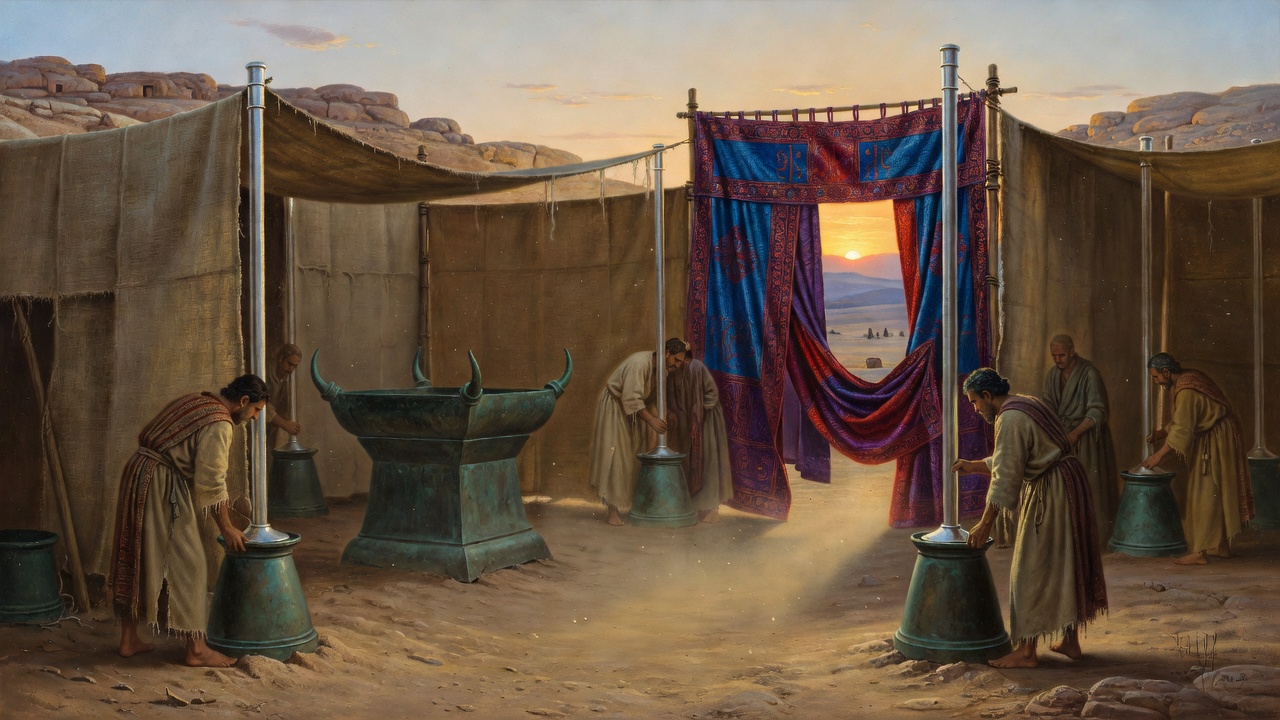
1Moreouer thou shalt make the altar of Shittim wood, fiue cubites long and fiue cubites broade (the altar shall be foure square) and the height thereof three cubites. 2And thou shalt make it hornes in the foure corners thereof: the hornes shalbe of it selfe, and thou shalt couer it with brasse. 3Also thou shalt make his ashpannes for his ashes and his besoms, and his basens, and his flesh-hookes, and his censers: thou shalt make all the instruments thereof of brasse. 4And thou shalt make vnto it a grate like networke of brasse: also vpon that grate shalt thou make foure brasen rings vpon the foure corners thereof. 5And thou shalt put it vnder the compasse of the altar beneath, that the grate may be in the middes of the altar. 6Also thou shalt make barres for the altar, barres, I say, of Shittim wood, and shalt couer them with brasse. 7And the barres thereof shalbe put in the rings, the which barres shalbe vpon the two sides of the altar to beare it. 8Thou shalt make the altar holowe betweene the boardes: as God shewed thee in the mount, so shall they make it.
The Courtyard
9Also thou shalt make the court of the Tabernacle in the Southside, euen full South: the court shall haue curtaines of fine twined linnen, of an hundreth cubites long, for one side, 10And it shall haue twentie pillars, with their twentie sockets of brasse: the heades of the pillars, and their filets shalbe siluer. 11Likewise on the Northside in length there shalbe hangings of an hundreth cubites long, and the twentie pillars thereof with their twentie sockets of brasse: the heades of the pillars and the filets shalbe siluer. 12And the breadth of the court on the Westside shall haue curtaines of fiftie cubites, with their ten pillars and their ten sockets. 13And the breadth of the court, Eastwarde full East shall haue fiftie cubites. 14Also hangings of fifteene cubites shalbe on the one side with their three pillars and their three sockets. 15Likewise on the other side shalbe hangings of fifteene cubites, with their three pillars and their three sockets. 16And in the gate of the court shalbe a vaile of twentie cubites, of blewe silke, and purple, and skarlet, and fine twined linen wrought with needle, with the foure pillars thereof and their foure sockets. 17All the pillars of the court shall haue filets of siluer round about, with their heads of siluer, and their sockets of brasse. 18The length of the court shalbe an hundreth cubites, and the breadth fiftie at either ende, and the height fiue cubites, and the hangings of fine twined linen, and their sockets of brasse. 19Al the vessels of the Tabernacle for al maner seruice thereof, and all the pinnes thereof, and all the pinnes of the court shalbe brasse.
The Oil for the Lamps
20And thou shalt commande the children of Israel, that they bring vnto thee pure oyle oliue beaten, for the light, that the lampes may alway burne. 21In the Tabernacle of the Congregation without the vaile, which is before the Testimony, shall Aaron and his sonnes dresse them from euening to morning before the Lord, for a statute for euer vnto their generations, to be obserued by the children of Israel.
¿Sabías que…?
El altar de bronce, el atrio y las lámparas
- Este capítulo dispone un altar cuadrado de madera de acacia, de cinco codos de largo, cinco de ancho y tres de alto, con un cuerno en cada una de sus cuatro esquinas, los cuernos de una sola pieza, y el altar recubierto de bronce. Debía construirse hueco, con tablas, con una rejilla de malla de bronce puesta bajo un borde, de modo que la malla quedara a media altura, y con varas de madera de acacia recubiertas de bronce, insertadas en anillos, para que el altar pudiera transportarse. Todos sus utensilios —recipientes para retirar las cenizas, palas, tazones para rociar, tenedores para la carne y braseros— serían de bronce, y el altar debía hacerse tal como se había mostrado en el monte.Fuentes: el propio texto bíblico
- El atrio del tabernáculo debía tener cien codos de largo y cincuenta de ancho, con cortinas de lino fino hilado de cinco codos de alto. Los lados sur y norte, de cien codos cada uno, tendrían veinte postes y veinte bases de bronce, con ganchos y bandas de plata; el lado oeste, de cincuenta codos de ancho, tendría diez postes y diez bases. El lado este, hacia la salida del sol, también tendría cincuenta codos de ancho, con una cortina de entrada de veinte codos, bordada con hilo azul, púrpura y carmesí y lino fino hilado, sobre cuatro postes, y con cortinas de quince codos a cada lado.Fuentes: el propio texto bíblico
- Los israelitas debían traer aceite puro de olivas prensadas para el alumbrado, de modo que las lámparas siguieran ardiendo de continuo. En la Tienda de reunión, fuera del velo que está delante del Testimonio, Aarón y sus hijos debían cuidar las lámparas delante del Señor, desde la tarde hasta la mañana, un estatuto permanente para los israelitas por las generaciones venideras. Aarón, hijo mayor de Amram y Jocabed, nació en Egipto tres años antes que su hermano Moisés y, con Elisabet, hija de Aminadab, de la casa de Judá, con quien se casó, tuvo cuatro hijos: Nadab, Abiú, Eleazar e Itamar.Fuentes: el propio texto bíblico · Aaron
Notas escritas con ayuda de IA a partir de fuentes abiertas (Theographic Bible Metadata, CC BY-SA 4.0; Easton’s Bible Dictionary, dominio público) y revisadas antes de publicarse.
Créditos y licencia de esta traducción
Geneva Bible 1599
The Geneva Bible in Old English of 1599
Public Domain
Language: English
Dialect: Old
This digital copy is freely available world-wide, with no copyright restrictions, courtesy of eBible.org and many others. Note that the spelling used is the original spelling, which is not modern English.
2024-03-16
Títulos de sección adaptados de la Berean Standard Bible (dominio público); no forman parte del texto bíblico de esta traducción.
Fuente: http://ebible.org/enggnv/ · eBible.org