Lucas 6
The New Testament with Commentary · Toca un versículo para ver sus referencias cruzadas.
Jesus is Lord of the Sabbath
1Now it happened on a second-first Sabbath that He was passing through the grain fields, and His disciples began to pick and eat the heads of grain, rubbing them in their hands. 2But some of the Pharisees said to them, “Why are you doing that which is not lawful to do on the Sabbath?” 3So in answer to them Jesus said: “Have you not even read this, what David did when he was hungry, he and those who were with him: 4how he went into the house of God, took and ate the showbread, and even gave it to those with him—that which only the priests are allowed to eat?” 5Then He said to them, “The Son of the Man is Lord even of the Sabbath!”
He heals on the Sabbath
6Now it happened on a different Sabbath that He entered the synagogue and began to teach. Well there was a man there whose right hand was shriveled; 7so the scribes and the Pharisees started watching, to see if He would heal on the Sabbath, so that they might find an accusation against Him. 8But He knew their thoughts and said to the man with the shriveled hand, “Get up and stand in the center.” So he got up and stood. 9Then Jesus said to them: “I will ask you something: Is it lawful on the Sabbath to do good or to do evil, to save life or to kill?” 10And when He had looked around at them all, He said to him, “Stretch out your hand!” So he did that, and his hand was restored, as sound as the other.
The rejection
11But they were filled with rage, and began to discuss with one another what they might do to Jesus.
Choosing the Twelve
12Now it happened in those days that He went out to the mountain to pray, and He continued all night in prayer to God. 13When it was day He called His disciples, and from them He chose twelve, whom He also named apostles: 14Simon (whom He also named Peter) and Andrew his brother, James and John, Phillip and Bartholomew, 15Matthew and Thomas, James (the son of Alphaeus) and Simon (the one called ‘Zealot’), 16Judas of James and Judas Iscariot (who also became ‘traitor’).
A sermon on a level place
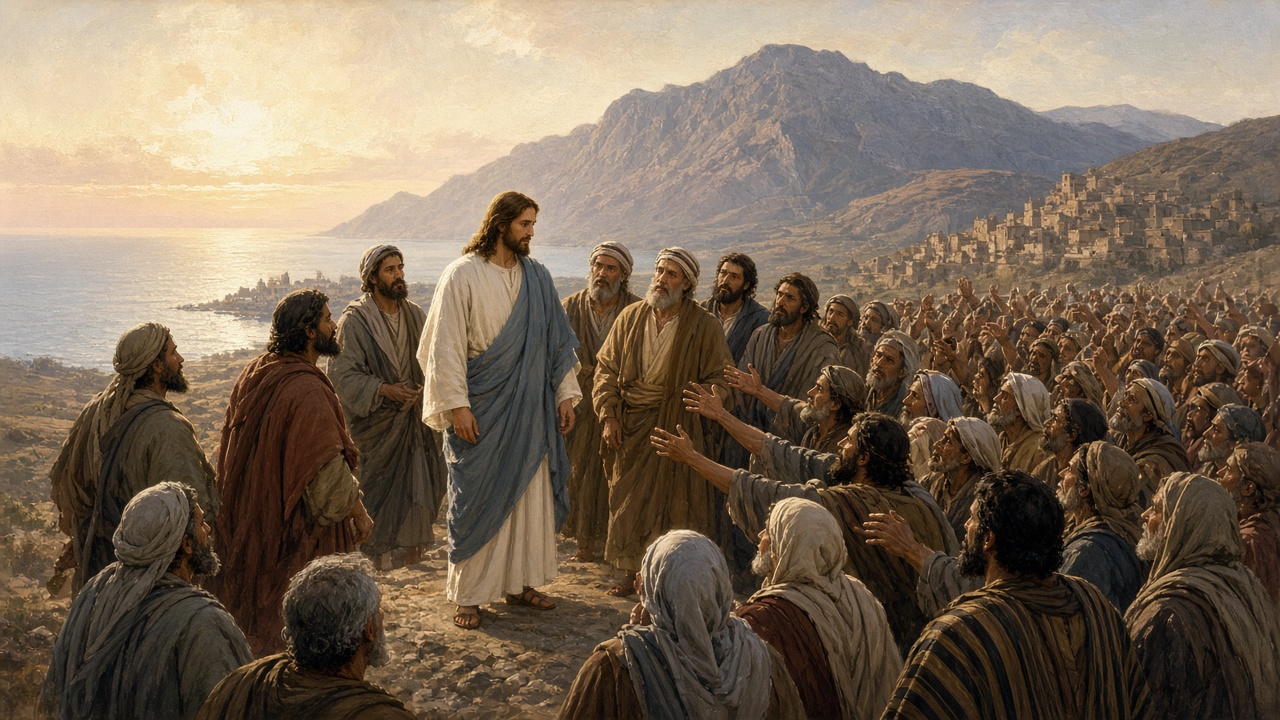
17Then He came down with them and stood on a level place, with a crowd of His disciples and a great multitude of people from all Judea and Jerusalem, also from the seacoast of Tyre and Sidon, who came to hear Him and to be healed of their diseases, 18as well as those who were being harassed by unclean spirits—and they were being healed! 19So the whole crowd kept trying to touch Him, because power was going out from Him and was healing all.
Blessings
20Then He raised His eyes toward His disciples and said:
“Blessed are you poor,
because the Kingdom of God is yours.
21Blessed are you who hunger now,
because you will be filled.
Blessed are you who weep now,
because you will laugh.
22Blessed are you whenever men hate you,
and whenever they exclude you and heap insults on you
and trash your name as ‘malignant’, for the Son of the Man's sake.
23Rejoice in that day and skip about! Because your reward really is great in Heaven; for that is how their fathers treated the prophets.
Woes
24“But woe to you who are rich!
because you have already received your comfort.
25Woe to you who are full!
because you will go hungry.
Woe to you who are presently laughing!
because you will mourn and weep.
26Woe, when all men speak well of you;
for that is how their fathers treated the false prophets!
Instructions
27“Further, to you who are listening I say: Love your enemies, do good to those who hate you; 28bless those who curse you, pray for those who mistreat you. 29To him who strikes you on the cheek, offer also the other; and from him who takes away your cloak, do not withhold the tunic as well. 30Give to everyone who asks of you; and from him who takes away your things, do not demand them back. 31Yes, like you want people to treat you, that is just how you must treat them. 32Also, if you love those who love you, what credit is that to you? Even ‘sinners’ love those who love them. 33And if you do good to those doing good to you, what credit is that to you? Even ‘sinners’ do the same. 34And if you lend to those from whom you expect to get it back, what credit is that to you? Even ‘sinners’ lend to ‘sinners’, to receive an equal value back.
Be compassionate
35“So, love your enemies, and do good, and lend, expecting nothing back; and your reward will be great, and you will be sons of the Most High; because He is kind toward the ungrateful and wicked. 36So be compassionate, even as your Father is compassionate.
We get what we give
37“Do not judge, and you will not be judged. Do not condemn, and you will not be condemned. Forgive, and you will be forgiven. 38Give and it will be given to you: a good measure—pressed down and shaken together and running over—will they deposit in your lap. Because with the same measure that you use it will be measured back to you.”
39Then He told them a parable: “Can a blind man guide a blind man? Will they not both fall into a ditch? 40A disciple is not above his teacher, but everyone who is fully trained will be like his teacher. 41Why do you look at the speck in your brother's eye, but do not consider the plank that is in your own eye? 42Or how can you say to your brother, ‘Brother, let me remove the speck that is in your eye,’ when you yourself do not see the plank that is in your own eye? Hypocrite! First remove the plank from your own eye, and then you will see clearly to remove the speck that is in your brother's eye.
A tree is known by its fruit
43“Now no good tree produces rotten fruit, nor does a rotten tree produce good fruit 44—each tree is known by its own fruit: people do not gather figs from thorn bushes, nor do they pick a bunch of grapes from a bramble. 45The good man produces the good out of the good treasure in his heart, and the malignant man produces the malignant out of the malignant treasure in his heart; because his mouth speaks out of the abundance of the heart.
Two foundations
46“Why do you call me, ‘Lord, Lord’, and not do what I say? 47Everyone who comes to me and hears my words and does them—I will show you who he is like: 48he is like a man building a house, who dug down deep and laid the foundation on the bedrock. When a flood occurred, the torrent burst upon that house but could not shake it, because it was founded on the bedrock. 49But he who heard and did nothing is like a man who built his house on the ground without a foundation, against which the torrent burst, and immediately it fell; and the ruin of that house was great.”
¿Sabías que…?
El sábado, los Doce y la llanura
- En un sábado, mientras Jesús pasaba por los sembrados, sus discípulos arrancaban espigas, las restregaban entre las manos y se las comían, y algunos fariseos dijeron que eso era ilícito. Jesús recordó que David y sus compañeros, con hambre, comieron el pan consagrado de la casa de Dios, lícito solo para los sacerdotes, y dijo que el Hijo del Hombre es Señor del sábado. En otro sábado, restauró en la sinagoga la mano derecha atrofiada de un hombre, mientras los escribas y fariseos lo observaban buscando un motivo para acusarlo; una cronología fecha ambos episodios en el año 28 d. C.Fuentes: el propio texto bíblico · Corn on the Sabbath · Healing a Withered Hand
- Después de pasar la noche en oración en el monte, Jesús llamó a sus discípulos y eligió a doce, a quienes designó apóstoles. Entre ellos estaban Simón, a quien llamó Pedro, y Andrés, hermano de Pedro, pescadores de Betsaida, en la costa occidental del mar de Galilea, y Mateo, recaudador de impuestos en Capernaúm, antes conocido como Leví.Fuentes: el propio texto bíblico · Simon Peter · Andrew · Matthew
- Jesús bajó con ellos y se detuvo en un lugar llano, donde se había reunido gente de Judea, de Jerusalén y de la costa de Tiro y Sidón para oírlo y ser sanada. Tiro y Sidón eran antiguas ciudades fenicias del Mediterráneo; Sidón, la más antigua, quedaba a unas veinticinco millas al norte de Tiro. Una cronología fecha esta enseñanza en el año 28 d. C. y la titula Sermón del Monte, aunque el relato sitúa a Jesús en terreno llano después de bajar del monte.Fuentes: el propio texto bíblico · Tyre · Sidon · Sermon on the Mount
Notas escritas con ayuda de IA a partir de fuentes abiertas (Theographic Bible Metadata, CC BY-SA 4.0; Easton’s Bible Dictionary, dominio público) y revisadas antes de publicarse.
Lugares de este capítulo
- Jerusalem · 31.777, 35.234 · versículo 17
- Judea · Hoy: Judea 1 · 31.777, 35.234 · versículo 17
- Sidon · Hoy: Sandikli archaeological site in Sidon · 33.561, 35.372 · versículo 17
- Tyre · 33.271, 35.196 · versículo 17
Solo aparecen lugares identificados con alta confianza (90 % o más según las fuentes académicas reunidas por OpenBible). Mapa de la época: DARE (Digital Atlas of the Roman Empire), CC BY 4.0; mapa actual: © colaboradores de OpenStreetMap; lugares: OpenBible.info (CC BY 4.0).
Créditos y licencia de esta traducción
The New Testament with Commentary
The New Testament with Commentary according to Family 35, 2nd Edition
copyright © 2016 Wilbur N. Pickering, ThM, PhD
Language: English
Dialect: American
This translation is made available to you under the terms of the
Creative Commons Attribution Share-Alike license 4.0.
You have permission to share and redistribute this Bible translation in any format and to make reasonable revisions and adaptations of this translation, provided that:
You include the above copyright and source information.
If you make any changes to the text, you must indicate that you did so in a way that makes it clear that the original licensor is not necessarily endorsing your changes.
If you redistribute this text, you must distribute your contributions under the same license as the original.
Pictures included with Scriptures and other documents on this site are licensed just for use with those Scriptures and documents.
For other uses, please contact the respective copyright owners.
Note that in addition to the rules above, revising and adapting God's Word involves a great responsibility to be true to God's Word. See Revelation 22:18-19.
2026-10-02
Fuente: http://ebible.org/engf35/ · eBible.org