1 Corintios 7
English Majority Text Version · Toca un versículo para ver sus referencias cruzadas.
Instruction on Marriage
1Now concerning the things of which you wrote to me:
It is good for a man not to touch a woman. 2Nevertheless, because of sexual immorality, let each man have his own wife, and let each woman have her own husband. 3Let the husband render to his wife the affection due her, and likewise also the wife to her husband. 4The wife does not have authority over her own body, but the husband does. And likewise the husband does not have authority over his own body, but the wife does. 5Do not deprive one another, except by mutual agreement, and that for a season, so that you may devote yourselves to fasting and prayer; and come together again, lest Satan tempt you because of your lack of self-control. 6But I say this as a concession, not as a commandment. 7For I wish that all men would be as I myself. But each one has his own gift from God, one in this way and another in that.
8But I say to the unmarried and to the widows: It is good for them if they should remain as I also remain; 9but if they are not exercising self-control, let them marry. For it is better to marry than to burn with passion.
Keep Your Marriage Vows
10Now to those who have married I command, yet not I, but the Lord: A wife is not to be separated from her husband— 11and even if she does separate, let her remain unmarried or be reconciled to her husband—and a husband is not to divorce his wife.
12But to the rest I, not the Lord, say: If any brother has an unbelieving wife, and she consents to live with him, let him not divorce her. 13And a wife who has an unbelieving husband, if he consents to live with her, let her not divorce him. 14For the unbelieving husband has been sanctified by the wife, and the unbelieving wife has been sanctified by the husband; otherwise your children would be unclean, but now they are holy. 15But if the unbelieving spouse separates, let him or her separate; the brother or the sister has not been bound in such cases; but God has called us to peace. 16For how do you know, O wife, whether you will save your husband? Or how do you know, O husband, whether you will save your wife?
Live as You Are Called
17Otherwise as God has distributed to each one, as the Lord has called each one, so let him walk. And so I command in all the churches. 18Was anyone called while circumcised? Let him not become uncircumcised. Was anyone called while uncircumcised? Let him not be circumcised. 19Circumcision is nothing and uncircumcision is nothing, but keeping the commandments of God. 20Let each one remain in the same calling in which he was called. 21Were you called as a slave? Do not be concerned about it; but if you can be made free, rather make use of it. 22For he who is called in the Lord while a slave is the Lord's free man. Likewise he who is called as a free man is Christ's slave. 23You were bought with a price; do not become slaves of men. 24Brothers, let each one remain with God in the state in which he was called.
The Unmarried and the Widowed
25Now concerning virgins, I have no command of the Lord; but I give an opinion, as having received mercy by the Lord to be faithful. 26Therefore I consider this to be good because of the present distress, that it is good for a man to be as he is: 27Have you been bound to a wife? Do not seek to be released. Have you been released from a wife? Do not seek a wife. 28But even if you should marry, you have not sinned; and if a virgin should marry, she has not sinned. But such will have trouble in the flesh, and I would spare you.
29But this I say, brothers, the time has been shortened; so that from now on even those having wives should be as though they had none, 30and those weeping as though not weeping, and those rejoicing as though not rejoicing, and those buying as though not possessing, 31and those using this world as not using it up. For the form of this world is passing away.
32But I want you to be without anxiety. The unmarried man cares about the things of the Lord— about how he may please the Lord. 33But the man having married cares about the things of the world— about how he may please his wife. 34And the wife and the virgin are different. The unmarried woman cares about the things of the Lord, that she may be holy both in body and in spirit. But the woman having married cares about the things of the world—about how she may please her husband. 35And this I say for your own profit, not that I may put a snare upon you, but for that which is proper, and that you may serve the Lord without distraction.
36But if any man thinks he is behaving dishonorably toward his virgin, if she is past her youth, and thus it must be, let him do what he desires. He does not sin; let them marry. 37But he who stands in his heart, not having necessity, but has power over his own desire, and has decided this in his heart that he will keep his virgin, does well. 38So then he who gives her in marriage does well, but he who does not give her in marriage does better.
39A wife has been bound by law as long as her husband lives; but if her husband also dies, she is free to be married to whom she desires, only in the Lord. 40But she is happier if she remains as she is, in my opinion—and I think I also have the Spirit of God.
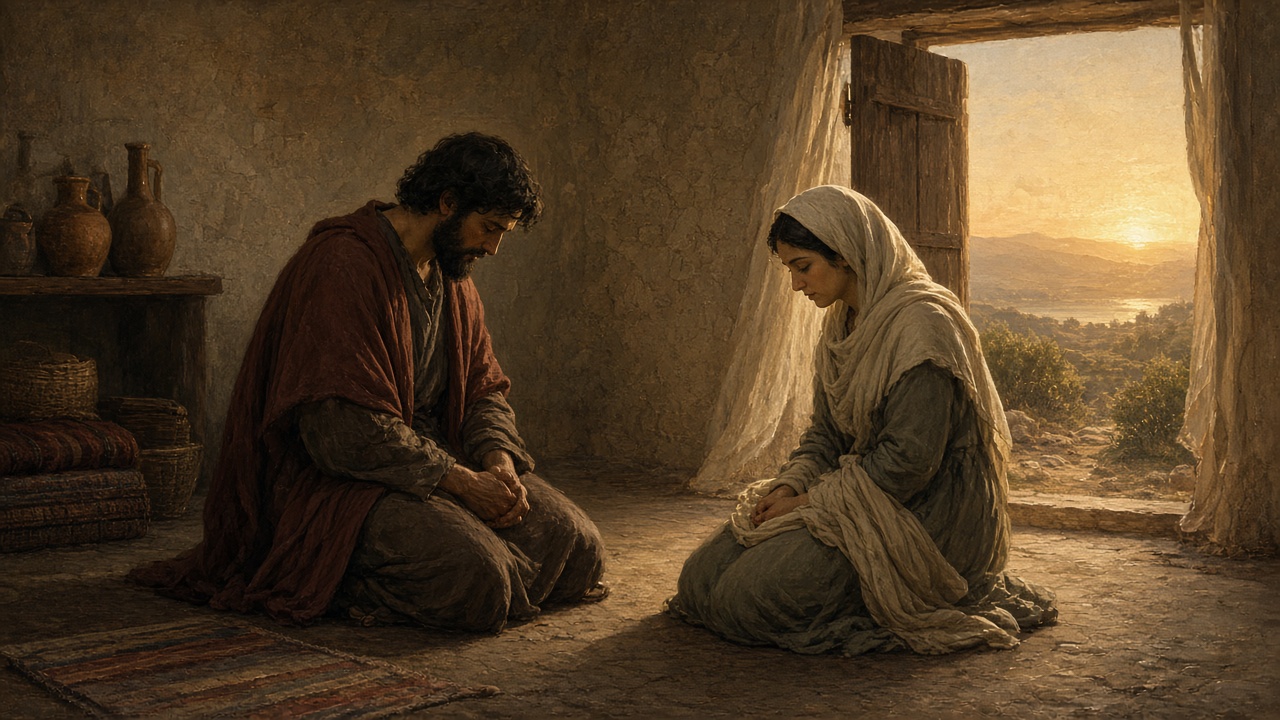
¿Sabías que…?
Consejos sobre el matrimonio y la crisis presente
- El capítulo comienza como respuesta a asuntos sobre los que los lectores habían escrito. El autor dice que es bueno abstenerse de las relaciones sexuales, pero, porque hay tanta inmoralidad sexual, cada hombre debe tener su propia esposa y cada mujer su propio esposo. Presenta esto como una concesión, no como un mandamiento, y dice que cada persona tiene su propio don de parte de Dios.Fuentes: el propio texto bíblico
- En el matrimonio, el autor dice que la esposa no tiene autoridad sobre su propio cuerpo, sino el esposo, y del mismo modo el esposo no tiene autoridad sobre su propio cuerpo, sino la esposa. No deben privarse el uno del otro, excepto de común acuerdo y por un tiempo, para dedicarse a la oración, y luego volver a unirse, a fin de que Satanás no los tiente por su falta de dominio propio. El diccionario bíblico de Easton (1897) presenta el nombre Satanás como “adversario” o “acusador”, y señala que tentó a Jesús en el desierto.Fuentes: el propio texto bíblico · Satan
- El autor distingue un mandamiento que atribuye al Señor —la esposa no debe separarse de su esposo, y el esposo no debe divorciarse de su esposa— de su propio juicio, en los casos en que dice que habla él, y no el Señor, incluidos los matrimonios con una persona no creyente y las cuestiones sobre las vírgenes. A causa de lo que llama la crisis presente, y porque dice que el tiempo es corto y que este mundo, en su forma actual, está pasando, considera bueno permanecer como se está. Añade que casarse no es pecar, aunque quienes se casan enfrentarán dificultades en esta vida.Fuentes: el propio texto bíblico
Notas escritas con ayuda de IA a partir de fuentes abiertas (Theographic Bible Metadata, CC BY-SA 4.0; Easton’s Bible Dictionary, dominio público) y revisadas antes de publicarse.
Créditos y licencia de esta traducción
English Majority Text Version
The New Testament, English Majority Text Version
Copyright © 2014 Dr. Paul W. Esposito
Language: English
This translation is made available to you under the terms of the
Creative Commons Attribution-Noncommercial-No Derivatives license 4.0.
You may share and redistribute this Bible translation or extracts from it in any format, provided that:
You include the above copyright and source information.
You do not sell this work for a profit.
You do not change any of the words or punctuation of the Scriptures.
Pictures included with Scriptures and other documents on this site are licensed just for use with those Scriptures and documents.
For other uses, please contact the respective copyright owners.
2020-12-20
Fuente: http://ebible.org/engemtv/ · eBible.org