Números 19
Berean Standard Bible · Toca un versículo para ver sus referencias cruzadas.
The Red Heifer
1Then the LORD said to Moses and Aaron, 2“This is the statute of the law that the LORD has commanded: Instruct the Israelites to bring you an unblemished red heifer that has no defect and has never been placed under a yoke. 3Give it to Eleazar the priest, and he will have it brought outside the camp and slaughtered in his presence.
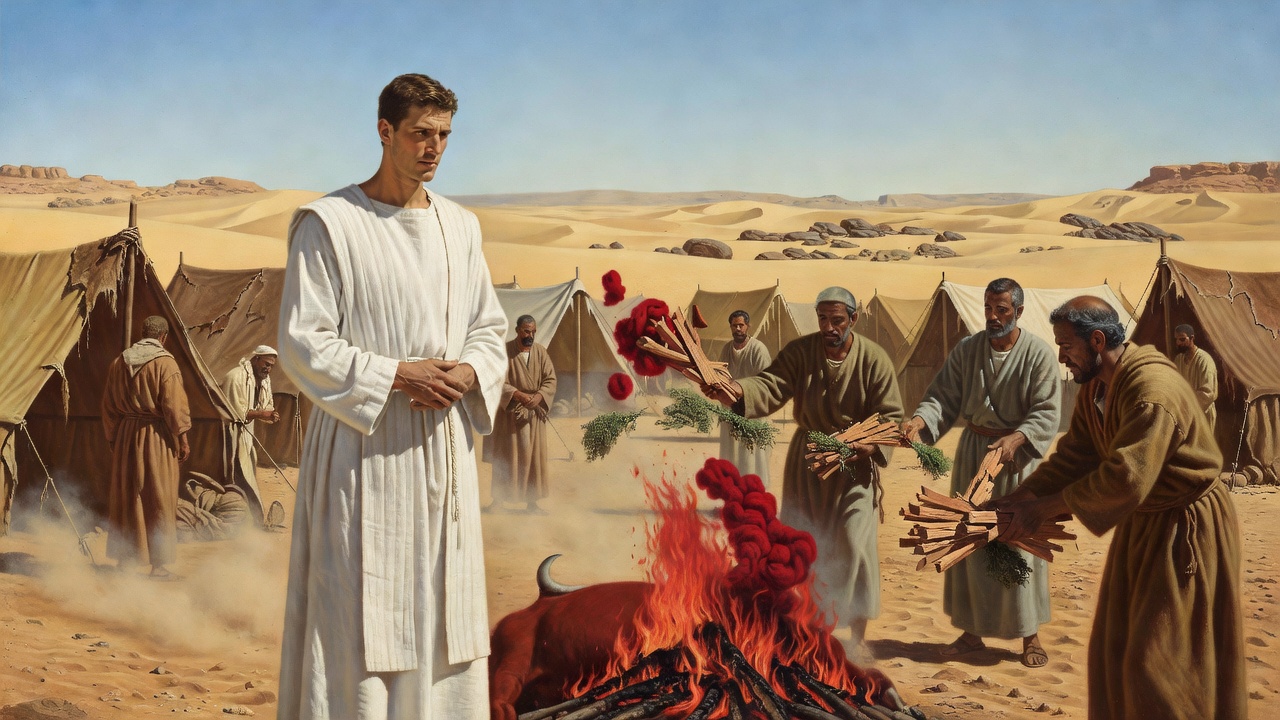
4Eleazar the priest is to take some of its blood on his finger and sprinkle it seven times toward the front of the Tent of Meeting. 5Then the heifer must be burned in his sight. Its hide, its flesh, and its blood are to be burned, along with its dung. 6The priest is to take cedar wood, hyssop, and scarlet wool and throw them onto the burning heifer.
7Then the priest must wash his clothes and bathe his body in water; after that he may enter the camp, but he will be ceremonially unclean until evening. 8The one who burned the heifer must also wash his clothes and bathe his body in water, and he too will be ceremonially unclean until evening.
9Then a man who is ceremonially clean is to gather up the ashes of the heifer and store them in a ceremonially clean place outside the camp. They must be kept by the congregation of Israel for preparing the water of purification; this is for purification from sin. 10The man who has gathered up the ashes of the heifer must also wash his clothes, and he will be ceremonially unclean until evening. This is a permanent statute for the Israelites and for the foreigner residing among them.
Purification of the Unclean
11Whoever touches any dead body will be unclean for seven days. 12He must purify himself with the water on the third day and on the seventh day; then he will be clean. But if he does not purify himself on the third and seventh days, he will not be clean. 13Anyone who touches a human corpse and fails to purify himself defiles the tabernacle of the LORD. That person must be cut off from Israel. He remains unclean, because the water of purification has not been sprinkled on him, and his uncleanness is still on him.
14This is the law when a person dies in a tent: Everyone who enters the tent and everyone already in the tent will be unclean for seven days, 15and any open container without a lid fastened on it is unclean.
16Anyone in the open field who touches someone who has been killed by the sword or has died of natural causes, or anyone who touches a human bone or a grave, will be unclean for seven days.
17For the purification of the unclean person, take some of the ashes of the burnt sin offering, put them in a jar, and pour fresh water over them. 18Then a man who is ceremonially clean is to take some hyssop, dip it in the water, and sprinkle the tent, all the furnishings, and the people who were there. He is also to sprinkle the one who touched a bone, a grave, or a person who has died or been slain.
19The man who is ceremonially clean is to sprinkle the unclean person on the third day and on the seventh day. After he purifies the unclean person on the seventh day, the one being cleansed must wash his clothes and bathe in water, and that evening he will be clean. 20But if a person who is unclean does not purify himself, he will be cut off from the assembly, because he has defiled the sanctuary of the LORD. The water of purification has not been sprinkled on him; he is unclean.
21This is a permanent statute for the people: The one who sprinkles the water of purification must wash his clothes, and whoever touches the water of purification will be unclean until evening. 22Anything the unclean person touches will become unclean, and anyone who touches it will be unclean until evening.”
¿Sabías que…?
La novilla roja y la purificación de la impureza
- A diferencia de los sacrificios habituales presentados en el altar del tabernáculo, la novilla roja sin defecto y que nunca había llevado yugo era llevada fuera del campamento. Allí era sacrificada ante el sacerdote Eleazar y quemada por completo junto con madera de cedro, hisopo y lana escarlata.Fuentes: el propio texto bíblico · Eleazar
- Las cenizas de la novilla se guardaban fuera del campamento para preparar el agua de purificación. Paradójicamente, aunque esta mezcla purificaba a quienes contraían impureza por la muerte, todos los que manipulaban la novilla, recogían las cenizas o rociaban el agua quedaban ceremonialmente impuros hasta el anochecer.Fuentes: el propio texto bíblico
- Tocar un cadáver, un hueso humano, una tumba o permanecer en una tienda donde alguien había muerto causaba siete días de impureza ceremonial. Para purificarse, la persona debía ser rociada con el agua de purificación al tercer y al séptimo día, además de lavar sus vestiduras y bañarse.Fuentes: el propio texto bíblico
Notas escritas con ayuda de IA a partir de fuentes abiertas (Theographic Bible Metadata, CC BY-SA 4.0; Easton’s Bible Dictionary, dominio público) y revisadas antes de publicarse.
Créditos y licencia de esta traducción
Berean Standard Bible
The Holy Bible in English: Berean Standard Bible
Public Domain
Language: English
Contributor: BSB Publishing, LLC
2026-10-02
Fuente: http://ebible.org/engbsb/ · eBible.org