Lucas 20
Berean Standard Bible · Toca un versículo para ver sus referencias cruzadas.
Jesus’ Authority Challenged
1One day as Jesus was teaching the people in the temple courts and proclaiming the gospel, the chief priests and scribes, together with the elders, came up to Him. 2“Tell us,” they said, “by what authority are You doing these things, and who gave You this authority?”
3“I will also ask you a question,” Jesus replied. “Tell Me: 4John’s baptism—was it from heaven, or from men?”
5They deliberated among themselves and said, “If we say, ‘From heaven,’ He will ask, ‘Why did you not believe him?’ 6But if we say, ‘From men,’ all the people will stone us, for they are convinced that John was a prophet.”
7So they answered that they did not know where it was from.
8And Jesus replied, “Neither will I tell you by what authority I am doing these things.”
The Parable of the Wicked Tenants
9Then He proceeded to tell the people this parable: “A man planted a vineyard, rented it out to some tenants, and went away for a long time. 10At harvest time, he sent a servant to the tenants to collect his share of the fruit of the vineyard. But the tenants beat the servant and sent him away empty-handed.
11So he sent another servant, but they beat him and treated him shamefully, sending him away empty-handed.
12Then he sent a third, but they wounded him and threw him out.
13‘What shall I do?’ asked the owner of the vineyard. ‘I will send my beloved son. Perhaps they will respect him.’
14But when the tenants saw the son, they discussed it among themselves and said, ‘This is the heir. Let us kill him, and the inheritance will be ours.’ 15So they threw him out of the vineyard and killed him.
What then will the owner of the vineyard do to them? 16He will come and kill those tenants, and will give the vineyard to others.”
And when the people heard this, they said, “May such a thing never happen!”
17But Jesus looked directly at them and said, “Then what is the meaning of that which is written:
‘The stone the builders rejected
has become the cornerstone’?
18Everyone who falls on this stone will be broken to pieces, but he on whom it falls will be crushed.”
Paying Taxes to Caesar
19When the scribes and chief priests realized that Jesus had spoken this parable against them, they sought to arrest Him that very hour. But they were afraid of the people.
20So they watched Him closely and sent spies who pretended to be sincere. They were hoping to catch Him in His words in order to hand Him over to the rule and authority of the governor. 21“Teacher,” they inquired, “we know that You speak and teach correctly. You show no partiality, but teach the way of God in accordance with the truth. 22Is it lawful for us to pay taxes to Caesar or not?”
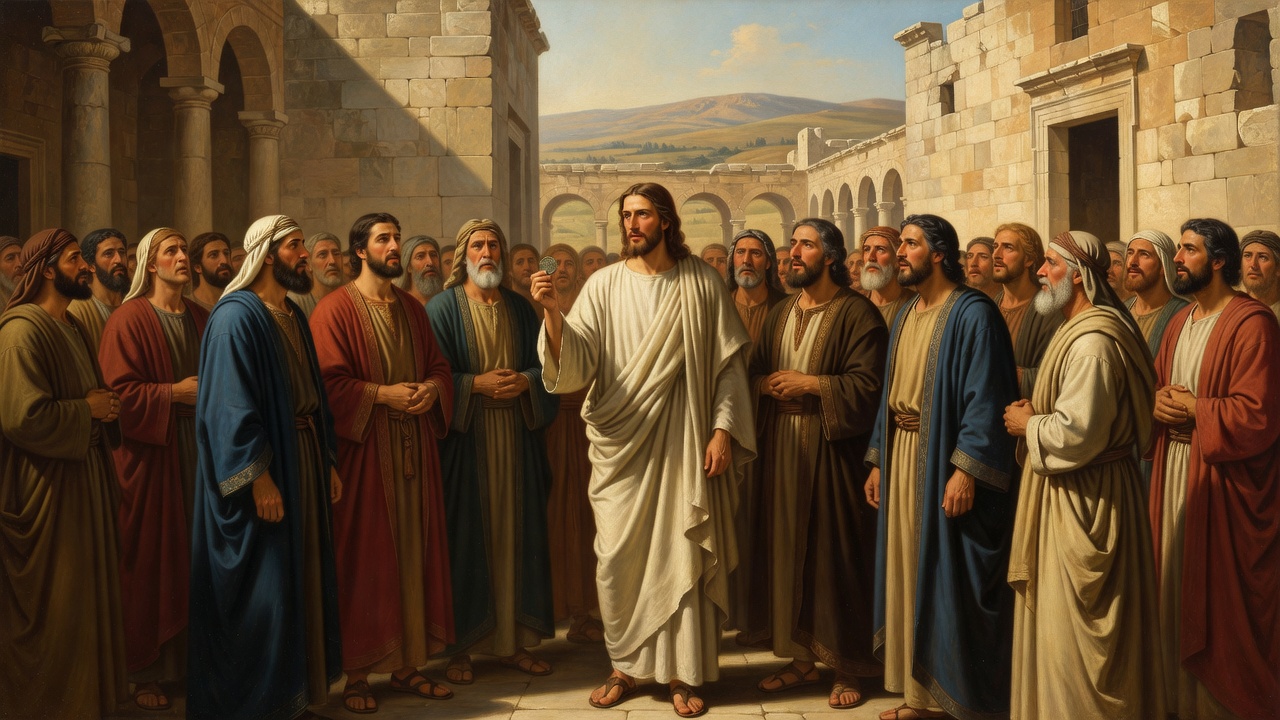
23But Jesus saw through their duplicity and said to them, 24“Show Me a denarius. Whose image and inscription are on it?”
“Caesar’s,” they answered.
25So Jesus told them, “Give to Caesar what is Caesar’s, and to God what is God’s.”
26And they were unable to trap Him in His words before the people; and amazed at His answer, they fell silent.
The Sadducees and the Resurrection
27Then some of the Sadducees, who say there is no resurrection, came to question Him. 28“Teacher,” they said, “Moses wrote for us that if a man’s brother dies and leaves a wife but no children, the man is to marry his brother’s widow and raise up offspring for him. 29Now there were seven brothers. The first one married a wife, but died childless. 30Then the second 31and the third married the widow, and in the same way all seven died, leaving no children. 32And last of all, the woman died. 33So then, in the resurrection, whose wife will she be? For all seven were married to her.”
34Jesus answered, “The sons of this age marry and are given in marriage. 35But those who are considered worthy to share in the age to come and in the resurrection from the dead will neither marry nor be given in marriage. 36In fact, they can no longer die, because they are like the angels. And since they are sons of the resurrection, they are sons of God.
37Even Moses demonstrates that the dead are raised, in the passage about the burning bush. For he calls the Lord ‘the God of Abraham, the God of Isaac, and the God of Jacob.’ 38He is not the God of the dead, but of the living, for to Him all are alive.”
39Some of the scribes answered, “Teacher, You have spoken well!” 40And they did not dare to question Him any further.
Whose Son Is the Christ?
41Then Jesus declared, “How can it be said that the Christ is the Son of David? 42For David himself says in the book of Psalms:
‘The Lord said to my Lord,
“Sit at My right hand
43until I make Your enemies
a footstool for Your feet.”’
44Thus David calls Him ‘Lord.’ So how can He be David’s son?”
Beware of the Scribes
45In the hearing of all the people, Jesus said to His disciples, 46“Beware of the scribes. They like to walk around in long robes, and they love the greetings in the marketplaces, the chief seats in the synagogues, and the places of honor at banquets. 47They defraud widows of their houses, and for a show make lengthy prayers. These men will receive greater condemnation.”
¿Sabías que…?
Debates en los atrios del templo
- Cuando le preguntan con qué autoridad actúa, Jesús pregunta si el bautismo de Juan venía del cielo o de los hombres. Los líderes no responden: si dicen que del cielo, él puede preguntar por qué no le creyeron; si dicen que de los hombres, temen que el pueblo los apedree, pues la multitud está convencida de que Juan era profeta. El Easton's Bible Dictionary (1897) describe a Juan el Bautista como de linaje sacerdotal —su padre, Zacarías, sacerdote del turno de Abías, y su madre, Elisabet, de las hijas de Aarón— y señala que su misión fue objeto de profecía.Fuentes: el propio texto bíblico · John the Baptist
- Unos saduceos, que dicen que no hay resurrección, preguntan de quién sería esposa una mujer si, como escribió Moisés, siete hermanos se hubieran casado con ella, uno tras otro, para suscitar descendencia. Jesús señala el pasaje de la zarza ardente, donde Moisés llama al Señor el Dios de Abraham, el Dios de Isaac y el Dios de Jacob, y dice que Dios es Dios de los vivos. El Easton's Bible Dictionary llama a Abraham, hijo de Taré, padre de una multitud; a Isaac, único hijo de Abraham con Sara; y a Jacob, también llamado Israel, segundo gemelo de Isaac y Rebeca, el que sigue los talones de otro.Fuentes: el propio texto bíblico · Abraham · Isaac · Jacob (Israel)
- Jesús pregunta cómo el Cristo puede ser hijo de David si el propio David, en el libro de los Salmos, lo llama Señor. El Easton's Bible Dictionary identifica a David como el octavo y más joven hijo de Isaí, ciudadano de Belén, que al principio apacentaba las ovejas de su padre en las tierras altas de Judá.Fuentes: el propio texto bíblico · David
Notas escritas con ayuda de IA a partir de fuentes abiertas (Theographic Bible Metadata, CC BY-SA 4.0; Easton’s Bible Dictionary, dominio público) y revisadas antes de publicarse.
Créditos y licencia de esta traducción
Berean Standard Bible
The Holy Bible in English: Berean Standard Bible
Public Domain
Language: English
Contributor: BSB Publishing, LLC
2026-10-02
Fuente: http://ebible.org/engbsb/ · eBible.org