Lucas 18
Berean Standard Bible · Toca un versículo para ver sus referencias cruzadas.
The Parable of the Persistent Widow
1Then Jesus told them a parable about their need to pray at all times and not lose heart: 2“In a certain town there was a judge who neither feared God nor respected men. 3And there was a widow in that town who kept appealing to him, ‘Give me justice against my adversary.’
4For a while he refused, but later he said to himself, ‘Though I neither fear God nor respect men, 5yet because this widow keeps pestering me, I will give her justice. Then she will stop wearing me out with her perpetual requests.’”
6And the Lord said, “Listen to the words of the unjust judge. 7Will not God bring about justice for His elect who cry out to Him day and night? Will He continue to defer their help? 8I tell you, He will promptly carry out justice on their behalf. Nevertheless, when the Son of Man comes, will He find faith on earth?”
The Pharisee and the Tax Collector
9To some who trusted in their own righteousness and viewed others with contempt, He also told this parable: 10“Two men went up to the temple to pray. One was a Pharisee and the other a tax collector. 11The Pharisee stood by himself and prayed, ‘God, I thank You that I am not like the other men—swindlers, evildoers, adulterers—or even like this tax collector. 12I fast twice a week and pay tithes of all that I acquire.’
13But the tax collector stood at a distance, unwilling even to lift up his eyes to heaven. Instead, he beat his breast and said, ‘God, have mercy on me, a sinner!’ 14I tell you, this man, rather than the Pharisee, went home justified. For everyone who exalts himself will be humbled, but the one who humbles himself will be exalted.”
Jesus Blesses the Children
15Now people were even bringing their babies to Jesus for Him to place His hands on them. And when the disciples saw this, they rebuked those who brought them.
16But Jesus called the children to Him and said, “Let the little children come to Me, and do not hinder them! For the kingdom of God belongs to such as these. 17Truly I tell you, anyone who does not receive the kingdom of God like a little child will never enter it.”
The Rich Young Ruler
18Then a certain ruler asked Him, “Good Teacher, what must I do to inherit eternal life?”
19“Why do you call Me good?” Jesus replied. “No one is good except God alone. 20You know the commandments: ‘Do not commit adultery, do not murder, do not steal, do not bear false witness, honor your father and mother.’”
21“All these I have kept from my youth,” he said.
22On hearing this, Jesus told him, “You still lack one thing: Sell everything you own and give to the poor, and you will have treasure in heaven. Then come, follow Me.”
23But when the ruler heard this, he became very sad, because he was extremely wealthy.
24Seeing the man’s sadness, Jesus said, “How hard it is for the rich to enter the kingdom of God! 25Indeed, it is easier for a camel to pass through the eye of a needle than for a rich man to enter the kingdom of God.”
26Those who heard this asked, “Who then can be saved?”
27But Jesus said, “What is impossible with man is possible with God.”
28“Look,” said Peter, “we have left all we had to follow You.”
29“Truly I tell you,” Jesus replied, “no one who has left home or wife or brothers or parents or children for the sake of the kingdom of God 30will fail to receive many times more in this age—and in the age to come, eternal life.”
The Third Prediction of the Passion
31Then Jesus took the Twelve aside and said to them, “Look, we are going up to Jerusalem, and everything the prophets have written about the Son of Man will be fulfilled. 32He will be delivered over to the Gentiles and will be mocked and insulted and spit upon. 33They will flog Him and kill Him, and on the third day He will rise again.”
34But the disciples did not understand any of these things. The meaning was hidden from them, and they did not comprehend what He was saying.
Jesus Heals a Blind Beggar
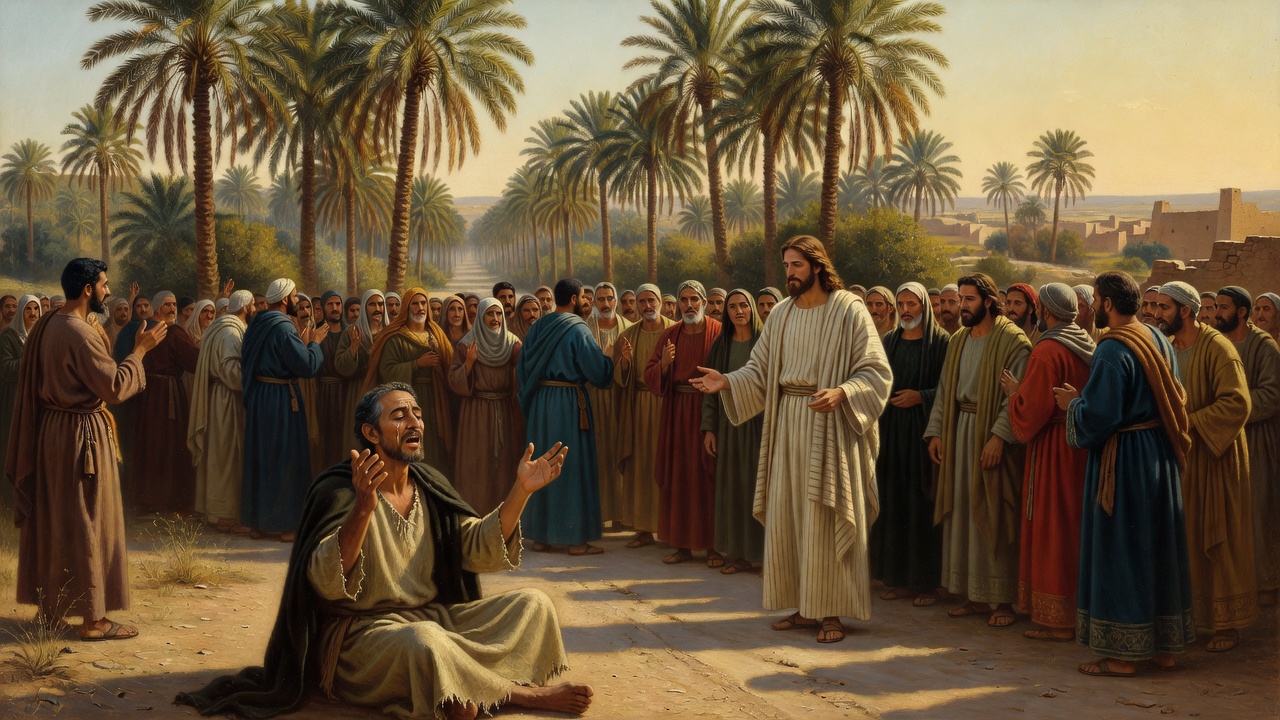
35As Jesus drew near to Jericho, a blind man was sitting beside the road, begging. 36When he heard the crowd going by, he asked what was happening.
37“Jesus of Nazareth is passing by,” they told him.
38So he called out, “Jesus, Son of David, have mercy on me!”
39Those who led the way admonished him to be silent, but he cried out all the louder, “Son of David, have mercy on me!”
40Jesus stopped and directed that the man be brought to Him. When he had been brought near, Jesus asked him, 41“What do you want Me to do for you?”
“Lord,” he said, “let me see again.”
42“Receive your sight!” Jesus replied. “Your faith has healed you.” 43Immediately he received his sight and followed Jesus, glorifying God. And all the people who saw this gave praise to God.
¿Sabías que…?
Oración, humildad y misericordia en el camino
- Cuando Jesús se acerca a Jericó, un ciego está sentado junto al camino, pidiendo limosna. El Easton's Bible Dictionary (1897) llama a Jericó “lugar de fragancia”: una ciudad amurallada en medio de un vasto bosque de palmeras en la llanura del Jordán, a unas cinco millas al oeste del río, y la ciudad más importante de ese valle.Fuentes: el propio texto bíblico · Jericho
- La multitud le dice al ciego que Jesús de Nazaret está pasando, y él grita: “¡Hijo de David, ten misericordia de mí!” David, cuyo nombre se explica como “amado”, era el octavo y el menor de los hijos de Jesé y ciudadano de Belén; Nazaret, que no se menciona en el Antiguo Testamento, era el hogar de José y María.Fuentes: el propio texto bíblico · David · Nazareth
- Jesús aparta a los Doce y les dice que suben a Jerusalén, donde se cumplirá todo lo que los profetas escribieron acerca del Hijo del Hombre. El nombre está en forma dual y significa “posesión de paz” o “fundación de paz”, probablemente en referencia a los montes Sion y Moriah sobre los que se construyó la ciudad, aunque algunos lo relacionan con la ciudad alta y la ciudad baja; Jerusalén también es llamada la ciudad santa y descrita como una ciudad de montaña.Fuentes: el propio texto bíblico · Jerusalem
Notas escritas con ayuda de IA a partir de fuentes abiertas (Theographic Bible Metadata, CC BY-SA 4.0; Easton’s Bible Dictionary, dominio público) y revisadas antes de publicarse.
Lugares de este capítulo
- Jerusalem · 31.777, 35.234 · versículo 31
- Jericho · Hoy: Tell el Alayiq · 31.852, 35.436 · versículo 35
- Nazareth · 32.702, 35.298 · versículo 37
Solo aparecen lugares identificados con alta confianza (90 % o más según las fuentes académicas reunidas por OpenBible). Mapa de la época: DARE (Digital Atlas of the Roman Empire), CC BY 4.0; mapa actual: © colaboradores de OpenStreetMap; lugares: OpenBible.info (CC BY 4.0).
Créditos y licencia de esta traducción
Berean Standard Bible
The Holy Bible in English: Berean Standard Bible
Public Domain
Language: English
Contributor: BSB Publishing, LLC
2026-10-02
Fuente: http://ebible.org/engbsb/ · eBible.org