Juan 9
Berean Standard Bible · Toca un versículo para ver sus referencias cruzadas.
Jesus Heals the Man Born Blind
1Now as Jesus was passing by, He saw a man blind from birth, 2and His disciples asked Him, “Rabbi, who sinned, this man or his parents, that he was born blind?”
3Jesus answered, “Neither this man nor his parents sinned, but this happened so that the works of God would be displayed in him. 4While it is daytime, we must do the works of Him who sent Me. Night is coming, when no one can work. 5While I am in the world, I am the light of the world.”
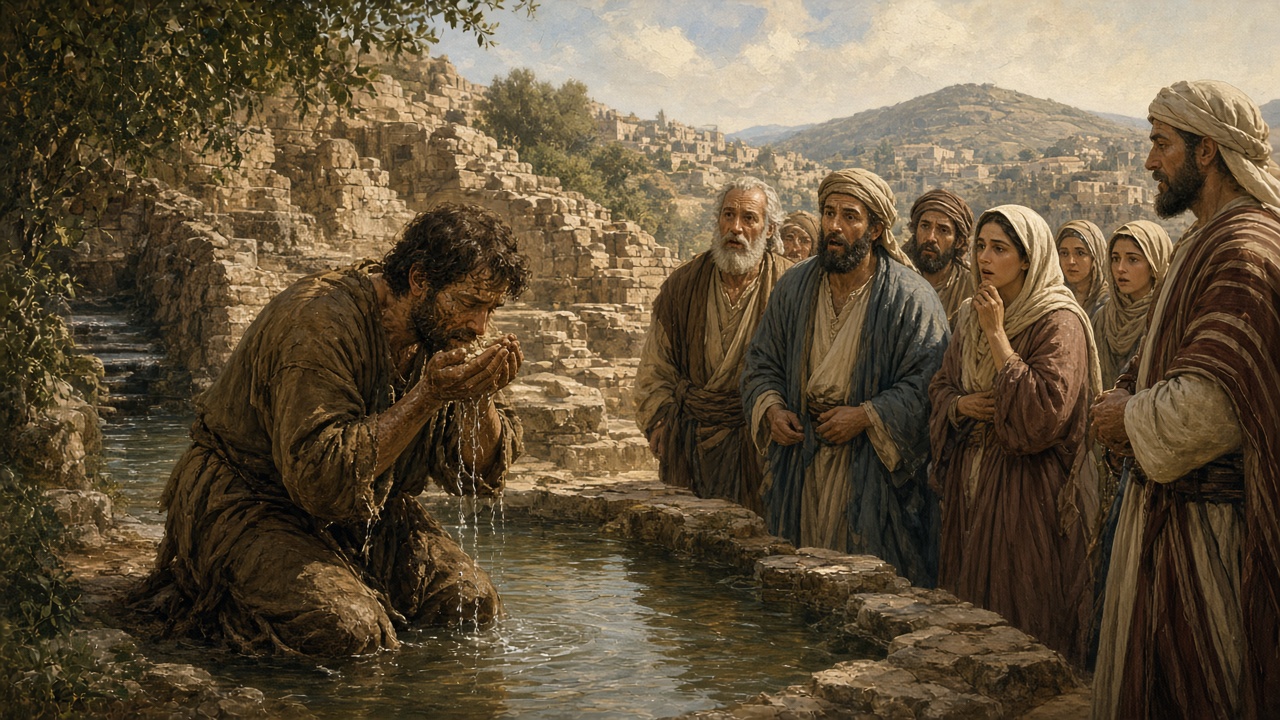
6When Jesus had said this, He spit on the ground, made some mud, and applied it to the man’s eyes. 7Then He told him, “Go, wash in the Pool of Siloam” (which means “Sent”). So the man went and washed, and came back seeing.
8At this, his neighbors and those who had formerly seen him begging began to ask, “Isn’t this the man who used to sit and beg?”
9Some claimed that he was, but others said, “No, he just looks like him.”
But the man kept saying, “I am the one.”
10“How then were your eyes opened?” they asked.
11He answered, “The man they call Jesus made some mud and anointed my eyes, and He told me to go to Siloam and wash. So I went and washed and received my sight.”
12“Where is He?” they asked.
“I do not know,” he answered.
The Pharisees Investigate the Healing
13They brought to the Pharisees the man who had been blind. 14Now the day on which Jesus had made the mud and opened his eyes was a Sabbath. 15So the Pharisees also asked him how he had received his sight.
The man answered, “He put mud on my eyes, and I washed, and now I can see.”
16Because of this, some of the Pharisees said, “This man is not from God, for He does not keep the Sabbath.”
But others said, “How can a sinful man perform such signs?”
And there was division among them. 17So once again they asked the man who had been blind, “What do you say about Him, since it was your eyes He opened?”
“He is a prophet,” the man replied.
18The Jews still did not believe that the man had been blind and had received his sight until they summoned his parents 19and asked, “Is this your son, the one you say was born blind? So how is it that he can now see?”
20His parents answered, “We know he is our son, and we know he was born blind. 21But how he can now see or who opened his eyes, we do not know. Ask him. He is old enough to speak for himself.”
22His parents said this because they were afraid of the Jews. For the Jews had already determined that anyone who confessed Jesus as the Christ would be put out of the synagogue. 23That was why his parents said, “He is old enough. Ask him.”
24So a second time they called for the man who had been blind and said, “Give glory to God! We know that this man is a sinner.”
25He answered, “Whether He is a sinner I do not know. There is one thing I do know: I was blind, but now I see!”
26“What did He do to you?” they asked. “How did He open your eyes?”
27He replied, “I already told you, and you did not listen. Why do you want to hear it again? Do you also want to become His disciples?”
28Then they heaped insults on him and said, “You are His disciple; we are disciples of Moses. 29We know that God spoke to Moses, but we do not know where this man is from.”
30“That is remarkable indeed!” the man said. “You do not know where He is from, and yet He opened my eyes. 31We know that God does not listen to sinners, but He does listen to the one who worships Him and does His will. 32Never before has anyone heard of opening the eyes of a man born blind. 33If this man were not from God, He could do no such thing.”
34They replied, “You were born in utter sin, and you are instructing us?” And they threw him out.
Spiritual Blindness
35When Jesus heard that they had thrown him out, He found the man and said, “Do you believe in the Son of Man ?”
36“Who is He, Sir?” he replied. “Tell me so that I may believe in Him.”
37“You have already seen Him,” Jesus answered. “He is the One speaking with you.”
38“Lord, I believe,” he said. And he worshiped Jesus.
39Then Jesus declared, “For judgment I have come into this world, so that the blind may see and those who see may become blind.”
40Some of the Pharisees who were with Him heard this, and they asked Him, “Are we blind too?”
41“If you were blind,” Jesus replied, “you would not be guilty of sin. But since you claim you can see, your guilt remains.”
¿Sabías que…?
El hombre ciego de nacimiento
- El estanque de Siloé, adonde Jesús mandó al hombre a lavarse, se explica en el relato como Enviado; una nota sobre el lugar también vierte el nombre como Enviado o envío. Esa nota identifica el estanque con Birket Silwan, en el valle inferior del Tiropeón, al sureste del monte Sion. El agua llegaba de manera intermitente por un canal subterráneo sinuoso de 1750 pies, aunque la distancia directa era de solo 1100 pies, desde la Fuente de la Virgen, y el estanque medía 53 pies de norte a sur, 18 pies de ancho y 19 de profundidad.Fuentes: Siloam · el propio texto bíblico
- Los discípulos de Jesús suponían que alguien había pecado, el hombre o sus padres, porque había nacido ciego. Jesús respondió que ni él ni sus padres habían pecado y que esto había ocurrido para que las obras de Dios se manifestaran en él. Aun después, algunos de los que interrogaban al hombre hablaron de él como nacido en pleno pecado.Fuentes: el propio texto bíblico
- El día en que Jesús hizo barro y abrió los ojos del hombre era sábado, y los fariseos quedaron divididos: unos decían que no venía de Dios porque no guardaba el sábado, mientras otros preguntaban cómo un hombre pecador podía realizar tales señales. Los padres del hombre tuvieron miedo de decir cómo veía ahora, porque quien confesara a Jesús como el Cristo sería expulsado de la sinagoga. Una cronología del suceso sitúa la curación en el año 29 d. C. y le asigna la duración de un día.Fuentes: el propio texto bíblico · Blind Man Healed
Notas escritas con ayuda de IA a partir de fuentes abiertas (Theographic Bible Metadata, CC BY-SA 4.0; Easton’s Bible Dictionary, dominio público) y revisadas antes de publicarse.
Lugares de este capítulo
Solo aparecen lugares identificados con alta confianza (90 % o más según las fuentes académicas reunidas por OpenBible). Mapa de la época: DARE (Digital Atlas of the Roman Empire), CC BY 4.0; mapa actual: © colaboradores de OpenStreetMap; lugares: OpenBible.info (CC BY 4.0).
Créditos y licencia de esta traducción
Berean Standard Bible
The Holy Bible in English: Berean Standard Bible
Public Domain
Language: English
Contributor: BSB Publishing, LLC
2026-10-02
Fuente: http://ebible.org/engbsb/ · eBible.org