Génesis 39
Berean Standard Bible · Toca un versículo para ver sus referencias cruzadas.
Joseph and Potiphar’s Wife
1Meanwhile, Joseph had been taken down to Egypt, where an Egyptian named Potiphar, an officer of Pharaoh and captain of the guard, bought him from the Ishmaelites who had taken him there. 2And the LORD was with Joseph, and he became a successful man, serving in the household of his Egyptian master.
3When his master saw that the LORD was with him and made him prosper in all he did, 4Joseph found favor in his sight and became his personal attendant.
Potiphar put him in charge of his household and entrusted him with everything he owned. 5From the time that he put Joseph in charge of his household and all he owned, the LORD blessed the Egyptian’s household on account of him. The LORD’s blessing was on everything he owned, both in his house and in his field. 6So Potiphar left all that he owned in Joseph’s care; he did not concern himself with anything except the food he ate.
Now Joseph was well-built and handsome, 7and after some time his master’s wife cast her eyes upon Joseph and said, “Sleep with me.”
8But he refused. “Look,” he said to his master’s wife, “with me here, my master does not concern himself with anything in his house, and he has entrusted everything he owns to my care. 9No one in this house is greater than I am. He has withheld nothing from me except you, because you are his wife. So how could I do such a great evil and sin against God?”
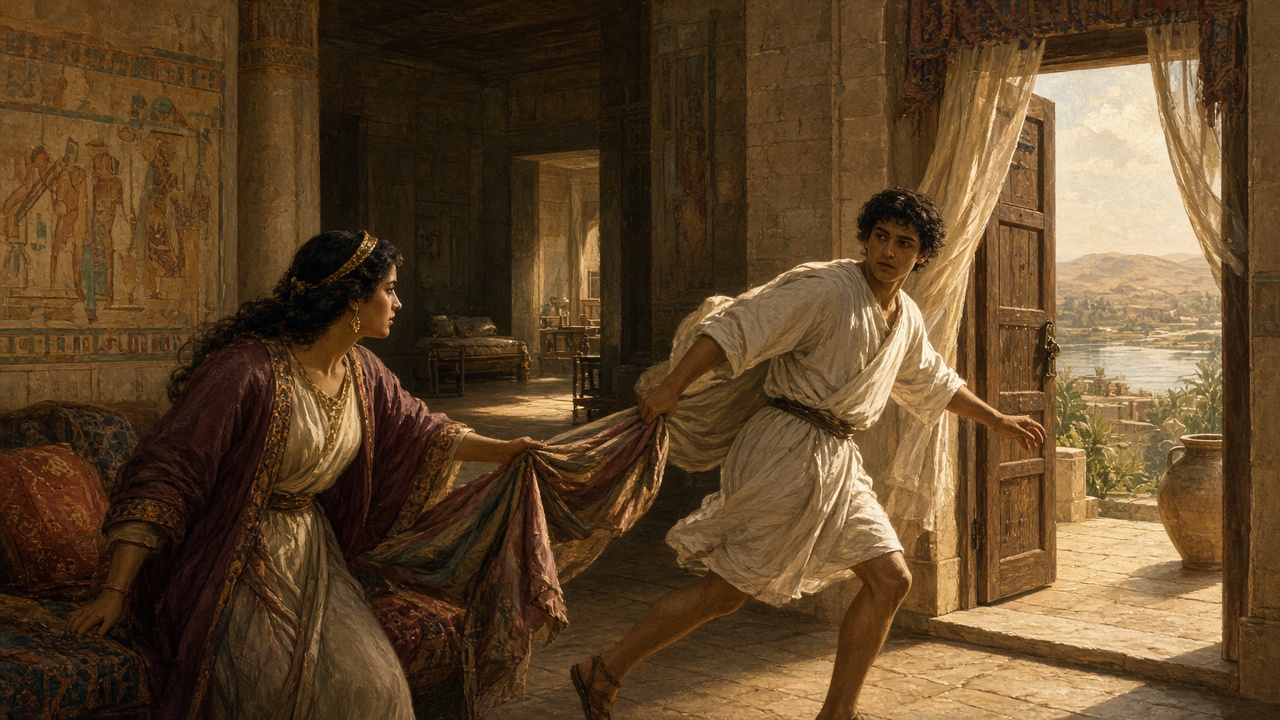
10Although Potiphar’s wife spoke to Joseph day after day, he refused to go to bed with her or even be near her. 11One day, however, Joseph went into the house to attend to his work, and not a single household servant was inside. 12She grabbed Joseph by his cloak and said, “Sleep with me!” But leaving his cloak in her hand, he escaped and ran outside.
Joseph Falsely Imprisoned
13When she saw that he had left his cloak in her hand and had run out of the house, 14she called her household servants. “Look,” she said, “this Hebrew has been brought to us to make sport of us. He came to me so he could sleep with me, but I screamed as loud as I could. 15When he heard me scream for help, he left his cloak beside me and ran out of the house.”
16So Potiphar’s wife kept Joseph’s cloak beside her until his master came home. 17Then she told him the same story: “The Hebrew slave you brought us came to me to make sport of me, 18but when I screamed for help, he left his cloak beside me and ran out of the house.”
19When his master heard the story his wife told him, saying, “This is what your slave did to me,” he burned with anger. 20So Joseph’s master took him and had him thrown into the prison where the king’s prisoners were confined.
While Joseph was there in the prison, 21the LORD was with him and extended kindness to him, granting him favor in the eyes of the prison warden. 22And the warden put all the prisoners under Joseph’s care, so that he was responsible for all that was done in the prison. 23The warden did not concern himself with anything under Joseph’s care, because the LORD was with Joseph and gave him success in whatever he did.
¿Sabías que…?
José en la casa de Potifar
- Potifar, el egipcio que compró a José a los ismaelitas, tiene un nombre que se explica como “dedicado a Ra”, el dios del sol. Era oficial del faraón y capitán de la guardia: probablemente el jefe de la policía del Estado, que formaba parte del ejército, pero también se empleaba en gran medida en tareas civiles. Una nota marginal de Génesis 37:36 llama a ese mismo cargo “jefe de los verdugos”.Fuentes: Potiphar · el propio texto bíblico
- Creyendo la acusación de su esposa, Potifar hizo encerrar a José en la prisión donde estaban confinados los presos del rey. Una referencia dice que permaneció allí algunos años, y una cronología fecha el inicio de ese encarcelamiento en 1717 a. C., con una duración de tres años.Fuentes: Potiphar · Joseph imprisoned · el propio texto bíblico
- El faraón a quien servía Potifar no es nombrado en este capítulo. Una referencia sostiene que el faraón de los días de José fue probablemente Apopi, o Apopis, el último de los reyes hicsos, mientras que algunos argumentan que José llegó a Egipto en el reinado de Thothmes III, mucho después de que los hicsos hubieran sido expulsados.Fuentes: Pharaoh (of Joseph) · el propio texto bíblico
Notas escritas con ayuda de IA a partir de fuentes abiertas (Theographic Bible Metadata, CC BY-SA 4.0; Easton’s Bible Dictionary, dominio público) y revisadas antes de publicarse.
Lugares de este capítulo
- Egypt · 30.129, 31.308 · versículo 1
Solo aparecen lugares identificados con alta confianza (90 % o más según las fuentes académicas reunidas por OpenBible). Mapa de la época: DARE (Digital Atlas of the Roman Empire), CC BY 4.0; mapa actual: © colaboradores de OpenStreetMap; lugares: OpenBible.info (CC BY 4.0).
Créditos y licencia de esta traducción
Berean Standard Bible
The Holy Bible in English: Berean Standard Bible
Public Domain
Language: English
Contributor: BSB Publishing, LLC
2026-10-02
Fuente: http://ebible.org/engbsb/ · eBible.org