Génesis 28
Berean Standard Bible · Toca un versículo para ver sus referencias cruzadas.
Jacob’s Departure
1So Isaac called for Jacob and blessed him. “Do not take a wife from the Canaanite women,” he commanded. 2“Go at once to Paddan-aram, to the house of your mother’s father Bethuel, and take a wife from among the daughters of Laban, your mother’s brother. 3May God Almighty bless you and make you fruitful and multiply you, so that you may become a company of peoples. 4And may He give the blessing of Abraham to you and your descendants, so that you may possess the land where you dwell as a foreigner, the land God gave to Abraham.”
5So Isaac sent Jacob to Paddan-aram, to Laban son of Bethuel the Aramean, the brother of Rebekah, who was the mother of Jacob and Esau.
Esau Marries Mahalath
6Now Esau learned that Isaac had blessed Jacob and sent him to Paddan-aram to take a wife there, commanding him, “Do not marry a Canaanite woman,” 7and that Jacob had obeyed his father and mother and gone to Paddan-aram.
8And seeing that his father Isaac disapproved of the Canaanite women, 9Esau went to Ishmael and married Mahalath, the sister of Nebaioth and daughter of Abraham’s son Ishmael, in addition to the wives he already had.
Jacob’s Ladder
10Meanwhile Jacob left Beersheba and set out for Haran. 11On reaching a certain place, he spent the night there because the sun had set. And taking one of the stones from that place, he put it under his head and lay down to sleep.
12And Jacob had a dream about a ladder that rested on the earth with its top reaching up to heaven, and God’s angels were going up and down the ladder. 13And there at the top the LORD was standing and saying, “I am the LORD, the God of your father Abraham and the God of Isaac. I will give you and your descendants the land on which you now lie. 14Your descendants will be like the dust of the earth, and you will spread out to the west and east and north and south. All the families of the earth will be blessed through you and your offspring. 15Look, I am with you, and I will watch over you wherever you go, and I will bring you back to this land. For I will not leave you until I have done what I have promised you.”
16When Jacob woke up, he thought, “Surely the LORD is in this place, and I was unaware of it.” 17And he was afraid and said, “How awesome is this place! This is none other than the house of God; this is the gate of heaven!”
The Stone of Bethel
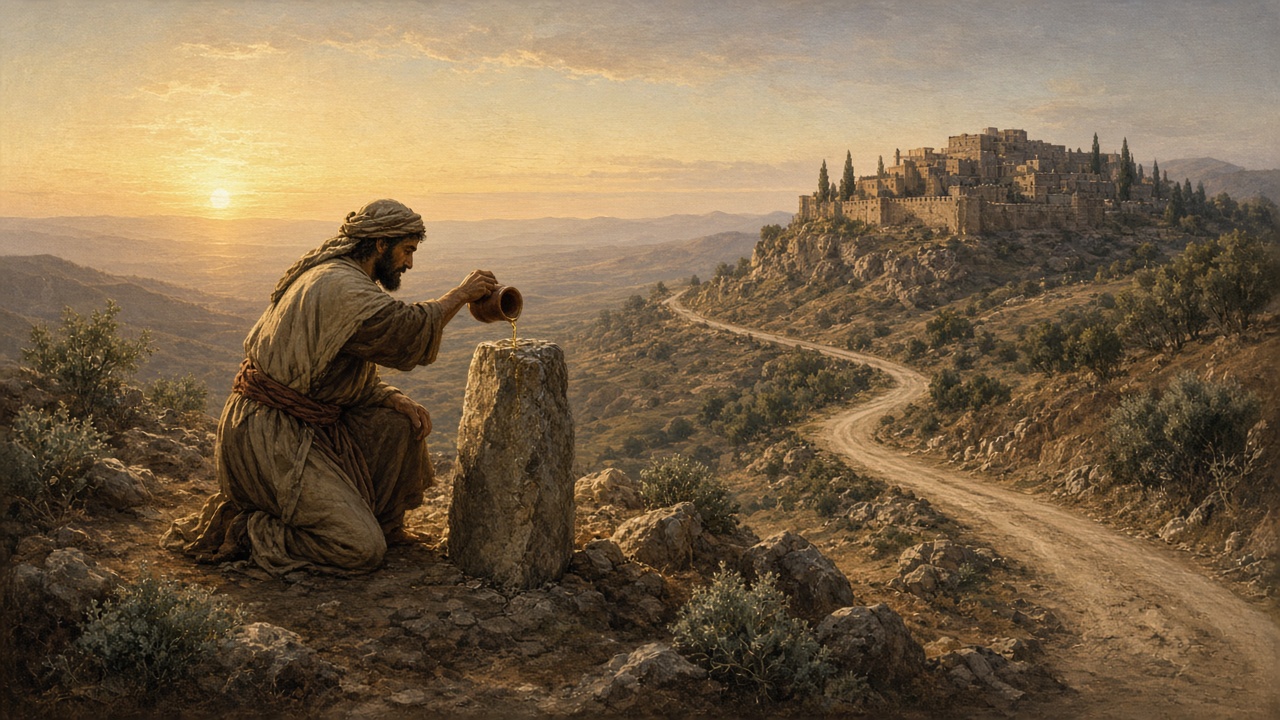
18Early the next morning, Jacob took the stone that he had placed under his head, and he set it up as a pillar. He poured oil on top of it, 19and he called that place Bethel, though previously the city had been named Luz.
20Then Jacob made a vow, saying, “If God will be with me and watch over me on this journey, and if He will provide me with food to eat and clothes to wear, 21so that I may return safely to my father’s house, then the LORD will be my God. 22And this stone I have set up as a pillar will be God’s house, and of all that You give me I will surely give You a tenth.”
¿Sabías que…?
El viaje de Jacob y el sueño en Betel
- Isaac envió a Jacob desde Beerseba a Padan-aram para que tomara esposa entre las hijas de Labán, hermano de su madre Rebeca, y no entre las mujeres cananeas. Padan-aram, llamada la llanura de Aram, se considera comúnmente el distrito mesopotámico alrededor de Harán, donde vivía Labán; Harán, también llamada la ciudad de Nacor, fue donde Abraham permaneció después de salir de Ur hasta que murió su padre Taré.Fuentes: el propio texto bíblico · Paddan-aram · Haran · Laban
- El lugar donde Jacob soñó, levantó como columna la piedra que había puesto bajo su cabeza y derramó aceite sobre ella era la ciudad real cananea de Luz; él la renombró Betel. El Easton's Bible Dictionary (1897) sitúa Betel en la Palestina central, a unas diez millas al norte de Jerusalén, y señala que el nombre se dio al principio, al parecer, a un santuario en las cercanías de Luz, y no se dio a la ciudad misma hasta después de que la tribu de Efraín la conquistara.Fuentes: el propio texto bíblico · Luz · Bethel (of Palestine)
- Cuando Esaú supo que Isaac había bendecido a Jacob y le había ordenado no casarse con una mujer cananea, fue a Ismael y se casó con Mahalat, hermana de Nebaiot e hija de Ismael, hijo de Abraham, además de las esposas que ya tenía. El Easton's Bible Dictionary (1897) también la llama Basemat y señala que las tres esposas de Esaú reciben nombres distintos en la genealogía edomita de Génesis 36 de los que se dan en el relato de Génesis 26 y 28.Fuentes: el propio texto bíblico · Bashemath
Notas escritas con ayuda de IA a partir de fuentes abiertas (Theographic Bible Metadata, CC BY-SA 4.0; Easton’s Bible Dictionary, dominio público) y revisadas antes de publicarse.
Lugares de este capítulo
- Canaan · 32.767, 35.333 · versículos 1, 6, 8
- Haran · Hoy: Harran · 36.864, 39.033 · versículo 10
- Luz · Hoy: Beitin · 31.923, 35.241 · versículo 19
Solo aparecen lugares identificados con alta confianza (90 % o más según las fuentes académicas reunidas por OpenBible). Mapa de la época: DARE (Digital Atlas of the Roman Empire), CC BY 4.0; mapa actual: © colaboradores de OpenStreetMap; lugares: OpenBible.info (CC BY 4.0).
Créditos y licencia de esta traducción
Berean Standard Bible
The Holy Bible in English: Berean Standard Bible
Public Domain
Language: English
Contributor: BSB Publishing, LLC
2026-10-02
Fuente: http://ebible.org/engbsb/ · eBible.org