Gálatas 4
Berean Standard Bible · Toca un versículo para ver sus referencias cruzadas.
Sons and Heirs
1What I am saying is that as long as the heir is a child, he is no different from a slave, although he is the owner of everything. 2He is subject to guardians and trustees until the date set by his father.
3So also, when we were children, we were enslaved under the basic principles of the world. 4But when the time had fully come, God sent His Son, born of a woman, born under the law, 5to redeem those under the law, that we might receive our adoption as sons. 6And because you are sons, God sent the Spirit of His Son into our hearts, crying out, “Abba, Father!” 7So you are no longer a slave, but a son; and since you are a son, you are also an heir through God.
Paul’s Concern for the Galatians
8Formerly, when you did not know God, you were slaves to those who by nature are not gods. 9But now that you know God, or rather are known by God, how is it that you are turning back to those weak and worthless principles? Do you wish to be enslaved by them all over again? 10You are observing special days and months and seasons and years! 11I fear for you, that my efforts for you may have been in vain. 12I beg you, brothers, become like me, for I became like you. You have done me no wrong.
13You know that it was because of an illness that I first preached the gospel to you. 14And although my illness was a trial to you, you did not despise or reject me. Instead, you welcomed me as if I were an angel of God, as if I were Christ Jesus Himself. 15What then has become of your blessing? For I can testify that, if it were possible, you would have torn out your eyes and given them to me. 16Have I now become your enemy by telling you the truth?
17Those people are zealous for you, but not in a good way. Instead, they want to isolate you from us, so that you may be zealous for them. 18Nevertheless, it is good to be zealous if it serves a noble purpose—at any time, and not only when I am with you.
19My children, for whom I am again in the pains of childbirth until Christ is formed in you, 20how I wish I could be with you now and change my tone, because I am perplexed about you.
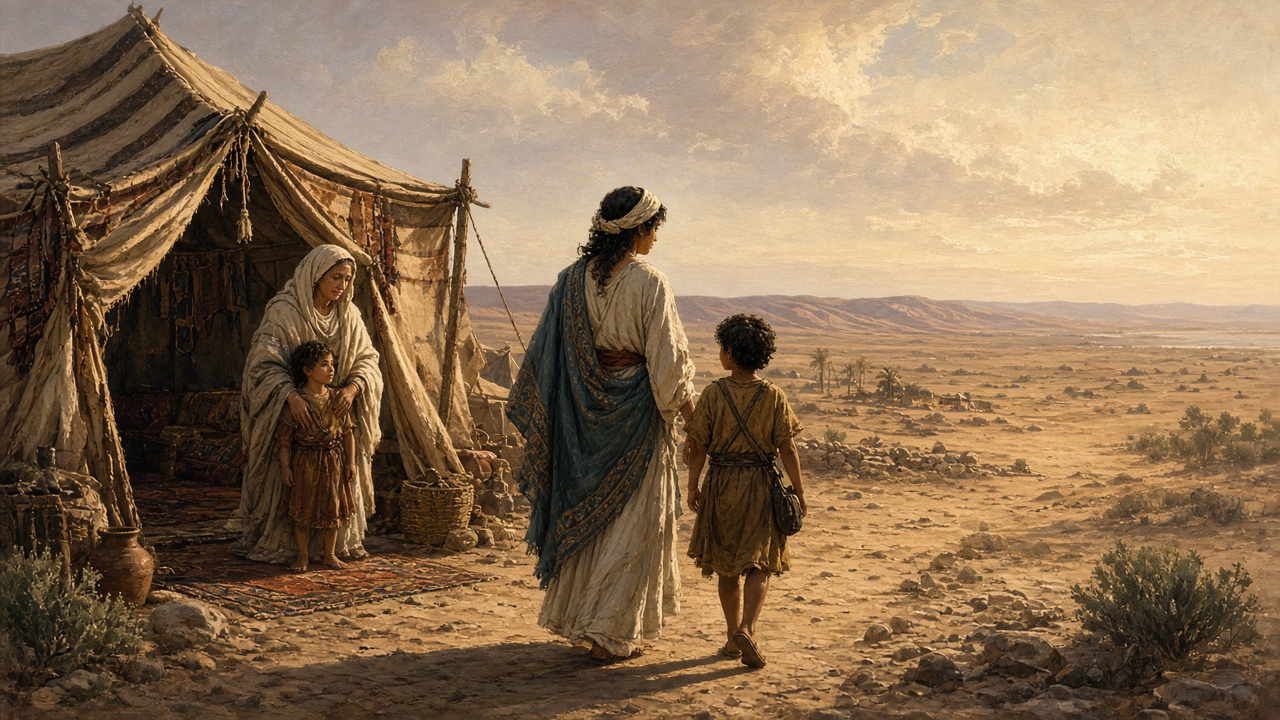
Hagar and Sarah
21Tell me, you who want to be under the law, do you not understand what the law says? 22For it is written that Abraham had two sons, one by the slave woman and the other by the free woman. 23His son by the slave woman was born according to the flesh, but his son by the free woman was born through the promise.
24These things serve as illustrations, for the women represent two covenants. One covenant is from Mount Sinai and bears children into slavery: This is Hagar. 25Now Hagar stands for Mount Sinai in Arabia and corresponds to the present-day Jerusalem, because she is in slavery with her children. 26But the Jerusalem above is free, and she is our mother. 27For it is written:
“Rejoice, O barren woman,
who bears no children;
break forth and cry aloud,
you who have never travailed;
because more are the children of the desolate woman
than of her who has a husband.”
28Now you, brothers, like Isaac, are children of promise. 29At that time, however, the son born by the flesh persecuted the son born by the Spirit. It is the same now.
30But what does the Scripture say? “Expel the slave woman and her son, for the slave woman’s son will never share in the inheritance with the free woman’s son.” 31Therefore, brothers, we are not children of the slave woman, but of the free woman.
¿Sabías que…?
Ya no esclavos, sino hijos
- Este capítulo dice que Abraham tuvo dos hijos, uno de la esclava y otro de la mujer libre, y que las dos mujeres representan dos pactos. Agar, la esclava, era egipcia, sierva de Sara, dada a Abraham como segunda esposa; su hijo fue Ismael. Isaac, único hijo de Abraham con Sara, es el hijo de la promesa con el que el capítulo compara a sus lectores.Fuentes: el propio texto bíblico · Hagar · Isaac
- El capítulo identifica a Agar con el monte Sinaí, en Arabia, montaña también llamada Horeb. El Diccionario Bíblico de Easton (1897) describe esa región montañosa como el lugar al que los hebreos llegaron en el tercer mes después del Éxodo, donde acamparon cerca de un año, y sitúa la península del Sinaí en Arabia Occidental.Fuentes: el propio texto bíblico · Mount Sinai · Arabia
- El capítulo contrasta la Jerusalén de su propio tiempo, de la que dice que está esclavizada con sus hijos, con la Jerusalén de arriba, a la que llama libre. El Diccionario Bíblico de Easton (1897) la llama ciudad santa y ciudad de Dios, y dice que su nombre, de forma dual, significa posesión de paz o fundación de paz, refiriéndose probablemente a los montes Sión y Moriah o, como algunos suponen, a la ciudad alta y la ciudad baja.Fuentes: el propio texto bíblico · Jerusalem
Notas escritas con ayuda de IA a partir de fuentes abiertas (Theographic Bible Metadata, CC BY-SA 4.0; Easton’s Bible Dictionary, dominio público) y revisadas antes de publicarse.
Lugares de este capítulo
- Arabia · Hoy: Arabia Petraea · 30.070, 35.350 · versículo 25
- Jerusalem · 31.777, 35.234 · versículos 25, 26
Solo aparecen lugares identificados con alta confianza (90 % o más según las fuentes académicas reunidas por OpenBible). Mapa de la época: DARE (Digital Atlas of the Roman Empire), CC BY 4.0; mapa actual: © colaboradores de OpenStreetMap; lugares: OpenBible.info (CC BY 4.0).
Créditos y licencia de esta traducción
Berean Standard Bible
The Holy Bible in English: Berean Standard Bible
Public Domain
Language: English
Contributor: BSB Publishing, LLC
2026-10-02
Fuente: http://ebible.org/engbsb/ · eBible.org