Éxodo 7
Berean Standard Bible · Toca un versículo para ver sus referencias cruzadas.
God Commands Moses and Aaron
1The LORD answered Moses, “See, I have made you like God to Pharaoh, and your brother Aaron will be your prophet. 2You are to speak all that I command you, and your brother Aaron is to tell Pharaoh to let the Israelites go out of his land.
3But I will harden Pharaoh’s heart, and though I will multiply My signs and wonders in the land of Egypt, 4Pharaoh will not listen to you.
Then I will lay My hand on Egypt, and by mighty acts of judgment I will bring the divisions of My people the Israelites out of the land of Egypt. 5And the Egyptians will know that I am the LORD, when I stretch out My hand against Egypt and bring the Israelites out from among them.”
6So Moses and Aaron did just as the LORD had commanded them. 7Moses was eighty years old and Aaron was eighty-three when they spoke to Pharaoh.
Aaron’s Staff
8The LORD said to Moses and Aaron, 9“When Pharaoh tells you, ‘Perform a miracle,’ you are to say to Aaron, ‘Take your staff and throw it down before Pharaoh,’ and it will become a serpent.”
10So Moses and Aaron went to Pharaoh and did just as the LORD had commanded. Aaron threw his staff down before Pharaoh and his officials, and it became a serpent.
11But Pharaoh called the wise men and sorcerers and magicians of Egypt, and they also did the same things by their magic arts. 12Each one threw down his staff, and it became a serpent. But Aaron’s staff swallowed up the other staffs.
13Still, Pharaoh’s heart was hardened, and he would not listen to them, just as the LORD had said.
The First Plague: Blood
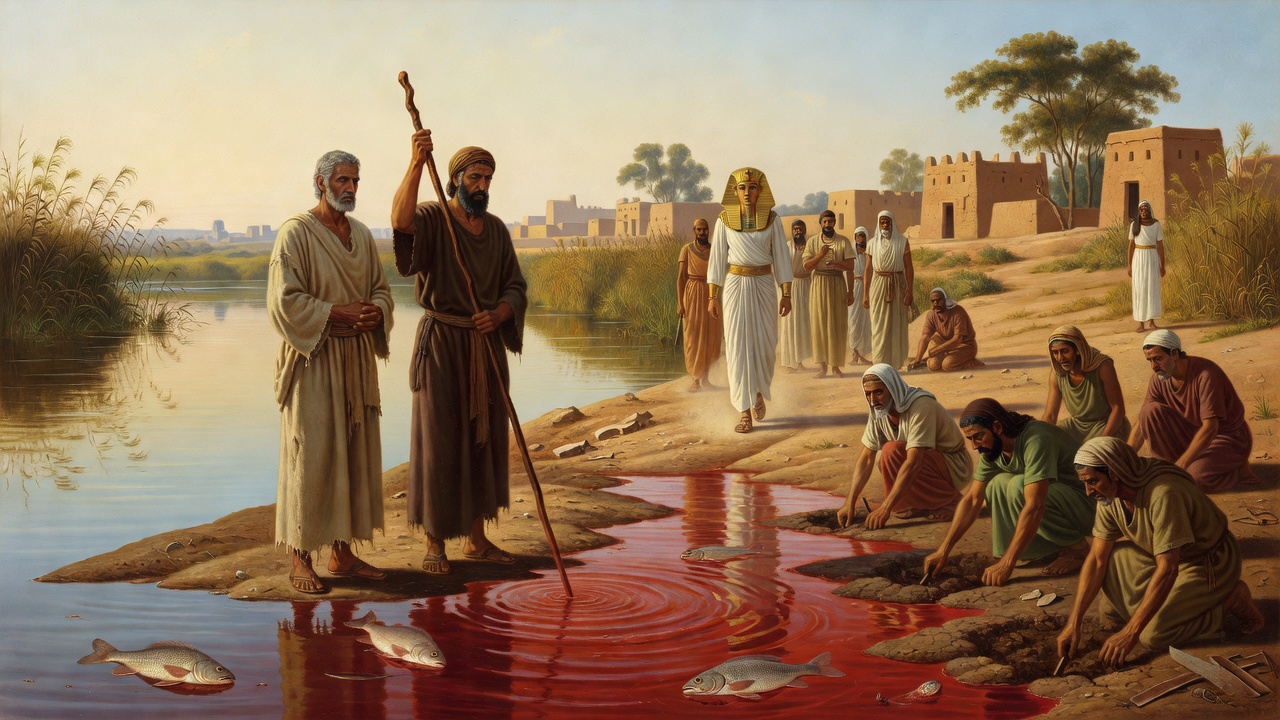
14Then the LORD said to Moses, “Pharaoh’s heart is unyielding; he refuses to let the people go. 15Go to Pharaoh in the morning as you see him walking out to the water. Wait on the bank of the Nile to meet him, and take in your hand the staff that was changed into a snake. 16Then say to him, ‘The LORD, the God of the Hebrews, has sent me to tell you: Let My people go, so that they may worship Me in the wilderness. But you have not listened until now. 17This is what the LORD says: By this you will know that I am the LORD. Behold, with the staff in my hand I will strike the water of the Nile, and it will turn to blood. 18The fish in the Nile will die, the river will stink, and the Egyptians will be unable to drink its water.’”
19And the LORD said to Moses, “Tell Aaron, ‘Take your staff and stretch out your hand over the waters of Egypt—over their rivers and canals and ponds and reservoirs—that they may become blood.’ There will be blood throughout the land of Egypt, even in the vessels of wood and stone.”
20Moses and Aaron did just as the LORD had commanded; in the presence of Pharaoh and his officials, Aaron raised the staff and struck the water of the Nile, and all the water was turned to blood. 21The fish in the Nile died, and the river smelled so bad that the Egyptians could not drink its water. And there was blood throughout the land of Egypt.
22But the magicians of Egypt did the same things by their magic arts. So Pharaoh’s heart was hardened, and he would not listen to Moses and Aaron, just as the LORD had said. 23Instead, Pharaoh turned around, went into his palace, and did not take any of this to heart. 24So all the Egyptians dug around the Nile for water to drink, because they could not drink the water from the river.
25And seven full days passed after the LORD had struck the Nile.
¿Sabías que…?
Moisés y Aarón ante el faraón
- Moisés tenía ochenta años y Aarón ochenta y tres cuando hablaron al faraón. El Easton's Bible Dictionary (1897) señala que Aarón, el hijo mayor de Amram y Jocabed, nació en Egipto tres años antes que su hermano Moisés. En este capítulo, el SEÑOR dice que ha hecho a Moisés "como Dios para el faraón", y que Aarón será su profeta: Moisés debe hablar todo lo que se le ordene, y Aarón debe decirle al faraón que deje salir a los israelitas de su tierra.Fuentes: el propio texto bíblico · Aaron
- El Easton's Bible Dictionary (1897) señala que el nombre Nilo no se encuentra en las Escrituras; el Antiguo Testamento llama a ese río Sihor, "la corriente negra", o simplemente "el río", y también "la inundación de Egipto". El Nilo está formado por el Nilo Blanco y el Nilo Azul, que se unen en Jartum, y es el agua que Aarón golpea en este capítulo. Los peces murieron, el río apestó, los egipcios no pudieron beberla y cavaron alrededor del Nilo en busca de agua, y pasaron siete días completos.Fuentes: Nile · el propio texto bíblico
- El Easton's Bible Dictionary (1897) dice que el faraón del Éxodo fue probablemente Menephtah I, el decimocuarto y mayor de los hijos sobrevivientes de Rameses II, y que residía en Zoan, donde tuvo las entrevistas con Moisés y Aarón registradas en Éxodo. La misma entrada deja abierta la identificación: sigue siendo una cuestión si Seti II o su padre Menephtah fue ese faraón, y algunos creen que las evidencias favorecen a Seti II.Fuentes: Pharaoh (of the Exodus) · el propio texto bíblico
Notas escritas con ayuda de IA a partir de fuentes abiertas (Theographic Bible Metadata, CC BY-SA 4.0; Easton’s Bible Dictionary, dominio público) y revisadas antes de publicarse.
Lugares de este capítulo
- Egypt · 30.129, 31.308 · versículos 3, 4, 5, 11, 19, 21, 22
- Nile · Hoy: Nile River · 31.465, 30.367 · versículos 15, 17, 18, 20, 21, 24, 25
Solo aparecen lugares identificados con alta confianza (90 % o más según las fuentes académicas reunidas por OpenBible). Mapa de la época: DARE (Digital Atlas of the Roman Empire), CC BY 4.0; mapa actual: © colaboradores de OpenStreetMap; lugares: OpenBible.info (CC BY 4.0).
Créditos y licencia de esta traducción
Berean Standard Bible
The Holy Bible in English: Berean Standard Bible
Public Domain
Language: English
Contributor: BSB Publishing, LLC
2026-10-02
Fuente: http://ebible.org/engbsb/ · eBible.org