Éxodo 3
Berean Standard Bible · Toca un versículo para ver sus referencias cruzadas.
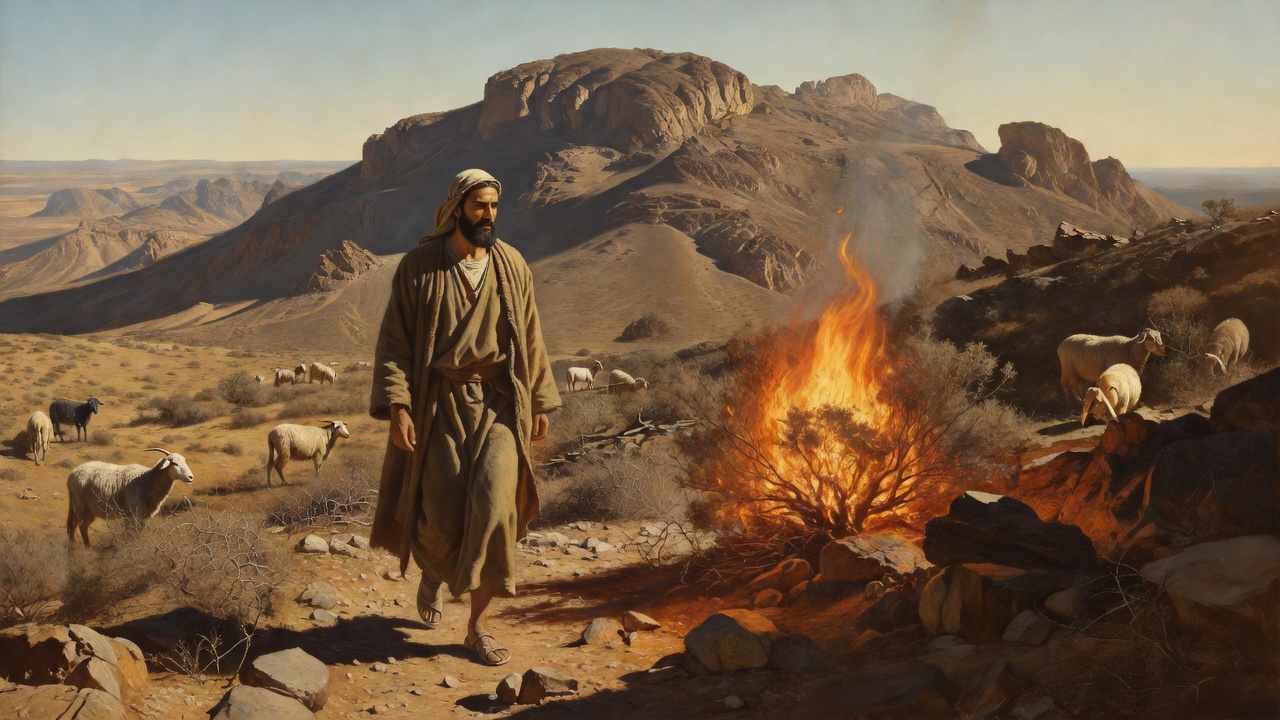
Moses at the Burning Bush
1Meanwhile, Moses was shepherding the flock of his father-in-law Jethro, the priest of Midian. He led the flock to the far side of the wilderness and came to Horeb, the mountain of God. 2There the angel of the LORD appeared to him in a blazing fire from within a bush. Moses saw the bush ablaze with fire, but it was not consumed. 3So Moses thought, “I must go over and see this marvelous sight. Why is the bush not burning up?”
4When the LORD saw that he had gone over to look, God called out to him from within the bush, “Moses, Moses!”
“Here I am,” he answered.
5“Do not come any closer,” God said. “Take off your sandals, for the place where you are standing is holy ground.” 6Then He said, “I am the God of your father, the God of Abraham, the God of Isaac, and the God of Jacob.”
At this, Moses hid his face, for he was afraid to look at God.
7The LORD said, “I have indeed seen the affliction of My people in Egypt. I have heard them crying out because of their oppressors, and I am aware of their sufferings. 8I have come down to rescue them from the hand of the Egyptians and to bring them up out of that land to a good and spacious land, a land flowing with milk and honey—the home of the Canaanites, Hittites, Amorites, Perizzites, Hivites, and Jebusites.
9And now the cry of the Israelites has reached Me, and I have seen how severely the Egyptians are oppressing them. 10Therefore, go! I am sending you to Pharaoh to bring My people the Israelites out of Egypt.”
11But Moses asked God, “Who am I, that I should go to Pharaoh and bring the Israelites out of Egypt?”
12“I will surely be with you,” God said, “and this will be the sign to you that I have sent you: When you have brought the people out of Egypt, all of you will worship God on this mountain.”
13Then Moses asked God, “Suppose I go to the Israelites and say to them, ‘The God of your fathers has sent me to you,’ and they ask me, ‘What is His name?’ What should I tell them?”
14God said to Moses, “I AM WHO I AM. This is what you are to say to the Israelites: ‘I AM has sent me to you.’”
15God also told Moses, “Say to the Israelites, ‘The LORD, the God of your fathers—the God of Abraham, the God of Isaac, and the God of Jacob—has sent me to you.’ This is My name forever, and this is how I am to be remembered in every generation.
16Go, assemble the elders of Israel and say to them, ‘The LORD, the God of your fathers—the God of Abraham, Isaac, and Jacob—has appeared to me and said: I have surely attended to you and have seen what has been done to you in Egypt. 17And I have promised to bring you up out of your affliction in Egypt, into the land of the Canaanites, Hittites, Amorites, Perizzites, Hivites, and Jebusites—a land flowing with milk and honey.’
18The elders of Israel will listen to what you say, and you must go with them to the king of Egypt and tell him, ‘The LORD, the God of the Hebrews, has met with us. Now please let us take a three-day journey into the wilderness, so that we may sacrifice to the LORD our God.’
19But I know that the king of Egypt will not allow you to go unless a mighty hand compels him. 20So I will stretch out My hand and strike the Egyptians with all the wonders I will perform among them. And after that, he will release you.
21And I will grant this people such favor in the sight of the Egyptians that when you leave, you will not go away empty-handed. 22Every woman shall ask her neighbor and any woman staying in her house for silver and gold jewelry and clothing, and you will put them on your sons and daughters. So you will plunder the Egyptians.”
¿Sabías que…?
El llamado de Moisés en la zarza ardente
- Moisés está pastoreando en Madián cuando comienza este capítulo. Los madianitas eran una tribu árabe nómada, descendiente de Madián, el cuarto hijo de Abraham con Cetura, cuyo nombre se explica como contienda. Vivían sobre todo en el desierto al norte de Arabia, y la península del Sinaí era tierra de pastoreo para sus rebaños; allí, tras huir de Egipto, Moisés llegó a ser siervo y luego yerno del sacerdote.Fuentes: el propio texto bíblico · Midian · Midian
- Su suegro es Jetro, llamado sacerdote de Madián. El Diccionario Bíblico de Easton (1897) identifica a ese sacerdote con Raguel y dice que, si los dos nombres corresponden a un mismo hombre, Raguel puede considerarse su nombre personal y Jetro, que significa excelencia, un título oficial.Fuentes: el propio texto bíblico · Jethro
- Moisés lleva el rebaño hasta Horeb, el monte de Dios. El nombre se explica como desierto, o monte, del suelo reseco, un término general para toda la cordillera de la cual el Sinaí era una de las cumbres; el Diccionario Bíblico de Easton (1897) da a la cordillera el nombre moderno de Jebel Musa y la describe como un enorme bloque de unas dos millas de largo por cerca de una milla de ancho, con una llanura muy espaciosa llamada Er Rahah en su extremo noreste, donde los israelitas acamparon después durante casi un año.Fuentes: el propio texto bíblico · Horeb
Notas escritas con ayuda de IA a partir de fuentes abiertas (Theographic Bible Metadata, CC BY-SA 4.0; Easton’s Bible Dictionary, dominio público) y revisadas antes de publicarse.
Lugares de este capítulo
- Midian · 28.495, 35.012 · versículo 1
- Mount Horeb · Hoy: Jebel Musa · 28.540, 33.973 · versículo 1
- Egypt · 30.129, 31.308 · versículos 7, 8, 10, 11, 12, 16, 17, 18, 19, 20, 22
Solo aparecen lugares identificados con alta confianza (90 % o más según las fuentes académicas reunidas por OpenBible). Mapa de la época: DARE (Digital Atlas of the Roman Empire), CC BY 4.0; mapa actual: © colaboradores de OpenStreetMap; lugares: OpenBible.info (CC BY 4.0).
Créditos y licencia de esta traducción
Berean Standard Bible
The Holy Bible in English: Berean Standard Bible
Public Domain
Language: English
Contributor: BSB Publishing, LLC
2026-10-02
Fuente: http://ebible.org/engbsb/ · eBible.org