Hechos 7
Berean Standard Bible · Toca un versículo para ver sus referencias cruzadas.
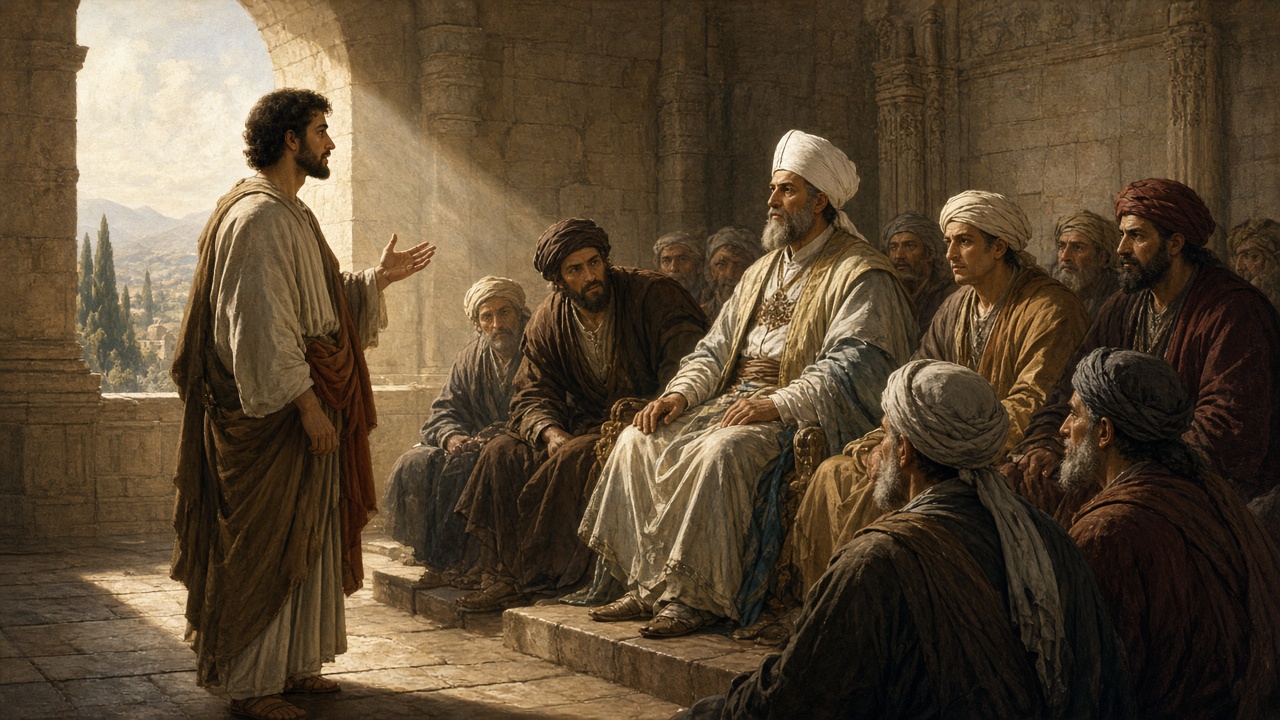
Stephen’s Address: The Call of Abraham
1Then the high priest asked Stephen, “Are these charges true?”
2And Stephen declared: “Brothers and fathers, listen to me! The God of glory appeared to our father Abraham while he was still in Mesopotamia, before he lived in Haran, 3and told him, ‘Leave your country and your kindred and go to the land I will show you.’ 4So Abraham left the land of the Chaldeans and settled in Haran. After his father died, God brought him out of that place and into this land where you are now living.
5He gave him no inheritance here, not even a foot of ground. But God promised to give possession of the land to Abraham and his descendants, even though he did not yet have a child. 6God told him that his descendants would be foreigners in a strange land, and that they would be enslaved and mistreated four hundred years. 7‘But I will punish the nation that enslaves them,’ God said, ‘and afterward they will come forth and worship Me in this place.’
8Then God gave Abraham the covenant of circumcision, and Abraham became the father of Isaac and circumcised him on the eighth day. And Isaac became the father of Jacob, and Jacob of the twelve patriarchs.
Joseph Sold into Egypt
9Because the patriarchs were jealous of Joseph, they sold him as a slave into Egypt. But God was with him 10and rescued him from all his troubles. He granted Joseph favor and wisdom in the sight of Pharaoh king of Egypt, who appointed him ruler over Egypt and all his household.
11Then famine and great suffering swept across Egypt and Canaan, and our fathers could not find food. 12When Jacob heard that there was grain in Egypt, he sent our fathers on their first visit. 13On their second visit, Joseph revealed his identity to his brothers, and his family became known to Pharaoh. 14Then Joseph sent for his father Jacob and all his relatives, seventy-five in all.
Israel Oppressed in Egypt
15So Jacob went down to Egypt, where he and our fathers died. 16Their bones were carried back to Shechem and placed in the tomb that Abraham had bought from the sons of Hamor at Shechem for a price he paid in silver.
17As the time drew near for God to fulfill His promise to Abraham, our people in Egypt increased greatly in number. 18Then another king, who knew nothing of Joseph, arose over Egypt. 19He exploited our people and oppressed our fathers, forcing them to abandon their infants so they would die.
The Birth and Adoption of Moses
20At that time Moses was born, and he was beautiful in the sight of God. For three months he was nurtured in his father’s house. 21When he was set outside, Pharaoh’s daughter took him and brought him up as her own son. 22So Moses was educated in all the wisdom of the Egyptians and was powerful in speech and action.
The Rejection and Flight of Moses
23When Moses was forty years old, he decided to visit his brothers, the children of Israel. 24And when he saw one of them being mistreated, Moses went to his defense and avenged him by striking down the Egyptian who was oppressing him. 25He assumed his brothers would understand that God was using him to deliver them, but they did not.
26The next day he came upon two Israelites who were fighting, and he tried to reconcile them, saying, ‘Men, you are brothers. Why are you mistreating each other?’
27But the man who was abusing his neighbor pushed Moses aside and said, ‘Who made you ruler and judge over us? 28Do you want to kill me as you killed the Egyptian yesterday?’ 29At this remark, Moses fled to the land of Midian, where he lived as a foreigner and had two sons.
The Call of Moses
30After forty years had passed, an angel appeared to Moses in the flames of a burning bush in the desert near Mount Sinai. 31When Moses saw it, he marveled at the sight. As he approached to look more closely, the voice of the Lord came to him: 32‘I am the God of your fathers, the God of Abraham, Isaac, and Jacob.’ Moses trembled with fear and did not dare to look.
33Then the Lord said to him, ‘Take off your sandals, for the place where you are standing is holy ground. 34I have indeed seen the oppression of My people in Egypt. I have heard their groaning and have come down to deliver them. Now come, I will send you back to Egypt.’
35This Moses, whom they had rejected with the words, ‘Who made you ruler and judge?’ is the one whom God sent to be their ruler and redeemer through the angel who appeared to him in the bush. 36He led them out and performed wonders and signs in the land of Egypt, at the Red Sea, and for forty years in the wilderness.
37This is the same Moses who told the Israelites, ‘God will raise up for you a prophet like me from among your brothers.’ 38He was in the assembly in the wilderness with the angel who spoke to him on Mount Sinai, and with our fathers. And he received living words to pass on to us.
The Rebellion of Israel
39But our fathers refused to obey him. Instead, they rejected him and in their hearts turned back to Egypt. 40They said to Aaron, ‘Make us gods who will go before us! As for this Moses who led us out of the land of Egypt, we do not know what has happened to him.’
41At that time they made a calf and offered a sacrifice to the idol, rejoicing in the works of their hands. 42But God turned away from them and gave them over to the worship of the host of heaven, as it is written in the book of the prophets:
‘Did you bring Me sacrifices and offerings
forty years in the wilderness, O house of Israel?
43You have taken along the tabernacle of Molech
and the star of your god Rephan,
the idols you made to worship.
Therefore I will send you into exile
beyond Babylon.’
The Tabernacle of the Testimony
44Our fathers had the tabernacle of the Testimony with them in the wilderness. It was constructed exactly as God had directed Moses, according to the pattern he had seen. 45And our fathers who received it brought it in with Joshua when they dispossessed the nations God drove out before them. It remained until the time of David, 46who found favor in the sight of God and asked to provide a dwelling place for the God of Jacob. 47But it was Solomon who built the house for Him.
48However, the Most High does not dwell in houses made by human hands. As the prophet says:
49‘Heaven is My throne
and the earth is My footstool.
What kind of house will you build for Me, says the Lord,
or where will My place of repose be?
50Has not My hand made all these things?’
51You stiff-necked people with uncircumcised hearts and ears! You always resist the Holy Spirit, just as your fathers did. 52Which of the prophets did your fathers fail to persecute? They even killed those who foretold the coming of the Righteous One. And now you are His betrayers and murderers— 53you who received the law ordained by angels, yet have not kept it.”
The Stoning of Stephen
54On hearing this, the members of the Sanhedrin were enraged, and they gnashed their teeth at him. 55But Stephen, full of the Holy Spirit, looked intently into heaven and saw the glory of God and Jesus standing at the right hand of God. 56“Look,” he said, “I see heaven open and the Son of Man standing at the right hand of God.”
57At this they covered their ears, cried out in a loud voice, and rushed together at him. 58They dragged him out of the city and began to stone him. Meanwhile the witnesses laid their garments at the feet of a young man named Saul.
59While they were stoning him, Stephen appealed, “Lord Jesus, receive my spirit.” 60Falling on his knees, he cried out in a loud voice, “Lord, do not hold this sin against them.” And when he had said this, he fell asleep.
¿Sabías que…?
Esteban relata la historia de Israel
- Esteban abre su discurso con Abraham todavía en Mesopotamia, antes de establecerse en Harán, cuando se le ordenó dejar su tierra y sus parientes. Mesopotamia —en hebreo Aram-naharaim, “Siria de los dos ríos”— era el nombre que griegos y romanos daban a la región entre el Éufrates y el Tigris; en el Antiguo Testamento también se llama Padan-aram, “la llanura de Aram”, y el norte de esa meseta fue el hogar antiguo de los antepasados de los hebreos. El Easton's Bible Dictionary (1897) observa que ese primer llamado no se menciona en el Antiguo Testamento, aunque Génesis 12 lo da a entender, y que Abraham salió de Ur, en Caldea, y recorrió unas 300 millas al norte, hasta Harán.Fuentes: el propio texto bíblico · Mesopotamia · Abraham
- Esteban afirma que los huesos de Jacob y de los padres fueron llevados de vuelta a Siquem y depositados en la tumba que Abraham había comprado a los hijos de Hamor. El Easton's Bible Dictionary (1897) identifica a Hamor como un heveo cuyo nombre significa “asno”, señala que en Hechos 7:16 se le llama Emmor y dice que Jacob le compró el terreno de Siquem en el que después fue sepultado José. El artículo añade que Siquem, hijo de Hamor, fundó la ciudad que llevó su nombre.Fuentes: el propio texto bíblico · Hamor
- Esteban sitúa la zarza ardiente en el desierto, cerca del monte Sinaí, y dice que Moisés recibió allí palabras vivas del ángel que le habló en el monte. El Easton's Bible Dictionary (1897) trata Sinaí —nombre ligado a Sin, un dios lunar— como el mismo distrito montañoso llamado también Horeb. Según el artículo, los hebreos llegaron a esa región al tercer mes después del Éxodo, tras un viaje de unas 150 millas desde el mar Rojo, con todos los recodos del camino, y permanecieron acampados cerca de un año.Fuentes: el propio texto bíblico · Mount Sinai
Notas escritas con ayuda de IA a partir de fuentes abiertas (Theographic Bible Metadata, CC BY-SA 4.0; Easton’s Bible Dictionary, dominio público) y revisadas antes de publicarse.
Lugares de este capítulo
- Haran · Hoy: Harran · 36.864, 39.033 · versículos 2, 4
- Mesopotamia · Hoy: Aram-naharaim · 36.864, 39.033 · versículo 2
- Chaldea · 30.962, 46.104 · versículo 4
- Egypt · 30.129, 31.308 · versículos 9, 10, 11, 12, 14, 15, 17, 18, 34, 36, 39, 40
- Canaan · 32.767, 35.333 · versículo 11
- Shechem · Hoy: Tell Balatah · 32.214, 35.282 · versículo 16
- Nile · Hoy: Nile River · 31.465, 30.367 · versículo 19
- Midian · 28.495, 35.012 · versículo 29
- Babylon · 32.543, 44.422 · versículo 43
Solo aparecen lugares identificados con alta confianza (90 % o más según las fuentes académicas reunidas por OpenBible). Mapa de la época: DARE (Digital Atlas of the Roman Empire), CC BY 4.0; mapa actual: © colaboradores de OpenStreetMap; lugares: OpenBible.info (CC BY 4.0).
Créditos y licencia de esta traducción
Berean Standard Bible
The Holy Bible in English: Berean Standard Bible
Public Domain
Language: English
Contributor: BSB Publishing, LLC
2026-10-02
Fuente: http://ebible.org/engbsb/ · eBible.org