Génesis 39
Barkly Bible Portions · Toca un versículo para ver sus referencias cruzadas.
Joseph's life in Egypt
1When the Ishmaelites got to Egypt, they sold Joseph to a man named Potifar. Potifar was an important man in Egypt. He was boss over all the soldiers that guarded the government building. That was where the king worked. 2God was very good to Joseph and helped him to do everything the right way. Joseph was so good at what he did, he was allowed to live in Potifar's house.
3Potifar saw that God helped Joseph do everything just right. 4And so Potifar was happy with Joseph and made him the boss over all the people in his house and over everything he owned. 5God did even more good things for Potifar after Joseph started to be the boss of Potifar's house. God made all Potifar's animals grow fat and his paddocks grow a lot of food. Joseph was God's man and that is why all these good things happened for Potifar. 6And so Potifar had no worries, he only had to worry about the food he ate.
Potifar's wife tried to get Joseph to do the wrong thing
7Potifar's wife looked at Joseph and saw that he was strong and good looking, and she wanted him. One day she said to him, “Come to bed with me.”
8Joseph said, “No way. I cannot do that. Your husband trusts me to look after everything he owns. 9I am the boss of this house, and your husband has not kept anything from me, just you. You are his wife and you belong to him, and so there is no way that I will do this really bad thing that you want me to do. If I did that bad thing, I would be going against God.”
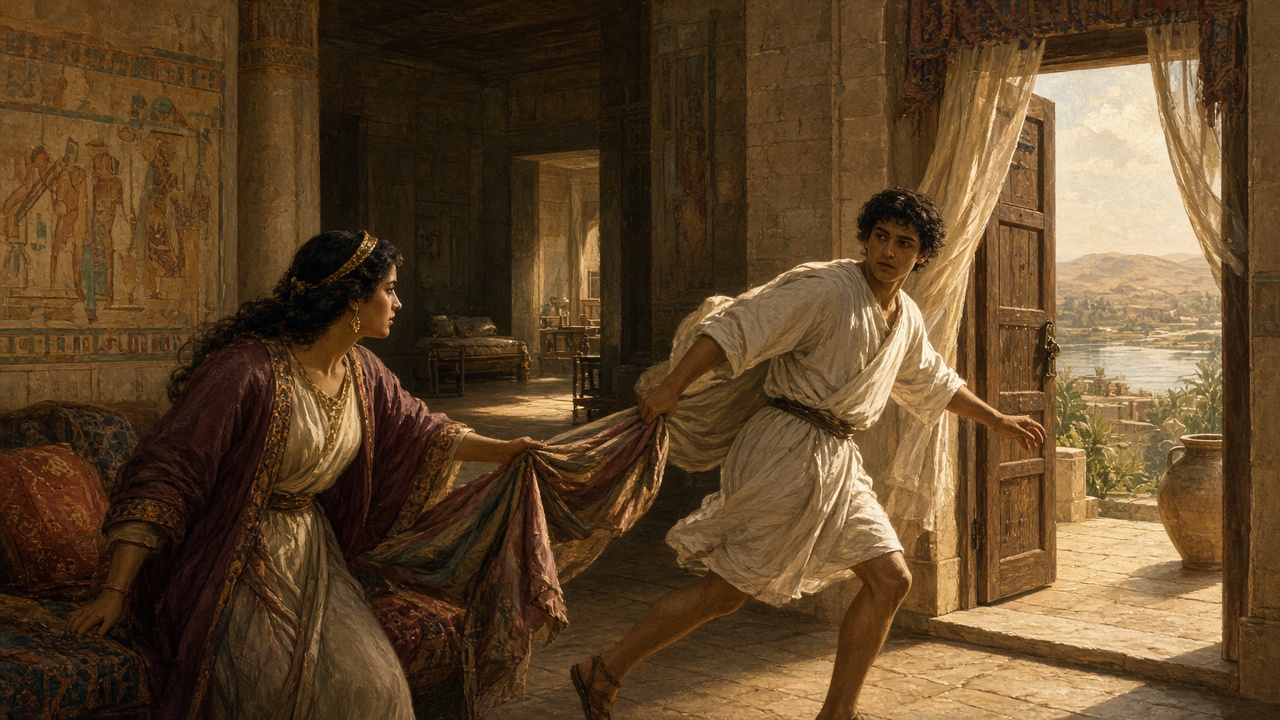
10Day after day, she tried to get him to sleep with her, but every day he said, “No.” He would not listen to her or stay near her. 11But one day, when Joseph went into the house to do his work, Potifar's wife saw her chance to get him. She knew that there weren't any other men in the house and so she grabbed Joseph's coat and said, “Come to bed with me!” Potifar's wife tried to do the wrong thing with Joseph|src="lll2-07 Joseph&potiphar's wife.tif" size="col" copy="Global Recordings Network" ref="39:11-12"
But Joseph got out of his coat and ran outside. 13When Potifar's wife saw that she still had Joseph's coat in her hand, she got wild and shouted out to the workers, “Look at this. This coat belongs to that Hebrew stranger. My husband has let him come into my house and he has shamed me. He came and tried to sleep with me like I was his wife, but I screamed and he ran away without his coat.”
16She kept Joseph's coat and when her husband came home she told him the same story. She said, “That Hebrew stranger you let come into our house tried to shame me. He tried to sleep with me like we were married. 18But I screamed and he ran away without his coat.”
19Potifar listened to his wife's story and got really angry. 20He arrested Joseph and put him in jail where the king's prisoners were kept.
21But again, God was with Joseph and was kind to him. God made the boss of the jail respect Joseph. 22The jail boss picked Joseph to be the next boss under him. Joseph had to look after everything that happened in the jail. And he was the boss over all the other prisoners too. 23And so the guard did not have to worry about anything that happened in the jail. The Lord was with Joseph and helped him do everything just right.
¿Sabías que…?
José en la casa de Potifar
- Potifar, el egipcio que compró a José a los ismaelitas, tiene un nombre que se explica como “dedicado a Ra”, el dios del sol. Era oficial del faraón y capitán de la guardia: probablemente el jefe de la policía del Estado, que formaba parte del ejército, pero también se empleaba en gran medida en tareas civiles. Una nota marginal de Génesis 37:36 llama a ese mismo cargo “jefe de los verdugos”.Fuentes: Potiphar · el propio texto bíblico
- Creyendo la acusación de su esposa, Potifar hizo encerrar a José en la prisión donde estaban confinados los presos del rey. Una referencia dice que permaneció allí algunos años, y una cronología fecha el inicio de ese encarcelamiento en 1717 a. C., con una duración de tres años.Fuentes: Potiphar · Joseph imprisoned · el propio texto bíblico
- El faraón a quien servía Potifar no es nombrado en este capítulo. Una referencia sostiene que el faraón de los días de José fue probablemente Apopi, o Apopis, el último de los reyes hicsos, mientras que algunos argumentan que José llegó a Egipto en el reinado de Thothmes III, mucho después de que los hicsos hubieran sido expulsados.Fuentes: Pharaoh (of Joseph) · el propio texto bíblico
Notas escritas con ayuda de IA a partir de fuentes abiertas (Theographic Bible Metadata, CC BY-SA 4.0; Easton’s Bible Dictionary, dominio público) y revisadas antes de publicarse.
Lugares de este capítulo
- Egypt · 30.129, 31.308 · versículo 1
Solo aparecen lugares identificados con alta confianza (90 % o más según las fuentes académicas reunidas por OpenBible). Mapa de la época: DARE (Digital Atlas of the Roman Empire), CC BY 4.0; mapa actual: © colaboradores de OpenStreetMap; lugares: OpenBible.info (CC BY 4.0).
Créditos y licencia de esta traducción
Barkly Bible Portions
The Holy Bible in the Barkly dialect of English, spoken in Australia
copyright © 2024 Bible Society of Australia
Language: Barkly English (English)
Dialect: Barkly
This translation is made available to you under the terms of the
Creative Commons Attribution-Noncommercial-No Derivatives license 4.0.
You may share and redistribute this Bible translation or extracts from it in any format, provided that:
You include the above copyright and source information.
You do not sell this work for a profit.
You do not change any of the words or punctuation of the Scriptures.
Pictures included with Scriptures and other documents on this site are licensed just for use with those Scriptures and documents.
For other uses, please contact the respective copyright owners.
2026-04-14
Fuente: http://ebible.org/engbarkly/ · eBible.org