Génesis 21
Barkly Bible Portions · Toca un versículo para ver sus referencias cruzadas.
Sarah had a son named Isaac
1The Lord was kind to Sarah and she found out that she was going to have a baby. Then, at the right time, the baby that the Lord promised to Sarah was born. And so Sarah gave that old man Abraham a son. And Abraham named the baby Isaac which means Laughing. 4Abraham remembered his side of the promise he made with God. And so when Isaac was 8 days old, Abraham did the young men's operation on Isaac to show that Isaac belonged to God.
5Abraham was 100 years old when Isaac was born. 6Sarah said, “God has given me a chance to laugh now, and everyone who hears my story will laugh and be happy with me.” 7Then she said, “We are so old that no-one thought that Abraham and I could ever have a baby. But now we have a son.” Isaac was born|src="IMG_1125 Abraham Sarah and Isaac born.tif" size="col" copy="Paul Davies" ref="21:7"
8Isaac grew and on the day he stopped just having milk and started to eat food, Abraham gave a big party.
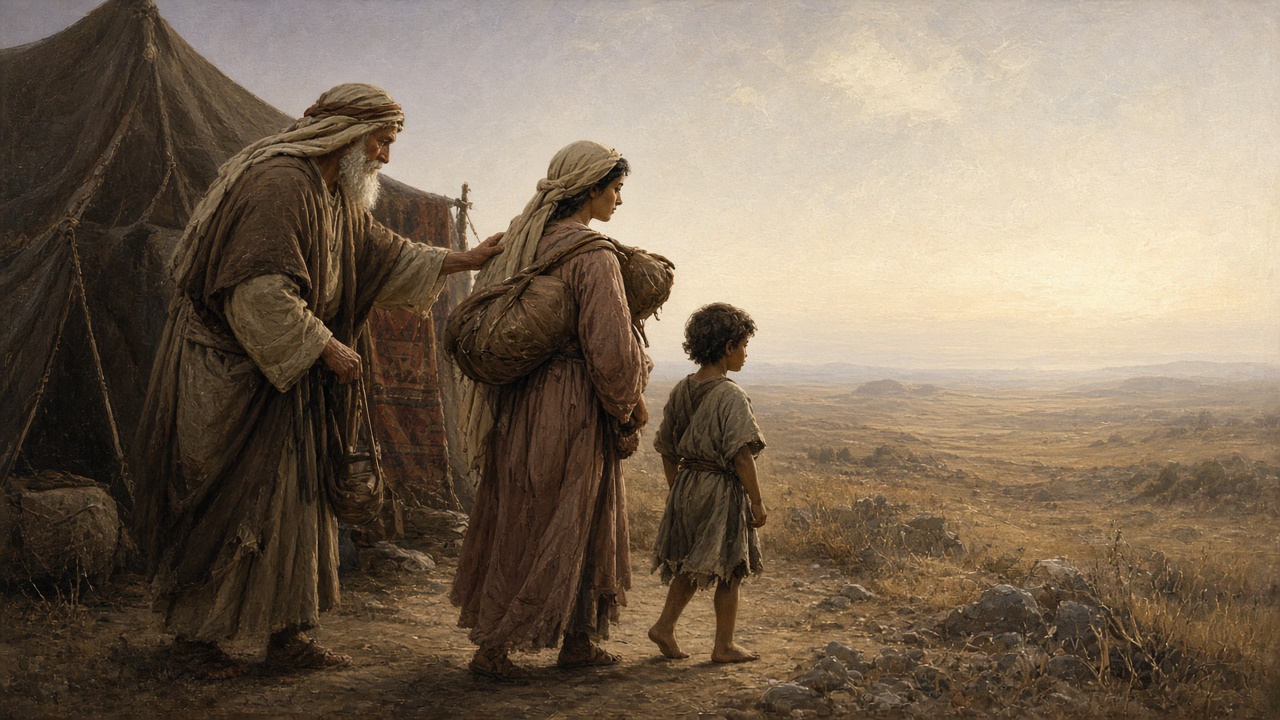
Abraham sent Hagar and Ishmael away from his camp.
9One day Sarah saw Ishmael and Isaac playing together. And she started to worry that Hagar's son Ishmael would get a share of everything after Abraham died. So she said to Abraham, “When you die, my son Isaac must get everything you own. Hagar's son must not get anything. Send him and his mother away from here.”
11Ishmael was his son too and so Abraham was really upset by Sarah's words. 12But God said to Abraham, “Do not worry about Ishmael. It is ok. I will look after him and his mother. You should listen to Sarah and do what she says. Remember that I promised you a family. That family will come from Isaac, not Ishmael. 13I will give Ishmael a family too. His family will grow into a nation. He is your son and that is why I will do good things for him.”
14The next morning, Abraham got some food and a water bag. He put them on Hagar's shoulder and sent her and Ishmael out of the camp. Together they walked into the dry country called Beersheba. 15They walked until there was no water left in the water bag. They stopped and Hagar left Ishmael under a tree, and then she went and sat by herself a long way off. She said to herself, “I cannot watch him die,” and she started to cry.
17God heard the boy crying too and so he sent an angel from heaven to talk to Hagar. And the angel said to her, “Why are you upset? God has heard Ishmael crying under that tree. Go and get your son, and do not be frightened. I promise you, a great nation will come from your son.” 19Then God showed her where to find a waterhole. She filled the water bag and gave Ishmael a drink.
20God kept Ishmael safe as he grew up in the dry country called Paran. He learned how to be a great hunter and later on Hagar got a wife for him from Egypt.
Abraham and Abimelek made a promise together
22One day, Abimelek and the leader of his army called Fycol, came to talk to Abraham. It was Abimelek who had nearly married Sarah.
Abimelek said to Abraham, “We know that God is very good to you and helps you with everything you do. 23But, Abraham, you are not one of my people. You are a stranger living here in my country and I have been kind to you and to all your people. And so, I want you to be kind to me and to all my people. And I want you to promise me that you will never try to trick me, or the family that comes after me. And I want you to say, ‘God, punish me if I break this promise.’” 24Abraham said, “Abimelek, I promise to do the right thing to you and to your family. And I say, ‘God, I want you to punish me if I break my promise to Abimelek’.”
25Then Abraham said to Abimelek, “We have just promised to be good friends, but I have a problem. Some of your people grabbed one of our waterholes, and then stopped us from getting any water from it.”
26Abimelek said, “I do not know who did this. Why didn't you tell me before now?”
27Abraham went to his camp and picked some sheep and cows and took them back to the meeting. He gave the animals to Abimelek and the 2 men made strong promises to each other again.
28Abraham picked 7 girl lambs and put them to one side. 29Abimelek asked, “Why did you put these 7 girl lambs to one side. What does it mean?”
30Abraham answered, “I want to give you these lambs as a present. When people see you take these sheep from me they will know that you and I agree that I dug this waterhole.” 31From that time on, that place was called Beersheba. And in that language it means Promise Waterhole, and it was where Abraham and Abimelek made strong promises to each other.
32Then Abimelek and Fycol, the leader of his army, went back home to the country where the Philistines lived. 33Abraham planted a Tamarisk tree in Beersheba. He did this to mark the place where he prayed and showed respect to the one true God who lives forever. 34Abraham and all his people lived in the land that belonged to the Philistines for a very long time. But they were always strangers in that country.
¿Sabías que…?
El nacimiento de Isaac, la partida de Agar y Beerseba
- Abraham tenía cien años cuando Sara dio a luz a Isaac, el único hijo que tuvieron juntos, y lo circuncidó a los ocho días, como Dios le había mandado. Sara dijo que Dios la había hecho reír y que cuantos oyeran la noticia reirían con ella. El Easton's Bible Dictionary (1897) señala que hubo una gran fiesta cuando destetaron a Isaac, probablemente hacia los dos años.Fuentes: el propio texto bíblico · Isaac
- Agar, cuyo nombre se explica como “huida” o, según otros, “extranjera”, era egipcia y sierva de Sara, quien la entregó a Abraham como esposa secundaria. Tras el nacimiento de Isaac, Abraham envió a Agar y al hijo de ambos, Ismael, al desierto de Beerseba, con pan y un odre de agua. Ismael se estableció después en el desierto de Parán, una región desértica en el noreste de la península del Sinaí, entre el Arabá al este y el desierto de Shur al oeste; llegó a ser un gran arquero, y su madre le consiguió una esposa de Egipto.Fuentes: el propio texto bíblico · Hagar · Paran
- Beerseba, “pozo del juramento” o “pozo de los siete”, recibió ese nombre cuando Abraham y Abimelec juraron allí por un pozo que Abraham dijo haber cavado; él apartó siete corderas como testimonio, y los dos hicieron un pacto. Ficol, capitán en jefe del ejército de Abimelec, el rey filisteo de Gerar, entró en esa alianza con Abraham. Luego Abraham plantó un tamarisco en Beerseba y vivió mucho tiempo en la tierra de los filisteos.Fuentes: el propio texto bíblico · Beersheba · Phichol
Notas escritas con ayuda de IA a partir de fuentes abiertas (Theographic Bible Metadata, CC BY-SA 4.0; Easton’s Bible Dictionary, dominio público) y revisadas antes de publicarse.
Lugares de este capítulo
Solo aparecen lugares identificados con alta confianza (90 % o más según las fuentes académicas reunidas por OpenBible). Mapa de la época: DARE (Digital Atlas of the Roman Empire), CC BY 4.0; mapa actual: © colaboradores de OpenStreetMap; lugares: OpenBible.info (CC BY 4.0).
Créditos y licencia de esta traducción
Barkly Bible Portions
The Holy Bible in the Barkly dialect of English, spoken in Australia
copyright © 2024 Bible Society of Australia
Language: Barkly English (English)
Dialect: Barkly
This translation is made available to you under the terms of the
Creative Commons Attribution-Noncommercial-No Derivatives license 4.0.
You may share and redistribute this Bible translation or extracts from it in any format, provided that:
You include the above copyright and source information.
You do not sell this work for a profit.
You do not change any of the words or punctuation of the Scriptures.
Pictures included with Scriptures and other documents on this site are licensed just for use with those Scriptures and documents.
For other uses, please contact the respective copyright owners.
2026-04-14
Fuente: http://ebible.org/engbarkly/ · eBible.org