Hechos 7
American Standard Version Byzantine Text · Toca un versículo para ver sus referencias cruzadas.
Stephen’s Address: The Call of Abraham
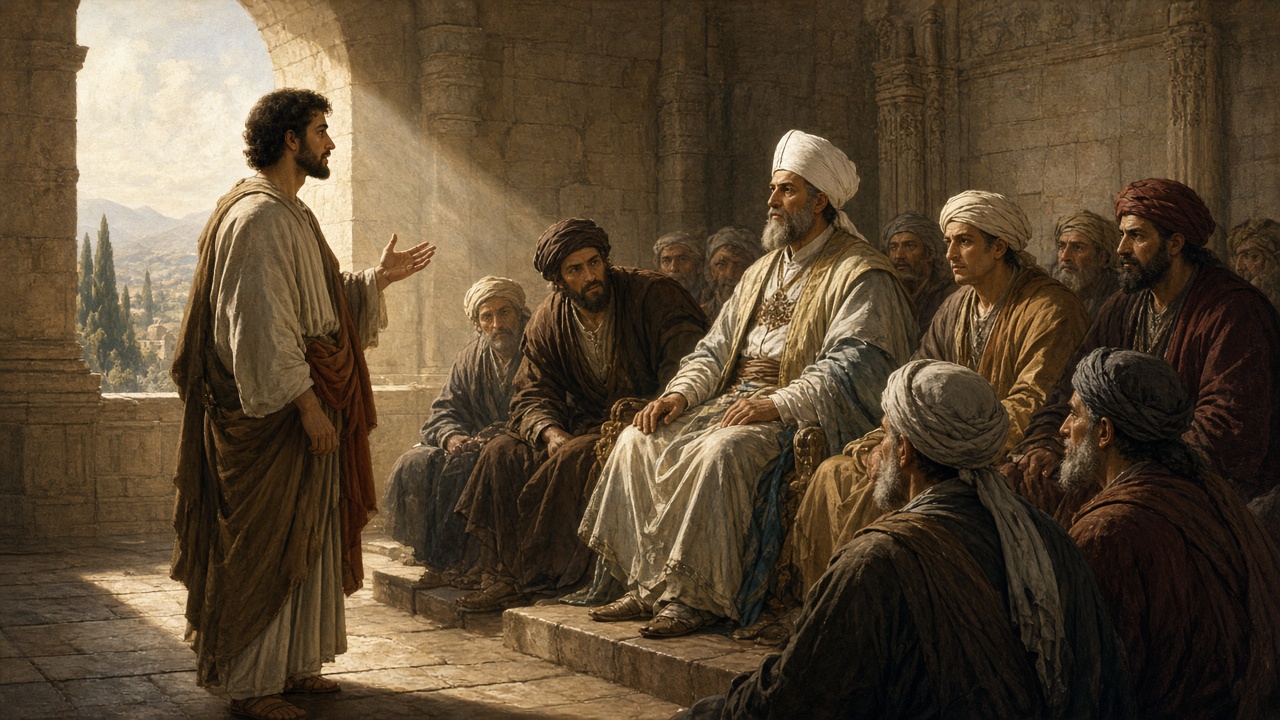
1And the high priest said, Are then these things so? 2And he said,
Brethren and fathers, hearken: The God of glory appeared unto our father Abraham, when he was in Mesopotamia, before he dwelt in Haran, 3and said unto him, Get thee out of thy land, and from thy kindred, and come into a land that I shall show thee. 4Then came he out of the land of the Chaldeans, and dwelt in Haran: and from thence, when his father was dead, God removed him into this land, wherein ye now dwell: 5and he gave him none inheritance in it, no, not so much as to set his foot on: and he promised that he would give it to him in possession, and to his seed after him, when as yet he had no child. 6And God spake on this wise, that his seed should sojourn in a strange land, and that they should bring them into bondage, and treat them ill, four hundred years. 7And the nation to which they shall be in bondage will I judge, said God: and after that shall they come forth, and serve me in this place. 8And he gave him the covenant of circumcision: and so Abraham begat Isaac, and circumcised him the eighth day; and Isaac begat Jacob, and Jacob the twelve patriarchs.
Joseph Sold into Egypt
9And the patriarchs, moved with jealousy against Joseph, sold him into Egypt: and God was with him, 10and delivered him out of all his afflictions, and gave him favor and wisdom before Pharaoh king of Egypt; and he made him governor over Egypt and all his house. 11Now there came a famine over all the land of Egypt and Canaan, and great affliction: and our fathers found no sustenance. 12But when Jacob heard that there was grain in Egypt, he sent forth our fathers the first time. 13And at the second time Joseph was made known to his brethren; and Joseph’s race became manifest unto Pharaoh. 14And Joseph sent, and called to him his father Jacob, and all his kindred, threescore and fifteen souls.
Israel Oppressed in Egypt
15And Jacob went down into Egypt; and he died, himself and our fathers; 16and they were carried over unto Shechem, and laid in the tomb that Abraham bought for a price in silver of the sons of Hamor the father of Shechem. 17But as the time of the promise drew nigh which God had sworn to Abraham, the people grew and multiplied in Egypt, 18till there arose another king, who knew not Joseph. 19The same dealt craftily with our race, and ill-treated our fathers, that they should cast out their babes to the end they might not live.
The Birth and Adoption of Moses
20At which season Moses was born, and was exceeding fair; and he was nourished three months in his father’s house: 21and when he was cast out, Pharaoh’s daughter took him up, and nourished him for her own son. 22And Moses was instructed in all the wisdom of the Egyptians; and he was mighty in words and in works.
The Rejection and Flight of Moses
23But when he was well-nigh forty years old, it came into his heart to visit his brethren the children of Israel. 24And seeing one of them suffer wrong, he defended him, and avenged him that was oppressed, smiting the Egyptian: 25and he supposed that his brethren understood that God by his hand was giving them deliverance; but they understood not. 26And the day following he appeared unto them as they strove, and urged them to peace, saying, Sirs, ye are brethren; why do ye wrong one to another? 27But he that did his neighbor wrong thrust him away, saying, Who made thee a ruler and a judge over us? 28Wouldest thou kill me, as thou killedst the Egyptian yesterday? 29And Moses fled at this saying, and became a sojourner in the land of Midian, where he begat two sons.
The Call of Moses
30And when forty years were fulfilled, an angel of the Lord appeared to him in the wilderness of mount Sinai, in a flame of fire in a bush. 31And when Moses saw it, he wondered at the sight: and as he drew near to behold, there came a voice of the Lord unto him, 32I am the God of thy fathers, the God of Abraham, and the God of Isaac, and the God of Jacob. And Moses trembled, and durst not behold. 33And the Lord said unto him, Loose the shoes from thy feet: for the place whereon thou standest is holy ground. 34I have surely seen the affliction of my people that is in Egypt, and have heard their groaning, and I am come down to deliver them: and now come, I will send thee into Egypt. 35This Moses whom they refused, saying, Who made thee a ruler and a judge? him did God send to be a ruler and a deliverer by the hand of the angel that appeared to him in the bush. 36This man led them forth, having wrought wonders and signs in the land of Egypt, and in the Red Sea, and in the wilderness forty years. 37This is that Moses, who said unto the children of Israel, A prophet shall the Lord your God raise up unto you from among your brethren, like unto me. 38This is he that was in the church in the wilderness with the angel that spake to him in the mount Sinai, and with our fathers: who received living oracles to give unto us:
The Rebellion of Israel
39to whom our fathers would not be obedient, but thrust him from them, and turned back in their heart unto Egypt, 40saying unto Aaron, Make us gods that shall go before us: for as for this Moses, who led us forth out of the land of Egypt, we know not what is become of him. 41And they made a calf in those days, and brought a sacrifice unto the idol, and rejoiced in the works of their hands. 42But God turned, and gave them up to serve the host of heaven; as it is written in the book of the prophets,
Did ye offer unto me slain beasts and sacrifices
Forty years in the wilderness, O house of Israel?
43And ye took up the tabernacle of Moloch,
And the star of your god Remphan,
The figures which ye made to worship them:
And I will carry you away beyond Babylon.
The Tabernacle of the Testimony
44Our fathers had the tabernacle of the testimony in the wilderness, even as he appointed who spake unto Moses, that he should make it according to the figure that he had seen. 45Which also our fathers, in their turn, brought in with Joshua when they entered on the possession of the nations, that God thrust out before the face of our fathers, unto the days of David; 46who found favor in the sight of God, and asked to find a habitation for the God of Jacob. 47But Solomon built him a house. 48Howbeit the Most High dwelleth not in temples made with hands; as saith the prophet,
49The heaven is my throne,
And the earth the footstool of my feet:
What manner of house will ye build me? saith the Lord:
Or what is the place of my rest?
50Did not my hand make all these things?
51Ye stiff-necked and uncircumcised in heart and ears, ye do always resist the Holy Spirit: as your fathers did, so do ye. 52Which of the prophets did not your fathers persecute? and they killed them that showed before of the coming of the Righteous One; of whom ye have now become betrayers and murderers; 53ye who received the law as it was ordained by angels, and kept it not.
The Stoning of Stephen
54Now when they heard these things, they were cut to the heart, and they gnashed on him with their teeth. 55But he, being full of the Holy Spirit, looked up steadfastly into heaven, and saw the glory of God, and Jesus standing on the right hand of God, 56and said, Behold, I see the heavens opened, and the Son of man standing on the right hand of God. 57But they cried out with a loud voice, and stopped their ears, and rushed upon him with one accord; 58and they cast him out of the city, and stoned him: and the witnesses laid down their garments at the feet of a young man named Saul. 59And they stoned Stephen, calling upon the Lord, and saying, Lord Jesus, receive my spirit. 60And he knelt down, and cried with a loud voice, Lord, lay not this sin to their charge. And when he had said this, he fell asleep.
¿Sabías que…?
Esteban relata la historia de Israel
- Esteban abre su discurso con Abraham todavía en Mesopotamia, antes de establecerse en Harán, cuando se le ordenó dejar su tierra y sus parientes. Mesopotamia —en hebreo Aram-naharaim, “Siria de los dos ríos”— era el nombre que griegos y romanos daban a la región entre el Éufrates y el Tigris; en el Antiguo Testamento también se llama Padan-aram, “la llanura de Aram”, y el norte de esa meseta fue el hogar antiguo de los antepasados de los hebreos. El Easton's Bible Dictionary (1897) observa que ese primer llamado no se menciona en el Antiguo Testamento, aunque Génesis 12 lo da a entender, y que Abraham salió de Ur, en Caldea, y recorrió unas 300 millas al norte, hasta Harán.Fuentes: el propio texto bíblico · Mesopotamia · Abraham
- Esteban afirma que los huesos de Jacob y de los padres fueron llevados de vuelta a Siquem y depositados en la tumba que Abraham había comprado a los hijos de Hamor. El Easton's Bible Dictionary (1897) identifica a Hamor como un heveo cuyo nombre significa “asno”, señala que en Hechos 7:16 se le llama Emmor y dice que Jacob le compró el terreno de Siquem en el que después fue sepultado José. El artículo añade que Siquem, hijo de Hamor, fundó la ciudad que llevó su nombre.Fuentes: el propio texto bíblico · Hamor
- Esteban sitúa la zarza ardiente en el desierto, cerca del monte Sinaí, y dice que Moisés recibió allí palabras vivas del ángel que le habló en el monte. El Easton's Bible Dictionary (1897) trata Sinaí —nombre ligado a Sin, un dios lunar— como el mismo distrito montañoso llamado también Horeb. Según el artículo, los hebreos llegaron a esa región al tercer mes después del Éxodo, tras un viaje de unas 150 millas desde el mar Rojo, con todos los recodos del camino, y permanecieron acampados cerca de un año.Fuentes: el propio texto bíblico · Mount Sinai
Notas escritas con ayuda de IA a partir de fuentes abiertas (Theographic Bible Metadata, CC BY-SA 4.0; Easton’s Bible Dictionary, dominio público) y revisadas antes de publicarse.
Lugares de este capítulo
- Haran · Hoy: Harran · 36.864, 39.033 · versículos 2, 4
- Mesopotamia · Hoy: Aram-naharaim · 36.864, 39.033 · versículo 2
- Chaldea · 30.962, 46.104 · versículo 4
- Egypt · 30.129, 31.308 · versículos 9, 10, 11, 12, 14, 15, 17, 18, 34, 36, 39, 40
- Canaan · 32.767, 35.333 · versículo 11
- Shechem · Hoy: Tell Balatah · 32.214, 35.282 · versículo 16
- Nile · Hoy: Nile River · 31.465, 30.367 · versículo 19
- Midian · 28.495, 35.012 · versículo 29
- Babylon · 32.543, 44.422 · versículo 43
Solo aparecen lugares identificados con alta confianza (90 % o más según las fuentes académicas reunidas por OpenBible). Mapa de la época: DARE (Digital Atlas of the Roman Empire), CC BY 4.0; mapa actual: © colaboradores de OpenStreetMap; lugares: OpenBible.info (CC BY 4.0).
Créditos y licencia de esta traducción
American Standard Version Byzantine Text
The Holy Bible with Apocrypha, American Standard Version conformed to the Byzantine Text New Testament
Public Domain
Language: English
Dialect: Archaic American
Changes to the ASV dedicated to the Public Domain by Adam Boyd in 2021. The ASV itself is in the Public Domain due to copyright expiration.
2026-10-02
Títulos de sección adaptados de la Berean Standard Bible (dominio público); no forman parte del texto bíblico de esta traducción.
Fuente: http://ebible.org/engasvbt/ · eBible.org