Génesis 38
Anindilyakwa English Bible · Toca un versículo para ver sus referencias cruzadas.
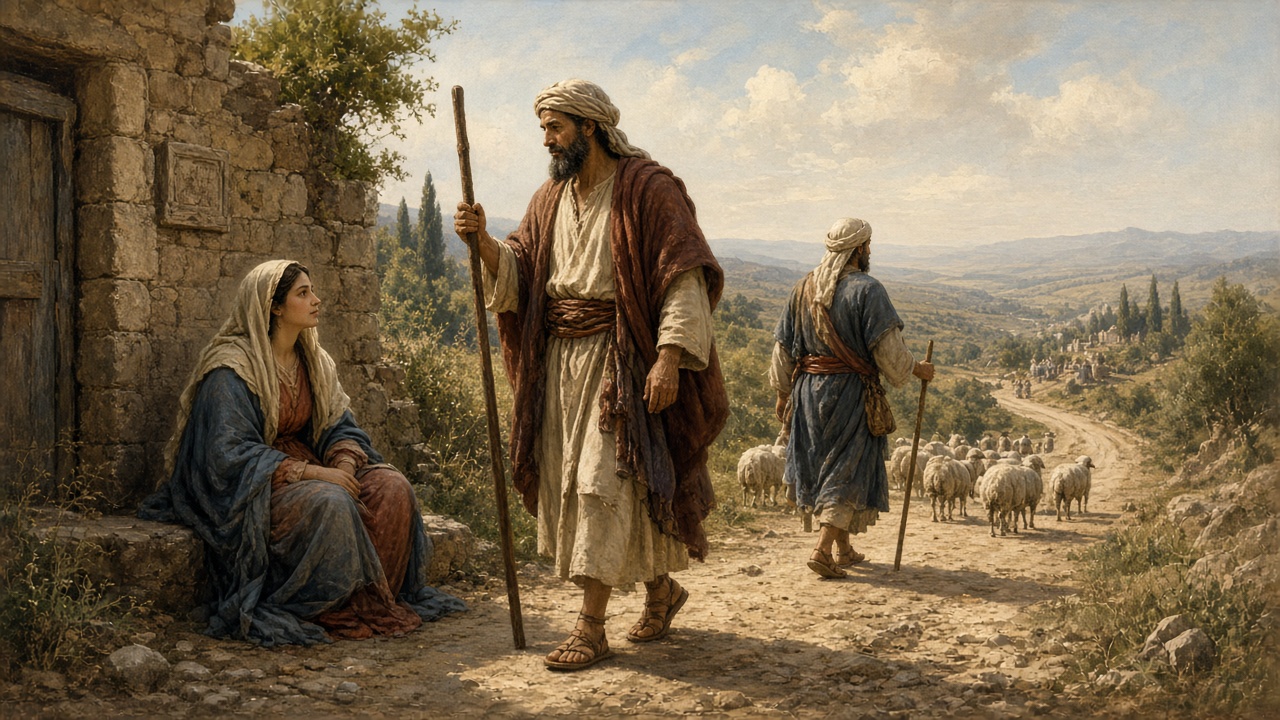
About Judah and Tamar
1At that time Judah left his brothers and went to stay with a man called Hirah who lived in a town called Adullam. They were friends. 2There Judah met a Canaanite girl whose father was called Shua, and he married her.
3She had a son and his father named him Er. 4Later she became pregnant again and had another son and named him Onan. 5Later she had another son and named him Shelah. But when the baby was born his father was staying in a place called Achzib.
6When Judah's oldest son Er grew up, his father got a wife for him called Tamar. 7But Er was not a good man, he kept on doing evil things. Yahweh did not like what he was doing and so he killed him.
8Then Judah spoke to Er's younger brother Onan. He said, “Now that your brother has died, go to his widow and sleep with her so that you can have children for him. Then you can bring them up for him.”
9But Onan said to himself, “If I have children with this widow they won't be mine. They will belong to my dead brother.” So when he went and slept with her he didn't want to have his brother's children, and he let his semen spill on the ground and he didn't make Tamar pregnant.
10But Yahweh didn't like what he had done and so he killed Onan too in the same way he had killed his older brother Er. 11So now Judah had only one son left alive, and he was afraid that Shelah would be killed like his two brothers.
So he said to his daughter-in-law Tamar, “Go back to your father's house and stay there as a widow. Then when my youngest son Shelah grows up you can marry him.” So Tamar went back alone to her father's house.
12After some time Judah's wife also died and he was very sad and stayed at home. When he was ready to go out again, Judah decided to go to a place called Timnah because his sheep were there. So he went there with his friend Hirah.
13Someone said to Tamar, “Your father-in-law is coming to Timnah to cut the wool from his sheep.”
14Tamar knew that Judah's youngest son Shelah had grown up now. But Judah had still not given him to her as her husband. He had not kept his promise. Tamar was still wearing her widow's clothes. So she took them off and put on other clothes and covered her face with some material. Then she went to a place called Enaim and sat down near the gate. Enaim was on the road that went to Timnah.
15Later Judah saw her there and thought she was a woman who slept with other men because she had covered her face. Those kinds of women used to cover their faces. 16So Judah didn't know it was his daughter-in-law Tamar.
He went over to her at the side of the road and said, “Come on, how much money do you want?”
She said, “What will you give me?”
17He answered, “I will send you a young goat afterwards.”
“Yes,” she said, “but give me something of yours now to keep until you give me the goat, so that you don't forget.”
18He asked, “What can I lend you?”
She said, “That cord of yours with your name and the walking stick you are carrying.” So he gave them to her and they slept together and he made her pregnant. 19Then Tamar went home and uncovered her face and put on her widow's clothes again.
20Judah gave a young goat to his friend Hirah. He said, “Take this to that woman and get that stick and the cord with my name that I gave her.” Hirah went to Enaim but he couldn't find the woman.
21He asked some men there, “Where is that bad woman who was sitting at the side of the road?”
They answered, “There have never been any women who sleep with other men in this place. And there aren't any here today.”
22Judah's friend went back to him and said, “I couldn't find her. The men there told me that there are no bad women in that place.”
23Judah said, “Let her keep the things. We don't want people to laugh at us. I wanted to give her the goat but you couldn't find her.”
24Three months later someone said to Judah, “Your daughter-in-law has been sleeping around and now she is pregnant.”
Judah said to them, “Take her away and burn her to death.”
25They were taking her away to burn her, but on the way she sent the things to her father-in-law. And she sent him a message saying, “I am pregnant today, but just look at these two things. Who do you think they belong to? The man who made me pregnant gave them to me.”
26When Judah saw the things he said, “They are mine. I didn't give her my son Shelah. I should have given my son to her and I didn't do it. It is my fault and not hers.” And Judah never slept with Tamar again.
27The time came for Tamar to give birth, but she had two babies. 28While she was in labour one of them put out an arm. The woman who was helping Tamar caught it and tied some red cotton round it so that she would know that it was the first. She said, “This one was born first.”
29But the baby pulled his arm back and the other one was born first. The woman said to him, “You have got out by yourself!” So he was named Perez, because Perez means “he got out by himself.”
30Then his younger brother with the red cotton was born and he was named Zerah, because Zerah means “red.”
¿Sabías que…?
Judá y Tamar
- Poco después de que José fue vendido a los ismaelitas, Judá dejó a sus hermanos y se estableció cerca de Hira, un adulamita, y se casó con la hija de Súa, un cananeo. Ella le dio a Er, Onán y Sela; Sela nació en Quezib, cuyo nombre significa engañoso y probablemente es el mismo lugar que Aczib.Fuentes: Judah (patriarch) · Shuah · Chezib · el propio texto bíblico
- Judá tomó a Tamar como esposa para su primogénito, Er. Después de que Er murió, le dijo a Onán que se acostara con ella, cumpliera el deber de cuñado y levantara descendencia para Er, pero Onán derramaba su semilla en la tierra para que el hijo no le perteneciera. El Diccionario Bíblico de Easton (1897) compara ese episodio con Deuteronomio 25:5 y Mateo 22:24; Onán murió antes de que la familia de Jacob bajara a Egipto, y Judá nunca entregó a Tamar a Sela, como había prometido.Fuentes: Tamar · Onan · el propio texto bíblico
- Después de que murió la hija de Súa, Judá y su amigo Hira subieron adonde sus esquiladores en Timnat, lugar que el Diccionario Bíblico de Easton (1897) describe como una ciudad de Judá a unas veinte millas al oeste de Jerusalén. Tamar se cubrió el rostro con un velo y esperó en Enaim, en el camino a Timnat —probablemente Enam, una ciudad de la llanura o Sefelá—, y Judá pensó que era una prostituta porque tenía el rostro cubierto. Más tarde dio a luz gemelos, y el niño que se abrió paso primero recibió el nombre de Fares, nombre que significa brecha.Fuentes: Timnah · Enaim · Pharez · el propio texto bíblico
Notas escritas con ayuda de IA a partir de fuentes abiertas (Theographic Bible Metadata, CC BY-SA 4.0; Easton’s Bible Dictionary, dominio público) y revisadas antes de publicarse.
Créditos y licencia de esta traducción
Anindilyakwa English Bible
Portions of the Holy Bible in English easy for Anindilyakwa speakers in Australia to understand.
Copyright © 2021 Bible Society Australia
Language: English
This translation is made available to you under the terms of the
Creative Commons Attribution-Noncommercial-No Derivatives license 4.0.
You may share and redistribute this Bible translation or extracts from it in any format, provided that:
You include the above copyright and source information.
You do not sell this work for a profit.
You do not change any of the words or punctuation of the Scriptures.
Pictures included with Scriptures and other documents on this site are licensed just for use with those Scriptures and documents.
For other uses, please contact the respective copyright owners.
2021-11-23
Fuente: http://ebible.org/engaoi/ · eBible.org