Números 21
Wycliffe Bible · Toca un versículo para ver sus referencias cruzadas.
The Defeat of Arad
1And whanne Chananei, the kyng of Arad, that dwellide at the south, hadde herd this, that is, that Israel cam bi the weye of aspieris, he fauyt ayens hem; and Chananei was ouercomere and ledde pray of Israel. 2And Israel bounde hym sylf bi avow to the Lord, and seide, If thou schalt bitake this puple in myn hond, Y schal do awei `the citees therof. 3And the Lord herde the preieris of Israel, and bitook the Chananey; and Israel killid hym, and distruyede hise citees; and clepide the name of that place Horma, that is, cursyng, `ethir hangyng up.
The Bronze Serpent
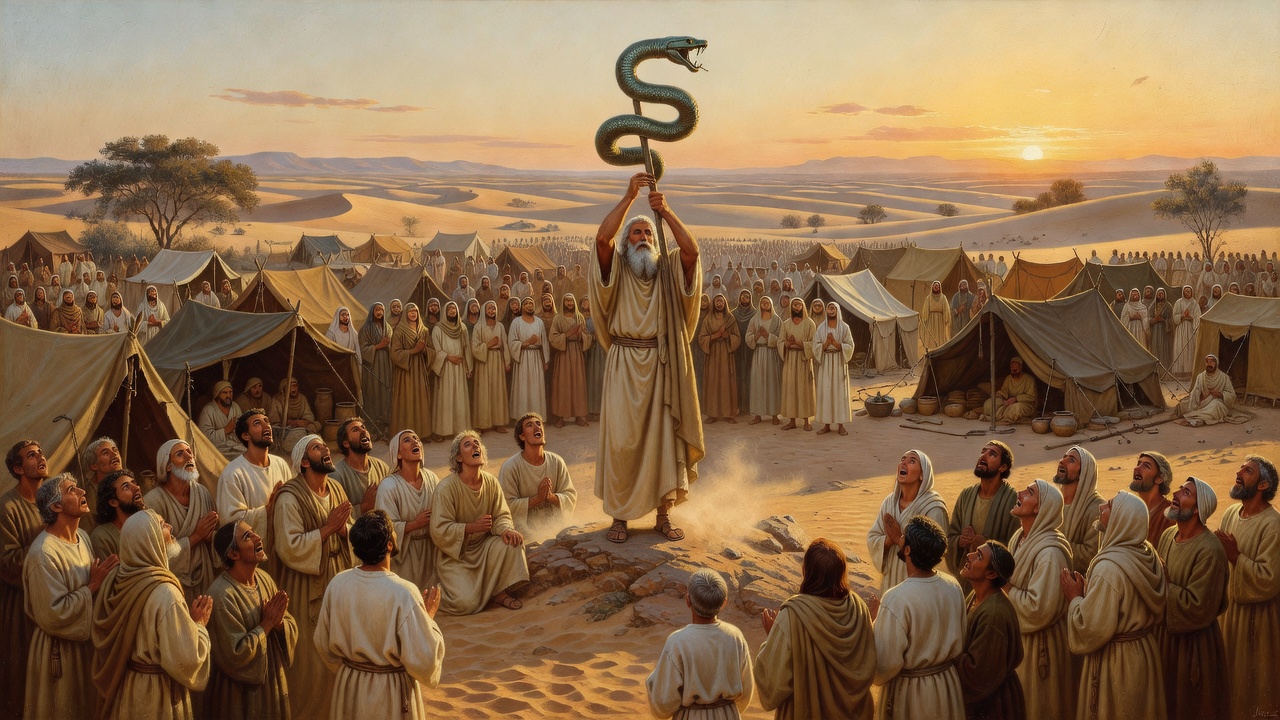
4`Forsothe thei yeden forth also fro the hil of Hor, bi the weie that ledith to the reed see, that thei schulden cumpasse the lond of Edom; and it bigan to anoye the puple, of the weie and trauel. 5And the puple spak ayens the Lord and Moises, and seide, Whi leddist thou vs out of Egipt, that we schulden die in wildirnesse? breed failith, watris ben not; oure soule wlatith now on this `meete moost liyt. 6Wherfor the Lord sente `firid serpentis in to the puple; at the woundis of whiche serpentis, and the dethis of ful many men, 7thei camen to Moyses, and seiden, We synneden, for we spaken ayens the Lord and thee; preie thou, that he take awey fro vs the serpentis. 8And Moises preiede for the puple; and the Lord seide to hym, Make thou a serpent of bras, and sette thou it for a signe ; he that is smytun and biholdith it, schal lyue. 9Therfor Moyses made a serpent of bras, and settide for a signe; and men smytun and biholdynge it, weren heelid.
The Journey to Moab
10And the sones of Israel yeden forth, 11and settiden tentis in Oboth; fro whennus thei yeden forth, and settiden tentis in Neabarym, in the wildirnesse, that biholdith Moab, ayens the eest coost. 12And thei moueden fro thennus, and camen to the stronde of Zareth; 13which thei leften, and settiden tentis ayens Arnon, which is in the deseert, and apperith in the coostis of Amorrei. Forsothe Arnon is the terme of Moab, and departith Moabitis and Ammoreis. 14Wherfor it is seid in the book of batels of the Lord, As he dide in the reed see, so he schal do in the strondis of Arnon; 15the harde rochis of the strondis weren bowid, that tho schulen reste in Arnon, and schulden ligge in the coostis of Moabitis. 16Fro that place the pit apperide, of which the Lord spak to Moyses, Gadere thou the puple, and Y schal yyue watir to it. 17Thanne Israel soong this song, The pit stie; 18thei sungen togidere, The pit which the princes diggiden, and the duykis of the multitude maden redi, in the yyuere of the lawe, and in her stauys. And thei yeden forth fro the wildirnesse to Mathana, 19fro Mathana to Naaliel, fro Naaliel in to Bamoth; 20Bamoth is a valey in the cuntrey of Moab, in the cop of Phasga, that biholdith ayens the deseert.
The Defeat of Sihon
21Forsothe Israel sente messangeris to Seon, kyng of Ammorreis, and seide, 22Y biseche that it be leueful to me to passe thorou thi loond; we schulen not bowe in to the feeldis and vyneris; we schulen not drynke watris of pittis; we schulen go in the kyngis weie, til we passen thi termes. 23Which nolde graunte that Israel schulde passe thury hise coostis, but rather, whanne the oost was gaderid, he yede out ayens Israel, in to deseert. And he cam in to Yasa, and fauyt ayens Israel; 24of whom he was smytun in the scharpnesse of swerd, and his lond was weldid fro Arnon `til to Jeboth and `the sones of Amon; for the termes of Amonytis weren holdun bi strong help. 25Therfor Israel took alle `the citees of hym, and dwelliden in the citees of Amorrei, that is, in Esebon, and hise townes. 26The citee of Esebon was Seons, kyng of Ammorei, which Seon fauyt ayens the kyng of Moab, and took al the lond that was of his lordschip, `til to Arnon. 27Therfor it is seid in prouerbe, Come ye in to Esebon, be it bildid, and maad the citee of Seon; 28fier yede out of Esebon, flawme yede out of the citee `ethir greet castel of Seon, and deuouryde Ar of Moabitis, and the dwelleris of the `hiye places of Arnon. 29Moab, wo to thee! thou, puple of Chamos, perischidist; it yaf the sones therof in to fliyt, and the douytris in to caitifte to Seon, kyng of Ammoreis; 30the yok of hem perischide, fro Esebon `til to Dibon; the wery men camen in to Jophe, and `til to Medaba.
The Defeat of Og
31And so Israel dwellide in the lond of Ammorrey. 32And Moises sente men that schulden aspie Jaser, whos `townes thei token, and weldiden the dwelleris. 33And thei turniden hem silf, and stieden bi the weie of Basan. And Og, the kyng of Basan, with al his puple cam ayens hem, to fiyte in Edray. 34And the Lord seide to Moises, Drede thou not hym, for Y haue bitake hym, and al his loond, and puple, in thin hoond; and thou schalt do to hym as thou didist to Seon, kyng of Ammorreis, the dwellere of Esebon. 35Therfor thei smytiden `bothe hym with hise sones and al his puple, `til to deeth; and thei weldiden `the lond of hym.
¿Sabías que…?
La serpiente de bronce y el avance más allá del Arnón
- Cuando los israelitas se impacientaron durante el viaje alrededor de Edom y se quejaron de la falta de comida y agua, aparecieron serpientes venenosas en el campamento. Moisés recibió instrucciones de hacer una serpiente de bronce y colocarla en un asta para que cualquiera que fuera mordido pudiera mirarla y vivir.Fuentes: el propio texto bíblico
- Este capítulo cita una antigua obra hebrea hoy perdida, llamada el Libro de las Batallas de Jehová, para delimitar la frontera a lo largo del río Arnón, que separaba a los moabitas de los amorreos.Fuentes: el propio texto bíblico · Arnon
- El pasaje incluye un poema antiguo que menciona a Quemos, la deidad adorada por los moabitas. El poema relata cómo Sehón, rey de los amorreos, había conquistado previamente tierras moabitas desde Hesbón hasta el Arnón antes de que Israel lo derrotara en batalla.Fuentes: el propio texto bíblico · Chemosh · Sihon · Heshbon
Notas escritas con ayuda de IA a partir de fuentes abiertas (Theographic Bible Metadata, CC BY-SA 4.0; Easton’s Bible Dictionary, dominio público) y revisadas antes de publicarse.
Lugares de este capítulo
- Negeb · 31.245, 34.841 · versículo 1
- Edom · 30.746, 35.604 · versículo 4
- Way of the Red Sea · Hoy: road between the Dead Sea and the Gulf of Aqaba · 29.727, 34.998 · versículo 4
- Egypt · 30.129, 31.308 · versículo 5
- Moab · Hoy: Moab 1 · 31.181, 35.701 · versículos 11, 13, 15, 20, 26, 28, 29
- Valley of Zered · Hoy: Wadi al Hasa · 31.027, 35.485 · versículo 12
- Arnon · Hoy: Wadi Mujib · 31.466, 35.573 · versículos 13, 14, 24, 26, 28
- Waheb · Hoy: within 50 km of Sufeh · 31.666, 35.817 · versículo 14
- Jeshimon · 31.470, 35.223 · versículo 20
- King’s Highway · 31.955, 35.934 · versículo 22
- Ammon · 31.955, 35.934 · versículo 24
- Jabbok · Hoy: Zarqa River · 32.115, 35.543 · versículo 24
- Dibon · Hoy: Tall Dhiban · 31.502, 35.777 · versículo 30
- Medeba · Hoy: Madaba · 31.716, 35.795 · versículo 30
- Bashan · 32.781, 35.935 · versículo 33
Solo aparecen lugares identificados con alta confianza (90 % o más según las fuentes académicas reunidas por OpenBible). Mapa de la época: DARE (Digital Atlas of the Roman Empire), CC BY 4.0; mapa actual: © colaboradores de OpenStreetMap; lugares: OpenBible.info (CC BY 4.0).
Créditos y licencia de esta traducción
Wycliffe Bible
This is the Pentateuch and Gospels from The Holy Bible, containing the Old and New Testaments, with the apocryphal books, in the earliest English version made from the latin Vulgate by John Wycliffe and his followers. c.1395
Public Domain
Language: Middle English (English)
Dialect: Middle
Translation by: John Wycliffe
2016-11-08
Títulos de sección adaptados de la Berean Standard Bible (dominio público); no forman parte del texto bíblico de esta traducción.
Fuente: http://ebible.org/engWycliffe/ · eBible.org