Marcos 12
Wycliffe Bible · Toca un versículo para ver sus referencias cruzadas.
The Parable of the Wicked Tenants
1And Jhesus bigan to speke to hem in parablis. A man plauntide a vynyerd, and sette an hegge aboute it, and dalf a lake, and bildide a toure, and hiryde it to tilieris, and wente forth in pilgrimage. 2And he sente to the erthe tilieris in tyme a seruaunt, to resseyue of the erthe tilieris of the fruyt of the vynyerd. 3And thei token hym, and beeten, and leften hym voide. 4And eftsoone he sente to hem anothir seruaunt, and thei woundiden hym in the heed, and turmentiden hym. 5And eftsoone he sente another, and thei slowen hym, and othir mo, betynge summe, and sleynge othere. 6But yit he hadde a moost derworth sone, and he sente hym last to hem, and seide, Perauenture thei schulen drede my sone. 7But the erthetilieris seiden togidere, This is the eire; come ye, sle we hym, and the eritage schal be ourun. 8And thei tokun hym, and killiden, and castiden out without the vynyerd. 9Thanne what schal the lord of the vynyerd do? He schal come, and lese the tilieris, and yyue the vynyerd to othere. 10Whether ye han not red this scripture, The stoon which the bilderis han disspisid, this is maad in to the heed of the corner? 11This thing is doon of the Lord, and is wondirful in oure iyen. 12And thei souyten to holde hym, and thei dredden the puple; for thei knewen that to hem he seide this parable; and thei leften hym,
Paying Taxes to Caesar
13and thei wenten awei. And thei senten to hym summe of the Farisees and Erodians, to take hym in word. 14Whiche camen, and seien to hym, Maistir, we witen that thou art sothfast, and reckist not of ony man; for nethir thou biholdist in to the face of man, but thou techist the weie of God in treuthe. Is it leeueful that tribute be youun to the emperoure, or we schulen not yyue? 15Which witynge her pryuei falsnesse, seide to hem, What tempten ye me? brynge ye to me a peny, that Y se. 16And thei brouyten to hym. And he seide to hem, Whos is this ymage, and the writyng? Thei seien to him, The emperouris. 17And Jhesus answeride and seide to hem, Thanne yelde ye to the emperour tho thingis that ben of the emperours; and to God tho thingis that ben of God.
The Sadducees and the Resurrection
18And thei wondriden of hym. And Saduces, that seien that ther is no ressurreccioun, camen to hym, and axeden hym, 19and seiden, Maister, Moyses wroot to vs, that if the brother of a man were deed, and lefte his wijf, and haue no sones, his brother take his wijf, and reise vp seed to his brother. 20Thanne seuene britheren ther weren; and the firste took a wijf, and diede, and lefte no seed. 21And the secounde took hir, and he diede, and nether this lefte seed. 22And the thridde also. And in lijk manere the seuene token hir, and leften not seed. And the womman the laste of alle `is deed. 23Thanne in the resurreccioun, whanne thei schulen rise ayen, whos wijf of these schal sche be? for seuene hadden hir to wijf. 24And Jhesus answeride, and seide to hem, Whether ye erren not therfor, that ye knowe not scripturis, nethir the vertu of God? 25For whanne thei schulen rise ayen fro deeth, nether thei schulen wedde, nethir schulen be weddid, but thei schulen be as aungels of God in heuenes. 26And of deed men, that thei risen ayen, han ye not red in the book of Moises, on the buysch, hou God spak to hym, and seide, Y am God of Abraham, and God of Isaac, and God of Jacob? 27He is not God of deed men, but of lyuynge men; therfor ye erren myche.
The Greatest Commandment
28And oon of the scribis, that hadde herde hem dispuytynge togidir, cam nyy, and saiy that Jhesus had wel answeride hem, and axide hym, which was the firste maundement of alle. 29And Jhesus answeride to him, that the firste maundement of alle is, Here thou, Israel, thi Lord God is o God; 30and thou schalt loue thi Lord God of al thin herte, and of al thi soule, and of al thi mynde, and of al thi myyt. 31This is the firste maundement. And the secounde is lijk to this, Thou schalt loue thi neiybore as thi silf. Ther is noon other maundement gretter than these. 32And the scribe seide to hym, Maister, in treuthe thou hast wel seid; for o God is, and ther is noon other, outakun hym; 33that he be loued of al the herte, and of al the mynde, and of al the vndurstondynge, and of al the soule, and of al strengthe, and to loue the neiybore as hym silf, is gretter than alle brent offryngis and sacrifices. 34And Jhesus seynge that he hadde answerid wiseli, seide to hym, Thou art not fer fro the kyngdom of God.
Whose Son Is the Christ?
35And thanne no man durste axe hym no more ony thing. And Jhesus answeride and seide, techynge in the temple, Hou seien scribis, that Crist is the sone of Dauid? 36For Dauid hym silf seide in the Hooli Goost, the Lord seide to my lord, Sitte on my riythalf, til Y putte thin enemyes the stool of thi feet. 37Thanne Dauid hym silf clepith him lord, hou thanne is he his sone? And myche puple gladli herde hym.
Beware of the Scribes
38And he seide to hem in his techyng, Be ye war of scribis, that wolen wandre in stolis, 39and be salutid in chepyng, and sitte in synagogis in the firste chaieris, and the firste sittyng placis in soperis; 40whiche deuouren the housis of widewis vndur colour of long preier; thei schulen take the longer doom.
The Widow’s Offering
41And Jhesus sittynge ayens the tresorie, bihelde hou the puple castide monei in to the tresorie; and many riche men castiden many thingis. 42But whanne a pore widewe was comun, sche keste two mynutis, that is, a ferthing. 43And he clepide togidere hise disciplis, and seide to hem, Treuli Y seie to you, that this pore widewe keste more thanne alle, that kesten in to the tresorie. 44For alle kesten of that thing that thei hadden plente of; but this of her pouert keste alle thingis that sche hadde, al hir lyuelode.
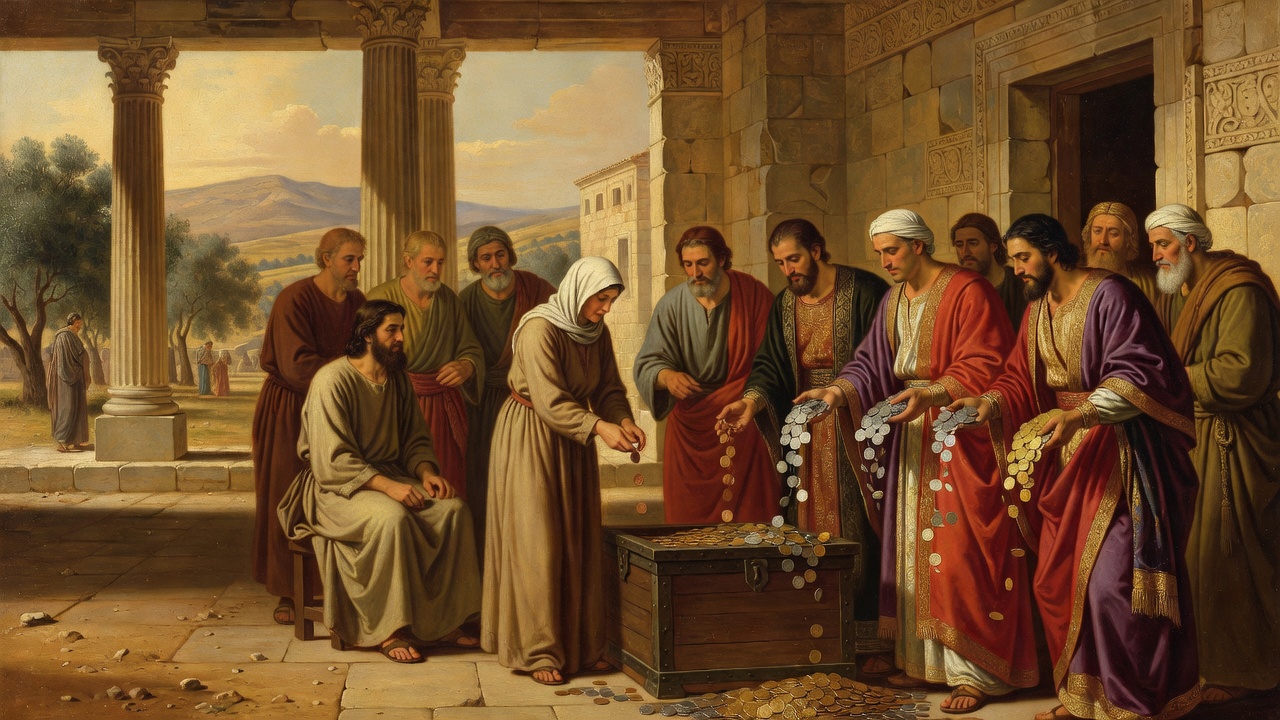
¿Sabías que…?
Debates en el templo
- Los saduceos, que dicen que no hay resurrección, interrogan a Jesús sobre siete hermanos y una viuda, apelando a lo que escribió Moisés. Él los remite a la zarza ardiente en el Libro de Moisés, donde Dios dice: “Yo soy el Dios de Abraham, el Dios de Isaac y el Dios de Jacob”. Abraham, “padre de una multitud”, era hijo de Taré; Isaac era el único hijo de Abraham con Sara; y Jacob era el segundo de los hijos gemelos de Isaac y Rebeca.Fuentes: el propio texto bíblico · Abraham · Isaac · Jacob (Israel)
- Cuando le preguntan cuál es el mandamiento más importante, Jesús comienza: “Oye, Israel, el Señor nuestro Dios, el Señor es uno”, y añade: “Ama a tu prójimo como a ti mismo”. Israel es otro nombre de Jacob, el segundo de los gemelos de Isaac y Rebeca; el nombre Jacob se explica como el que sigue los talones de otro, o suplantador.Fuentes: el propio texto bíblico · Jacob (Israel)
- Mientras enseña en los atrios del templo, Jesús pregunta cómo pueden decir los escribas que el Cristo es el Hijo de David, si el propio David lo llama “Señor”. David, cuyo nombre significa “Amado”, era el octavo y el menor de los hijos de Isaí, ciudadano de Belén, y su primera ocupación fue cuidar las ovejas de su padre en las tierras altas de Judá.Fuentes: el propio texto bíblico · David
Notas escritas con ayuda de IA a partir de fuentes abiertas (Theographic Bible Metadata, CC BY-SA 4.0; Easton’s Bible Dictionary, dominio público) y revisadas antes de publicarse.
Créditos y licencia de esta traducción
Wycliffe Bible
This is the Pentateuch and Gospels from The Holy Bible, containing the Old and New Testaments, with the apocryphal books, in the earliest English version made from the latin Vulgate by John Wycliffe and his followers. c.1395
Public Domain
Language: Middle English (English)
Dialect: Middle
Translation by: John Wycliffe
2016-11-08
Títulos de sección adaptados de la Berean Standard Bible (dominio público); no forman parte del texto bíblico de esta traducción.
Fuente: http://ebible.org/engWycliffe/ · eBible.org