Mateo 2
Wycliffe Bible · Toca un versículo para ver sus referencias cruzadas.
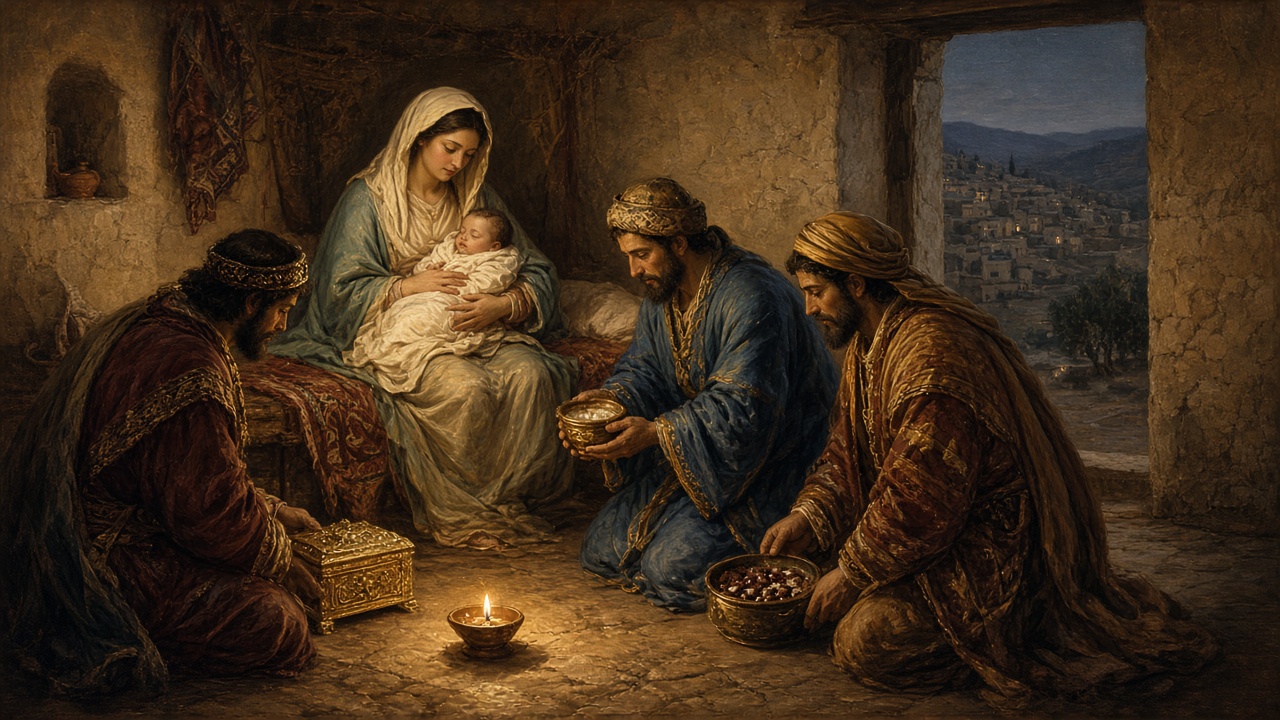
The Pilgrimage of the Magi
1Therfor whanne Jhesus was borun in Bethleem of Juda, in the daies of king Eroude, lo! astromyenes camen fro the eest to Jerusalem, 2and seiden, Where is he, that is borun king of Jewis? for we han seyn his sterre in the eest, and we comen to worschipe him. 3But king Eroude herde, and was trublid, and al Jerusalem with hym. 4And he gaderide to gidre alle the prynces of prestis, and scribis of the puple, and enqueride of hem, where Crist shulde be borun. 5And thei seiden to hym, In Bethleem of Juda; for so it is writun bi a profete, 6And thou, Bethleem, the lond of Juda, art not the leest among the prynces of Juda; for of thee a duyk schal go out, that schal gouerne my puple of Israel. 7Thanne Eroude clepide pryueli the astromyens, and lernyde bisili of hem the tyme of the sterre that apperide to hem. 8And he sente hem in to Bethleem, and seide, Go ye, and axe ye bisili of the child, and whanne yee han foundun, telle ye it to me, that Y also come, and worschipe hym. 9And whanne thei hadden herd the kyng, thei wenten forth. And lo! the sterre, that thei siyen in the eest, wente bifore hem, til it cam, and stood aboue, where the child was. 10And thei siyen the sterre, and ioyeden with a ful greet ioye. 11And thei entriden in to the hous, and founden the child with Marie, his modir; and thei felden doun, and worschipiden him. And whanne thei hadden openyd her tresouris, thei offryden to hym yiftis, gold, encense, and myrre. 12And whanne thei hadden take an aunswere in sleep, that thei schulden not turne ayen to Eroude, thei turneden ayen bi anothir weie in to her cuntrey.
The Flight to Egypt
13And whanne thei weren goon, lo! the aungel of the Lord apperide to Joseph in sleep, and seide, Rise vp, and take the child and his modir, and fle in to Egipt, and be thou there, til that I seie to thee; for it is to come, that Eroude seke the child, to destrie hym. 14And Joseph roos, and took the child and his modir bi nyyt, and wente in to Egipt, 15and he was there to the deeth of Eroude; that it schulde be fulfillid, that was seid of the Lord bi the profete, seiynge, Fro Egipt Y haue clepid my sone.
Weeping and Great Mourning
16Thanne Eroude seynge that he was disseyued of the astromyens, was ful wrooth; and he sente, and slowe alle the children, that weren in Bethleem, and in alle the coostis therof, fro two yeer age and with inne, aftir the tyme that he had enquerid of the astromyens. 17Thanne `it was fulfillid, that was seid bi Jeremye, the profete, 18seiynge, A vois was herd an hiy, wepynge and moche weilyng, Rachel biwepynge hir sones, and she wolde not be coumfortid, for thei ben noyt.
The Return to Nazareth
19But whanne Eroude was deed, loo! the aungel of the Lord apperide to Joseph in sleep in Egipt, 20and seide, Ryse vp, and take the child and his modir, and go in to the lond of Israel; for thei that souyten the lijf of the chijld ben deed. 21Joseph roos, and took the child and his modir, and cam in to the loond of Israel. 22And he herde that Archilaus regnede in Judee for Eroude, his fadir, and dredde to go thidir. And he was warned in sleep, and wente in to the parties of Galilee; 23and cam, and dwelte in a citee, that ys clepid Nazareth, that it shulde be fulfillid, that was seid bi profetis, For he shal be clepid a Nazarey.
¿Sabías que…?
Magos, Herodes y Nazaret
- El rey Herodes de este capítulo es Herodes el Grande. Su hijo Arquelao, habido con Malthace, una mujer samaritana, heredó la tercera parte del reino: Idumea, Judea y Samaria. Hasta pocos días antes de la muerte de Herodes, otro hijo, Antipas, había sido nombrado sucesor, pero en sus últimos momentos Herodes nombró a Arquelao; por temor a él, José se apartó de Judea y se retiró a Galilea.Fuentes: Archelaus · el propio texto bíblico
- Mateo relaciona la muerte de los niños en Belén con palabras pronunciadas por el profeta Jeremías: una voz en Ramá, Raquel llorando por sus hijos. Raquel, una de las esposas de Jacob, murió al dar a luz a Benjamín y fue sepultada junto al camino de Efrata, es decir, Belén, justo al norte de la ciudad. Su sepulcro es objeto de gran veneración entre los judíos.Fuentes: el propio texto bíblico · Rachel · Bethlehem
- Belén, en la región montañosa de Judá, se llamaba antes Efrata y también era conocida como la ciudad de David; bajo los romanos quedaba en Judea, la más meridional de las tres divisiones de Palestina. José y María fueron en cambio a Nazaret, en Galilea, su hogar, un pueblo que no se menciona en el Antiguo Testamento. En general se supone que el nombre Nazaret proviene del hebreo netser, un renuevo o brote, aunque algunos lo relacionan con una palabra que significa guardar o vigilar.Fuentes: Bethlehem · Judea · Nazareth · el propio texto bíblico
Notas escritas con ayuda de IA a partir de fuentes abiertas (Theographic Bible Metadata, CC BY-SA 4.0; Easton’s Bible Dictionary, dominio público) y revisadas antes de publicarse.
Lugares de este capítulo
- Bethlehem · 31.704, 35.208 · versículos 1, 5, 6, 8, 9, 16
- East · Hoy: region around Amman · 31.955, 35.934 · versículos 1, 2, 9
- Jerusalem · 31.777, 35.234 · versículos 1, 3
- Judea · Hoy: Judea 1 · 31.777, 35.234 · versículos 1, 5, 22
- Egypt · 30.129, 31.308 · versículos 13, 14, 15, 19
- Galilee · 32.760, 35.527 · versículo 22
- Nazareth · 32.702, 35.298 · versículo 23
Solo aparecen lugares identificados con alta confianza (90 % o más según las fuentes académicas reunidas por OpenBible). Mapa de la época: DARE (Digital Atlas of the Roman Empire), CC BY 4.0; mapa actual: © colaboradores de OpenStreetMap; lugares: OpenBible.info (CC BY 4.0).
Créditos y licencia de esta traducción
Wycliffe Bible
This is the Pentateuch and Gospels from The Holy Bible, containing the Old and New Testaments, with the apocryphal books, in the earliest English version made from the latin Vulgate by John Wycliffe and his followers. c.1395
Public Domain
Language: Middle English (English)
Dialect: Middle
Translation by: John Wycliffe
2016-11-08
Títulos de sección adaptados de la Berean Standard Bible (dominio público); no forman parte del texto bíblico de esta traducción.
Fuente: http://ebible.org/engWycliffe/ · eBible.org