Juan 6
Wycliffe Bible · Toca un versículo para ver sus referencias cruzadas.
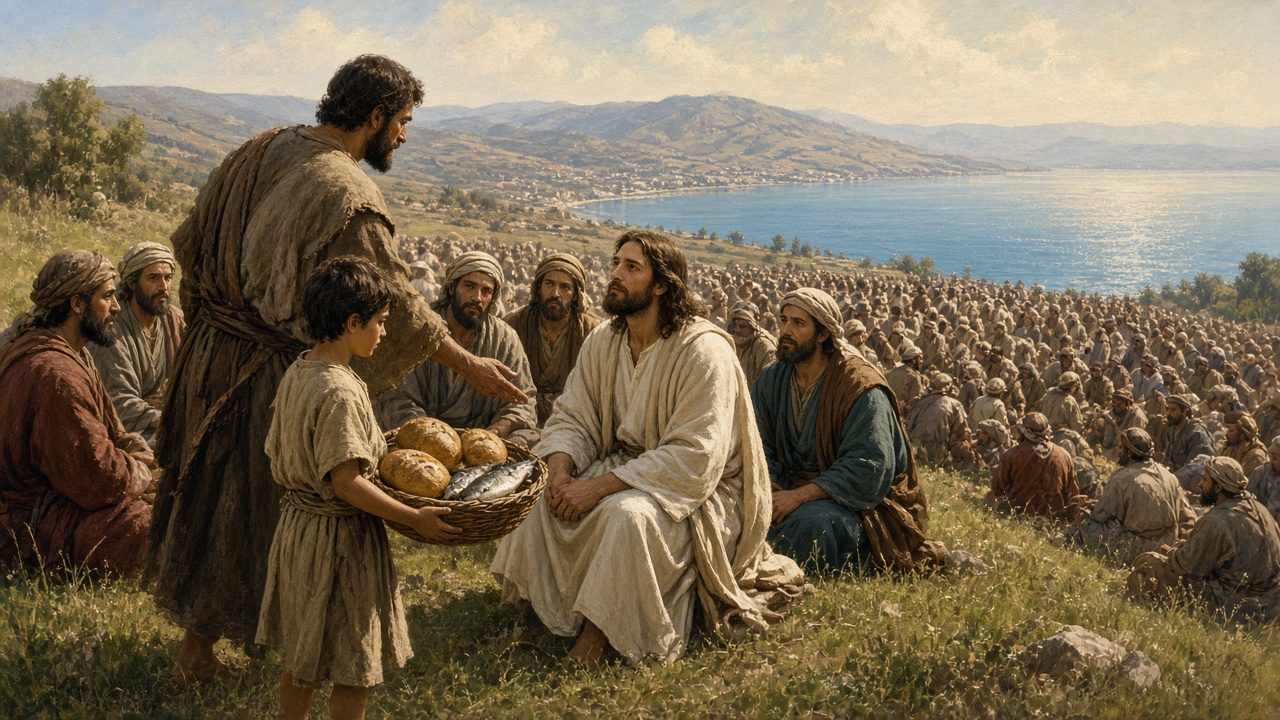
The Feeding of the Five Thousand
1Aftir these thingis Jhesus wente ouere the see of Galilee, that is Tiberias. 2And a greet multitude suede hym; for thei sayn the tokenes, that he dide on hem that weren sijke. 3Therfor Jhesus wente in to an hil, and sat there with hise disciplis. 4And the paske was ful niy, a feeste dai of the Jewis. 5Therfor whanne Jhesus hadde lift vp hise iyen, and hadde seyn, that a greet multitude cam to hym, he seith to Filip, Wherof schulen we bie looues, that these men ete? 6But he seide this thing, temptynge hym; for he wiste what he was to do. 7Filip answerde to hym, The looues of tweyn hundrid pans sufficen not to hem, that ech man take a litil what. 8Oon of hise disciplis, Andrew, the brothir of Symount Petre, 9seith to him, A child is here, that hath fyue barli looues and twei fischis; but what ben these among so manye? 10Therfor Jhesus seith, Make ye hem sitte to the mete. And there was myche hey in the place. And so men saten to the mete, as `fyue thousynde in noumbre. 11And Jhesus took fyue looues, and whanne he hadde do thankyngis, he departide to men that saten to the mete, and also of the fischis, as myche as thei wolden. 12And whanne thei weren fillid, he seide to hise disciplis, Gadir ye the relifs that ben left, that thei perischen not. 13And so thei gadriden, and filliden twelue cofyns of relif of the fyue barli looues and twei fischis, that lefte to hem that hadden etun. 14Therfor tho men, whanne thei hadden seyn the signe that he hadde don, seiden, For this is verili the profete, that is to come in to the world. 15And whanne Jhesus hadde knowun, that thei weren to come to take hym, and make hym kyng, he fleiy `aloone eft in to an hille.
Jesus Walks on Water
16And whanne euentid was comun, his disciplis wenten doun to the see. 17And thei wenten vp in to a boot, and thei camen ouer the see in to Cafarnaum. And derknessis weren maad thanne, and Jhesus was not come to hem. 18And for a greet wynde blew, the see roos vp. 19Therfor whanne thei hadden rowid as fyue and twenti furlongis or thretti, thei seen Jhesus walkynge on the see, and to be neiy the boot; and thei dredden. 20And he seide to hem, Y am; nyle ye drede. 21Therfor thei wolden take hym in to the boot, and anoon the boot was at the loond, to which thei wenten.
Jesus the Bread of Life
22On `the tother dai the puple, that stood ouer the see, say, that ther was noon other boot there but oon, and that Jhesu entride not with hise disciplis in to the boot, but hise disciplis aloone wenten. 23But othere bootis camen fro Tiberias bisidis the place, where thei hadden eetun breed, and diden thankyngis to God. 24Therfor whanne the puple hadde seyn, that Jhesu was not there, nether hise disciplis, thei wenten vp in to bootis, and camen to Cafarnaum, sekynge Jhesu. 25And whanne thei hadden foundun hym ouer the see, thei seiden to hym, Rabi, hou come thou hidur? 26Jhesus answerde to hem, and seide, Treuli, treuli, Y seie to you, ye seken me, not for ye sayn the myraclis, but for ye eten of looues, and weren fillid. 27Worche ye not mete that perischith, but that dwellith in to euerlastynge lijf, which mete mannys sone schal yyue to you; for God the fadir hath markid hym. 28Therfor thei seiden to hym, What schulen we do, that we worche the werkis of God? 29Jhesus answerde, and seide to hem, This is the werk of God, that ye bileue to hym, whom he sente. 30Therfor thei seiden to hym, What tokene thanne doist thou, that we seen, and bileue to thee? what worchist thou? 31Oure fadris eeten manna in desert, as it is writun, He yaf to hem breed fro heuene to ete. 32Therfor Jhesus seith to hem, Treuli, treuli, Y seie to you, Moyses yaf you not breed fro heuene, but my fadir yyueth you veri breed fro heuene; 33for it is very breed that cometh doun fro heuene, and yyueth lijf to the world. 34Therfor thei seiden to hym, Lord, euere yyue vs this breed. 35And Jhesus seide to hem, Y am breed of lijf; he that cometh to me, schal not hungur; he that bileueth in me, schal neuere thirste. 36But Y seid to you, that ye han seyn me, and ye bileueden not. 37Al thing, that the fadir yyueth to me, schal come to me; and Y schal not caste hym out, that cometh to me. 38For Y cam doun fro heuene, not that Y do my wille, but the wille of hym that sente me. 39And this is the wille of the fadir that sente me, that al thing that the fadir yaf me, Y leese not of it, but ayen reise it in the laste dai. 40And this is the wille of my fadir that sente me, that ech man that seeth the sone, and bileueth in hym, haue euerlastynge lijf; and Y schal ayen reyse hym in the laste dai. 41Therfor Jewis grutchiden of hym, for he hadde seid, Y am breed that cam doun fro heuene. 42And thei seiden, Whether this is not Jhesus, the sone of Joseph, whos fadir and modir we han knowun. Hou thanne seith this, That Y cam doun fro heuene? 43Therfor Jhesus answerde, and seide to hem, Nyle ye grutche togidere. 44No man may come to me, but if the fadir that sente me, drawe hym; and Y schal ayen reise hym in the laste dai. It is writun in prophetis, 45And alle men schulen be able for to be tauyt `of God. Ech man that herde of the fadir, and hath lerned, cometh to me. 46Not for ony man hath sey the fadir, but this that is of God, hath sey the fadir. 47Sotheli, sotheli, Y seie to you, he that bileueth in me, hath euerlastynge lijf. 48Y am breed of lijf. 49Youre fadris eeten manna in desert, and ben deed. 50This is breed comynge doun fro heuene, that if ony man ete therof, he die not. 51Y am lyuynge breed, that cam doun fro heuene. 52If ony man ete of this breed, he schal lyue withouten ende. And the breed that Y schal yyue, is my fleisch for the lijf of the world. 53Therfor the Jewis chidden togidere, and seiden, Hou may this yyue to vs his fleisch to ete? 54Therfor Jhesus seith to hem, Treuli, treuli, Y seie to you, but ye eten the fleisch of mannus sone, and drenken his blood, ye schulen not haue lijf in you. 55He that etith my fleisch, and drynkith my blood, hath euerlastynge lijf, and Y schal ayen reise hym in the laste dai. 56For my fleisch is veri mete, and my blood is very drynk. 57He that etith my fleisch, and drynkith my blood, dwellith in me, and Y in hym. 58As my fadir lyuynge sente me, and Y lyue for the fadir, and he that etith me, he schal lyue for me.
Many Disciples Turn Back
59This is breed, that cam doun fro heuene. Not as youre fadris eten manna, and ben deed; he that etith this breed, schal lyue withouten ende. 60He seide these thingis in the synagoge, techynge in Cafarnaum. 61Therfor many of hise disciplis herynge, seiden, This word is hard, who may here it? 62But Jhesus witynge at hym silf, that hise disciplis grutchiden of this thing, seide to hem, This thing sclaundrith you? 63Therfor if ye seen mannus sone stiynge, where he was bifor? 64It is the spirit that quykeneth, the fleisch profitith no thing; the wordis that Y haue spokun to you, ben spirit and lijf. 65But ther ben summe of you that bileuen not. For Jhesus wiste fro the bigynnynge, which weren bileuynge, and who was to bitraye hym. 66And he seide, Therfor Y seide to you, that no man may come to me, but it were youun to hym of my fadir.
Peter’s Confession of Faith
67Fro this tyme many of hise disciplis wenten abak, and wenten not now with hym. 68Therfor Jhesus seide to the twelue, Whether ye wolen also go awei? 69And Symount Petre answeride to hym, Lord, to whom schulen we gon? Thou hast wordis of euerlastynge lijf; 70and we bileuen, and han knowun, that thou art Crist, the sone of God. 71Therfor Jhesus answerde to hem, Whether Y chees not you twelue, and oon of you is a feend? And he seide this of Judas of Symount Scarioth, for this was to bitraye hym, whanne he was oon of the twelue.
¿Sabías que…?
El pan de vida
- En este capítulo, Juan llama al lago Mar de Galilea y también Mar de Tiberíades. El Diccionario Bíblico de Easton lo describe con doce millas y media de largo y de cuatro a siete millas y media de ancho, con la superficie a 682 pies bajo el Mediterráneo. De Tiberíades, en la orilla occidental, se dice que fue fundada por Herodes Antipas en el año 16 d.C. y que recibió su nombre en honor del emperador Tiberio; algunas barcas de esa ciudad llegaron cerca del lugar donde la gente había comido el pan.Fuentes: el propio texto bíblico · Sea of Galilee · Tiberias
- Esa noche los discípulos salieron en barca rumbo a Capernaúm, y al día siguiente la multitud cruzó y encontró allí a Jesús. Él pronunció la enseñanza sobre el pan de vida en la sinagoga de Capernaúm. El Diccionario Bíblico de Easton señala que la ciudad, no mencionada en el Antiguo Testamento, llegó a ser la propia ciudad de Jesús después de su expulsión de Nazaret y fue escenario de muchos episodios de su ministerio.Fuentes: el propio texto bíblico · Capernaum
- Cuando la multitud se acercaba, Jesús preguntó a Felipe dónde podían comprar pan, una pregunta que el relato dice que era para ponerlo a prueba, pues Jesús ya sabía lo que iba a hacer. Felipe, como Andrés y Pedro, era de Betsaida; respondió que doscientos denarios no alcanzarían para que cada persona recibiera un pedazo pequeño. Andrés, hermano de Pedro, señaló entonces a un muchacho con cinco panes de cebada y dos pescados pequeños, y el Diccionario Bíblico de Easton, al citar ese diálogo entre otros pasajes, dice que Felipe parece haber ocupado un lugar destacado entre los apóstoles.Fuentes: el propio texto bíblico · Phillip the Apostle · Andrew · Simon Peter
Notas escritas con ayuda de IA a partir de fuentes abiertas (Theographic Bible Metadata, CC BY-SA 4.0; Easton’s Bible Dictionary, dominio público) y revisadas antes de publicarse.
Lugares de este capítulo
Solo aparecen lugares identificados con alta confianza (90 % o más según las fuentes académicas reunidas por OpenBible). Mapa de la época: DARE (Digital Atlas of the Roman Empire), CC BY 4.0; mapa actual: © colaboradores de OpenStreetMap; lugares: OpenBible.info (CC BY 4.0).
Créditos y licencia de esta traducción
Wycliffe Bible
This is the Pentateuch and Gospels from The Holy Bible, containing the Old and New Testaments, with the apocryphal books, in the earliest English version made from the latin Vulgate by John Wycliffe and his followers. c.1395
Public Domain
Language: Middle English (English)
Dialect: Middle
Translation by: John Wycliffe
2016-11-08
Títulos de sección adaptados de la Berean Standard Bible (dominio público); no forman parte del texto bíblico de esta traducción.
Fuente: http://ebible.org/engWycliffe/ · eBible.org