Génesis 3
Wycliffe Bible · Toca un versículo para ver sus referencias cruzadas.
The Serpent’s Deception
1But and the serpent was feller than alle lyuynge beestis of erthe, whiche the Lord God hadde maad. Which serpent seide to the womman, Why comaundide God to you, that ye schulden not ete of ech tre of paradis? 2To whom the womman answerde, We eten of the fruyt of trees that ben in paradis; 3sothely God commaundide to vs, that we schulden not eate of the fruyt of the tre, which is in the myddis of paradijs, and that we schulden not touche it, lest perauenture we dien. 4Forsothe the serpent seide to the womman, ye schulen not die bi deeth; 5for whi God woot that in what euere dai ye schulen ete therof, youre iyen schulen be opened, and ye schulen be as Goddis, knowynge good and yuel. 6Therfore the womman seiy that the tre was good, and swete to ete, and fair to the iyen, and delitable in bi holdyng; and sche took of the fruyt therof, and eet, and yaf to hir hosebande, and he eet. 7And the iyen of bothe weren openid; and whanne thei knowen that thei weren nakid, thei sewden the leeues of a fige tre, and maden brechis to hem silf.
God Arraigns Adam and Eve
8And whanne thei herden the vois of the Lord God goynge in paradijs at the wynd after myddai, Adam and his wijf hidden hem fro the face of the Lord God in the middis of the tre of paradijs. 9And the Lord God clepide Adam, and seide to hym, Where art thou? 10And Adam seide, Y herde thi vois in paradijs, and Y drede, for Y was nakid, and Y hidde me. 11To whom the Lord seide, Who forsothe schewide to thee that thou were nakid, no but for thou hast ete of the tre of which Y comaundide to thee that thou schuldist not ete? 12And Adam seide, The womman which thou yauest felowe to me, yaf me of the tre, and Y eet. 13And the Lord seide to the womman, Whi didist thou this thing? Which answerde, The serpent disseyued me, and Y eet.
The Fate of the Serpent
14And the Lord God seide to the serpent, For thou didist this, thou schalt be cursid among alle lyuynge thingis and vnresonable beestis of erthe; thou schalt go on thi brest, and thou schalt ete erthe in alle daies of thi liif; 15Y schal sette enemytees bitwixe thee and the womman, and bitwixe thi seed and hir seed; sche schal breke thin heed, and thou schalt sette aspies to hir heele.
The Punishment of Mankind
16Also God seide to the womman, Y schal multiplie thi wretchidnessis and thi conseyuyngis; in sorewe thou schalt bere thi children; and thou schalt be vndur power of the hosebonde, and he schal be lord of thee. 17Sothely God seyde to Adam, For thou herdist the voys of thi wijf, and hast ete of the tree, of which Y comaundide to thee that thou schuldist not ete, the erthe schal be cursid in thi werk; in traueylis thou schalt ete therof in alle daies of thi lijf; 18it schal brynge forth thornes and breris to thee, and thou schalt ete eerbis of the erthe; 19in swoot of thi cheer thou schalt ete thi breed, til thou turne ayen in to the erthe of which thou art takun; for thou art dust, and thou schalt turne ayen in to dust. 20And Adam clepide the name of his wijf Eue, for sche was the moder of alle men lyuynge.
The Expulsion from Paradise
21And the Lord God made cootis of skynnys to Adam and Eue his wijf, and clothide hem; and seide, Lo! 22Adam is maad as oon of vs, and knowith good and yuel; now therfore se ye, lest perauenture he putte his hond, and take of the tre of lijf, and ete, and lyue with outen ende. 23And the Lord God sente hym out of paradijs of likyng, that he schulde worche the erthe, of which he was takun. 24And God castide out Adam, and settide bifore paradis of lykyng cherubyn, and a swerd of flawme and turnynge aboute to kepe the weie of the tre of lijf.
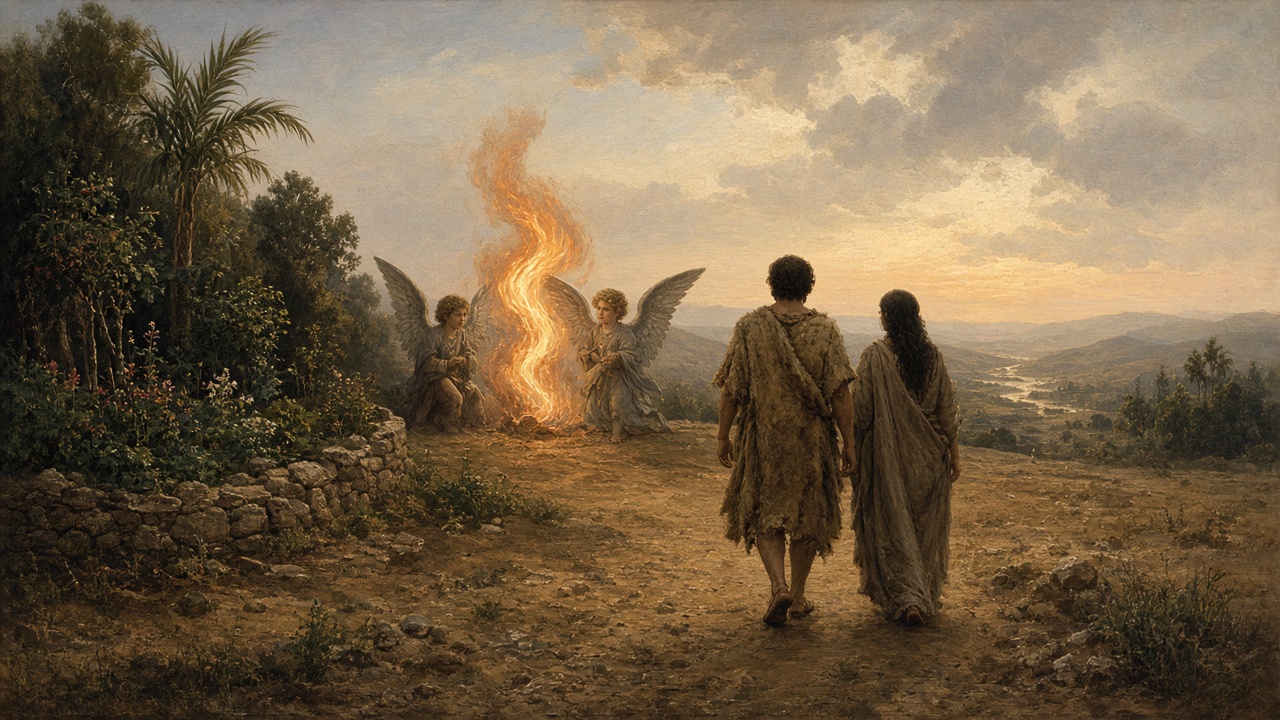
¿Sabías que…?
La caída y el exilio del Edén
- Una referencia tradicional explica Adán como “rojo”, palabra babilónica usada como nombre genérico del hombre, con el mismo sentido en hebreo y en asirio, y relaciona el nombre con el hecho de que fue formado del polvo de la tierra. En este capítulo ese origen reaparece en el juicio: trabajará por su alimento hasta volver al suelo, porque es polvo y al polvo volverá, y es enviado a labrar la tierra de la que fue tomado.Fuentes: Adam · el propio texto bíblico
- En este capítulo Adán da a su mujer el nombre Eva, que significa “vida” o “viviente”, porque ella sería la madre de todos los vivientes.Fuentes: Eve · el propio texto bíblico
- La ubicación del jardín de Edén, del que el hombre es expulsado en este capítulo, se ha discutido mucho: se ha situado en Armenia, al oeste del mar Caspio, en Media, cerca de Damasco, en Palestina, en el sur de Arabia y en Babilonia. Una nota geográfica tradicional lo busca a lo largo del Tigris y el Éufrates, en la tierra de Sinar, o Babilonia.Fuentes: Eden · el propio texto bíblico
Notas escritas con ayuda de IA a partir de fuentes abiertas (Theographic Bible Metadata, CC BY-SA 4.0; Easton’s Bible Dictionary, dominio público) y revisadas antes de publicarse.
Créditos y licencia de esta traducción
Wycliffe Bible
This is the Pentateuch and Gospels from The Holy Bible, containing the Old and New Testaments, with the apocryphal books, in the earliest English version made from the latin Vulgate by John Wycliffe and his followers. c.1395
Public Domain
Language: Middle English (English)
Dialect: Middle
Translation by: John Wycliffe
2016-11-08
Títulos de sección adaptados de la Berean Standard Bible (dominio público); no forman parte del texto bíblico de esta traducción.
Fuente: http://ebible.org/engWycliffe/ · eBible.org