Génesis 14
Wycliffe Bible · Toca un versículo para ver sus referencias cruzadas.
The War of the Kings
1Forsothe it was don in that tyme, that Amrafel, kyng of Sennaar, and Ariok, kyng of Ponte, and Chodorlaomor, kyng of Elemytis, 2and Tadal, kyng of folkis, bigunnen batel ayens Bara, kyng of Sodom, and ayens Bersa, kyng of Gomorre, and ayens Sennaar, kyng of Adama, and ayens Semeber, kyng of Seboym, and ayens the kyng of Bale; thilke Bale is Segor. 3Alle these camen togidre in to the valey of wode, which is now the see of salt. 4For in twelue yeer thei seruyden Chodorlaomor, and in the threttenthe yeer thei departiden fro hym. 5Therfor Chodorlaomor cam in the fourtenthe yeer, and kyngis that weren with him, and thei `han smyte Rafaym in Astaroth Carnaym, and Susym with hem, and Emym in Sabe Cariathaym, 6and Choreis in the hillis of Seir, til to the feldi placis of Faran, which is in wildirnesse. 7And thei turneden ayen, and camen til to the welle Mesphath; thilke is Cades. And thei `han smyte al the cuntre of men of Amalec, and Amorrei, that dwellide in Asason Thamar. 8And the kyng of Sodom, and the king of Gomorre, and the kyng of Adama, and the kyng of Seboym, also and the kyng of Bale, which is Segor, yeden out, and dressiden scheltrun ayens hem in the valei of wode, 9that is, ayens Chodorlaomor, kyng of Elamytis, and Thadal, kyng of folkis, and Amrafel, kyng of Sennaar, and Ariok, kyng of Ponte; foure kyngis ayens fyue.
Abram Rescues Lot
10Forsothe the valey of the wode hadde many pittis of pitche; and so the kyng of Sodom and the kyng of Gomorre turneden the backis, and felden doun there; and thei that leften fledden to the hil. 11Sotheli thei token awei al the catel of Sodom and Gomorre, and alle thingis that perteynen to mete, and yeden awei; 12also and thei token awey Loth and his catel, the sone of the brother of Abram, which Loth dwellide in Sodom. 13And, lo! oon that ascapide, telde to Abram Ebrew, that dwellide in the valei of Mambre of Amorrei, brother of Escol, and brother of Aner; for these maden couenaunt of pees with Abram. 14And whanne Abram hadde herd this thing, that is, Loth his brothir takun, he noumbride his borun seruauntis maad redy thre hundrid and eiytene, and pursuede hem `til to Dan. 15And whanne his felowis weren departid, he felde on hem in the niyt, and he smoot hem, and pursuede hem `til to Hoba, and Fenyce, which is at the left side of Damask. 16And he brouyte ayen al the catel, and Loth his brother with his catel, also wymmen and the puple.
Melchizedek Blesses Abram
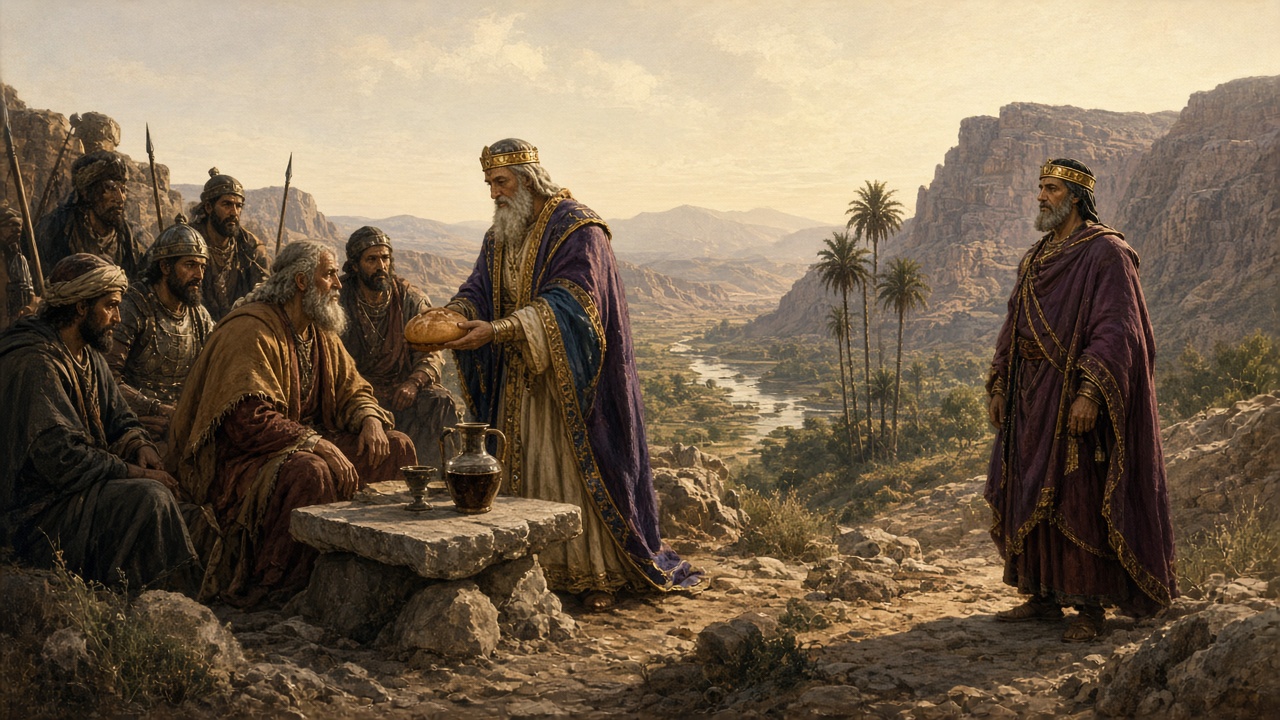
17Sotheli the kyng of Sodom yede out in to the metyng of him, after that he turnede ayen fro sleyng of Chodorlaomor, and of kyngis that weren with him, in the valei of Sabe, which is the valey of the kyng. 18And sotheli Melchisedech, kyng of Salem, brouyte forth breed and wyn, for he was the preest of hiyeste God; 19and he blesside Abram, and seide, Blessid be Abram of hiy God, that made heuene and erthe of nouyt, 20and blessid be hiy God, bi whom defendynge, enemyes ben bitakun in thin hondis. And Abram yaf tithis of alle thingis to hym. 21Forsothe the kyng of Sodom seide to Abram, Yyue thou the men to me; take thou othir thingis to thee. 22And Abram answerde to hym, Y reyse myn hondis to the hiy Lord God, 23Lord of heuene and of erthe, that fro the threde of oof til to the layner of the hose I schal not take of alle thingis that ben thine, lest thou seie, I made Abram riche; 24out takun these thingis whiche the yonge men eeten, and the partis of men that camen with me, Aner, Escol, and Mambre; these men schulen take her partis.
¿Sabías que…?
La campaña de los cuatro reyes
- El Diccionario Bíblico de Easton (1897) identifica a los cuatro reyes invasores con nombres de inscripciones antiguas: Quedorlaomer con Khudur-Lagamar, de Elam; Amrafel con Khammu-rabi, de Sinar (Caldea meridional); Arioc, rey de Elasar, con Eri-Aku, de Larsa; y Tidal con Tudkhula. Explica Eri-Aku como un nombre elamita que significa “siervo del dios de la luna”, cambiado después a Rimsin, y entiende Goim — “naciones” — como Gutium, al este del Tigris y al norte de Elam.Fuentes: Chedorlaomer · Amraphel · Arioch (king of Ellasar) · Tidal
- Los cinco reyes locales se formaron para la batalla en el valle de Sidim, que este capítulo identifica con el mar Salado, y el valle estaba lleno de pozos de brea, en los que cayeron algunos de los hombres que huían. El Diccionario Bíblico de Easton sitúa ese valle en el extremo sur del mar Muerto, entre Engedi y las ciudades de la llanura, y llama a esos pozos pozos de betún.Fuentes: el propio texto bíblico · Vale of Siddim
- Abram vivía cerca de las encinas de Mamre el amorreo, hermano de Escol y de Aner, y los tres estaban ligados a él por un tratado. El Diccionario Bíblico de Easton llama a Mamre y a Escol jefes amorreos y a Aner jefe cananeo, y señala que acompañaron a Abram en la persecución de Quedorlaomer y en la recuperación de Lot.Fuentes: el propio texto bíblico · Mamre · Eshcol · Aner
Notas escritas con ayuda de IA a partir de fuentes abiertas (Theographic Bible Metadata, CC BY-SA 4.0; Easton’s Bible Dictionary, dominio público) y revisadas antes de publicarse.
Lugares de este capítulo
- Elam · 32.189, 48.258 · versículos 1, 9
- Shinar · Hoy: Babylonia · 32.543, 44.422 · versículos 1, 9
- Salt Sea · Hoy: Dead Sea · 31.500, 35.500 · versículo 3
- Shaveh-kiriathaim · Hoy: within 1 km of Al Qurayyat · 31.541, 35.686 · versículo 5
- Dan · Hoy: Tel Dan · 33.249, 35.652 · versículo 14
- Damascus · 33.511, 36.306 · versículo 15
- Valley of Shaveh · Hoy: intersection of Kidron Valley and Valley of Hinnom · 31.767, 35.236 · versículo 17
- Salem · Hoy: Jerusalem · 31.777, 35.234 · versículo 18
Solo aparecen lugares identificados con alta confianza (90 % o más según las fuentes académicas reunidas por OpenBible). Mapa de la época: DARE (Digital Atlas of the Roman Empire), CC BY 4.0; mapa actual: © colaboradores de OpenStreetMap; lugares: OpenBible.info (CC BY 4.0).
Créditos y licencia de esta traducción
Wycliffe Bible
This is the Pentateuch and Gospels from The Holy Bible, containing the Old and New Testaments, with the apocryphal books, in the earliest English version made from the latin Vulgate by John Wycliffe and his followers. c.1395
Public Domain
Language: Middle English (English)
Dialect: Middle
Translation by: John Wycliffe
2016-11-08
Títulos de sección adaptados de la Berean Standard Bible (dominio público); no forman parte del texto bíblico de esta traducción.
Fuente: http://ebible.org/engWycliffe/ · eBible.org