Éxodo 21
Wycliffe Bible · Toca un versículo para ver sus referencias cruzadas.
Hebrew Servants
1These ben the domes, whiche thou schalt sette forth to hem. 2If thou biest an Ebrew seruaunt, he schal serue thee sixe yeer; in the seuenthe yeer he schal go out fre, 3with out prijs; with what maner clooth he entride, with siche clooth go he out; if he entride hauynge a wijf, and the wijf schal go out to gidere. 4But if the lord of the servaunt yaf a wijf to hym, and sche childide sones and douytris, the womman and hir children schulen be hir lordis; sotheli the seruaunt schal go out with his owne clooth. 5That if the seruaunt seith, Y loue my lord, and wijf, and children, Y schal not go out fre; 6the lord brynge hym to goddis, that is, iugis; and he schal be set to the dore, and postis; and the lord schal perse his eere with a nal, and he schal be seruaunt to hym til in to the world. 7If ony man sillith his douyter in to seruauntesse, sche schal not go out as handmaidis weren wont to go out; 8if sche displesith in the iyen of hir lord, to whom sche was bitakun, he schal delyuere hir; sotheli he schal not haue power to sille hir to an alien puple, if he forsakith hir. 9Forsothe if he weddith hir to his sonne, he schal do to hir `bi the custom of douytris; 10that if he takith another womman to hym, he schal puruey to the damysele weddingis, and clothis, and he schal not denye the prijs of chastite. 11If he doith not these thre, sche schal go out freli without money.
Personal Injury Laws
12He that smytith a man, and wole sle, die bi deeth; 13forsothe if a man settide not aspies, but God `bitook hym in to hise hondis, Y schal ordeyne a place to thee, whidur he owith to fle. 14If ony man sleeth his neiybore bi biforecastyng, and bi aspies, drawe thou hym awey fro myn auter, that he die. 15He that smytith his fadir, ether modir, die by deeth. 16He that cursith his fadir, ether modir, die bi deeth. 17He that stelith a man, and sillith hym, if he is conuyt of the gilt, die bi deeth. 18If men chiden, and the tother smyte his neiybore with a stoon, ether with the fist, and he is not deed, but liggith in the bed, 19if he risith, and goith forth on his staf, he that smoot schal be innocent; so netheles that he restore hise trauelis, and costis in lechis. 20He that smytith his seruaunt, ether handmayde, with a yerde, and thei ben deed in hise hondis, schal be gilti of cryme. 21Sotheli if the seruaunt ouerlyueth o dai, ether tweyne, he schal not be suget to peyne, `that is of deeth, for the seruaunt is his catel. 22If men chiden, and a man smytith a womman with childe, and sotheli makith the child deed borun, but the womman ouerlyueth, he schal be suget to the harm, as myche as the `hosebonde of the womman axith, and the iugis demen. 23But if the deeth of hir sueth, 24he schal yelde lijf for lijf, iye for iye, tooth for tooth, hond for hond, foot for foot, 25brennyng for brennyng, wounde `with schedyng of blood for wounde `with schedyng of blood, `a wan wounde for a wan wounde. 26If a man smytith the iye of his seruaunt, ethir of handmaide, and makith hem oon iyed, he schal delyuere hem fre for `the iye which he puttide out. 27Also if he smytith out a tooth fro his seruaunt, ethir handmaide, in lijk maner he schal delyuere hem fre. 28If an oxe smytith with horn a man, ether a womman, and thei ben deed, the oxe schal be oppressid with stoonus, and hise fleischis schulen not be etun, and the lord of the oxe schal be innocent. 29That if the oxe was `a pultere with horn fro yisterdai and the thridde dai ago, and men warneden `the lord of hym, nether the lord closide hym, and he sleeth a man, ethir womman, bothe the oxe schal be oppressid with stoonus, and thei schulen sle `the lord of hym; 30that if prijs is put to the lord, he schal yyue for his lijf what euer he is axide. 31And if he smytith with horn a son, and a douytir, he schal be suget to lijk sentence. 32If the oxe asailith a seruaunt, and handmaide, the lord of the oxe schal yyue thretti siclis of siluer to `his lord; forsothe the oxe schal be oppressid with stoonus. 33If ony man openeth a cisterne, and diggith, and hilith it not, and an oxe ether asse fallith in to it, 34the lord of the cisterne schal yelde the prijs of the werk beestis; forsothe that that is deed schal be his. 35If another mannus oxe woundith the oxe of another man, and he is deed, thei schulen sille the quyke oxe, and thei schulen departe the prijs; forsothe thei schulen departe bitwixe hem the karkeis of the deed oxe. 36Forsothe if his lord wiste, that the oxe was a puttere fro yistirdai and the thridde dai ago, and kepte not him, he schal yelde oxe for oxe, and he schal take the hool carkeys.
¿Sabías que…?
Ordenanzas sobre siervos y lesiones
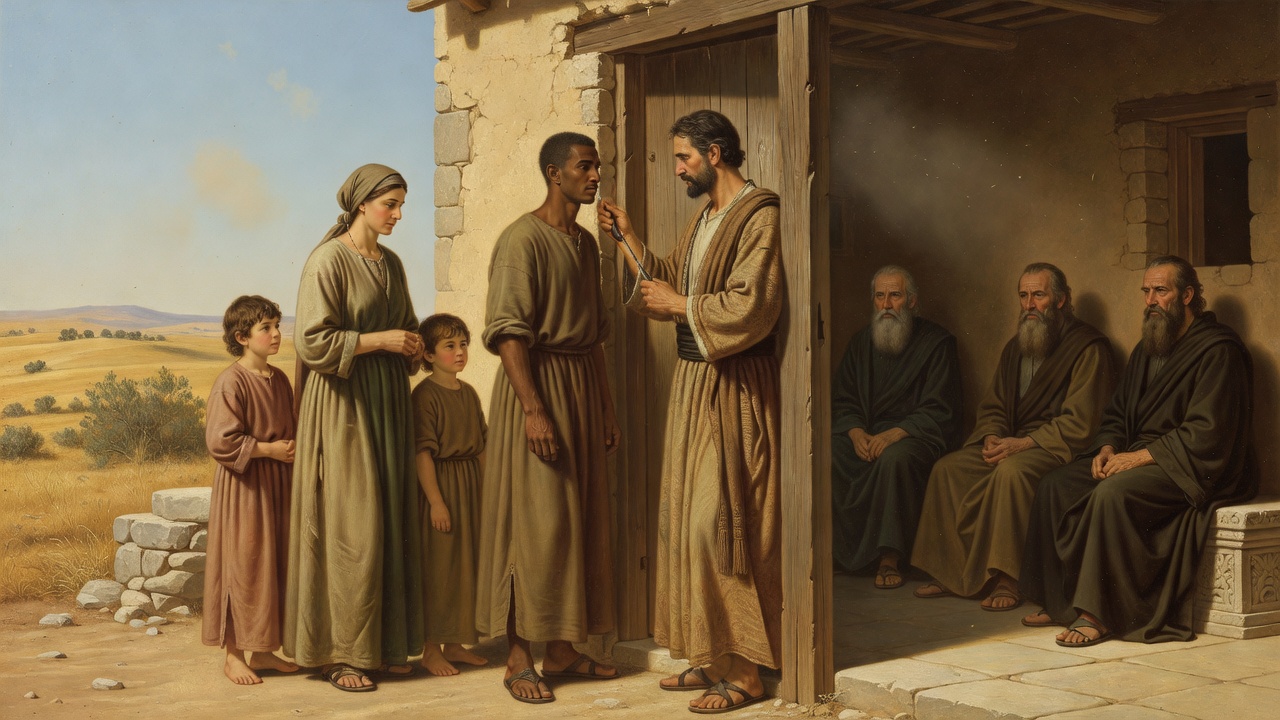
- Un siervo hebreo que era comprado servía seis años y quedaba libre en el séptimo año sin pagar nada. Se iba solo si había llegado solo, o con su esposa si había llegado con ella, pero la esposa dada por el amo y los hijos que ella tuviera permanecían con el amo. Si el siervo declaraba que amaba a su amo, a su esposa y a sus hijos y no quería quedar libre, el amo lo llevaba ante los jueces, le perforaba la oreja con una lezna en la puerta o en el poste, y él servía de por vida.Fuentes: el propio texto bíblico
- Quien golpeara y matara a un hombre debía ser muerto. Si no había estado al acecho, sino que Dios había permitido que sucediera, se designaba un lugar adonde pudiera huir; pero si tramaba y actuaba deliberadamente para matar a su prójimo, se lo apartaba incluso del altar para darle muerte. Quien golpeara o maldijera a su padre o a su madre, y quien secuestrara a otro hombre, ya fuera que lo vendiera o que el hombre fuera hallado en su poder, también debía ser muerto.Fuentes: el propio texto bíblico
- Si unos hombres reñían y uno golpeaba al otro con una piedra o con el puño, de modo que quedaba en cama pero no moría, el agresor quedaba impune una vez que el herido podía caminar afuera con su bastón, pero debía compensar el trabajo perdido y procurar que sanara por completo. Si resultaba una lesión grave, se exigía vida por vida, ojo por ojo, diente por diente, mano por mano, pie por pie, quemadura por quemadura, herida por herida y azote por azote. Si un hombre golpeaba y cegaba el ojo o le sacaba un diente a su siervo o a su sierva, debía dejarlo ir libre como compensación.Fuentes: el propio texto bíblico
Notas escritas con ayuda de IA a partir de fuentes abiertas (Theographic Bible Metadata, CC BY-SA 4.0; Easton’s Bible Dictionary, dominio público) y revisadas antes de publicarse.
Créditos y licencia de esta traducción
Wycliffe Bible
This is the Pentateuch and Gospels from The Holy Bible, containing the Old and New Testaments, with the apocryphal books, in the earliest English version made from the latin Vulgate by John Wycliffe and his followers. c.1395
Public Domain
Language: Middle English (English)
Dialect: Middle
Translation by: John Wycliffe
2016-11-08
Títulos de sección adaptados de la Berean Standard Bible (dominio público); no forman parte del texto bíblico de esta traducción.
Fuente: http://ebible.org/engWycliffe/ · eBible.org