Éxodo 19
Wycliffe Bible · Toca un versículo para ver sus referencias cruzadas.
Israel at Mount Sinai
1In the thridde monethe of the goyng `of Israel out of the lond of Egipt, in this dai thei camen in to the wildirnesse of Synai; 2for thei yeden forth fro Rafidym, and camen til in to deseert of Synai, and settiden tentis in the same place; and there Israel settide tentis, euen ayens the hil. 3Forsothe Moises stiede in to the hil to God; and the Lord clepide hym fro the mount, and seide, Thou schalt seie these thingis to the hows of Jacob, and thou schalt telle to the sones of Israel, 4Ye silf han seyn what thingis Y haue do to Egipcians, how Y bar you on the wengis of eglis, and took to me. 5Therfor if ye schulen here my vois, and schulen kepe my couenaunt, ye schulen be to me in to a specialte of alle puplis; for al the lond is myn; 6and ye schulen be to me in to a rewme of preesthod, and `ye schulen be an hooli folk; these ben the wordis whiche thou schalt speke to the sones of Israel. 7Moyses cam, and whanne the gretter men in birthe of the puple weren clepid to gidere, he expownede alle the wordis whiche the Lord comaundide. 8And alle the puple answeride to gidere, We schulen do alle thingis whiche the Lord spak. And whanne Moises hadde teld the wordis of the puple to the Lord, 9the Lord seide to hym, Riyt now Y schal come to thee in a derknesse of a cloude, that the puple here me spekynge to thee, and bileue to thee withouten ende. Therfor Moises telde the wordis of the puple to the Lord, 10which seide to Moises, Go thou to the puple, and make hem holi to dai and to morewe, and waische thei her clothis, 11and be thei redi in to the thridde dai; for in the thridde dai the Lord schal come doun bifore al the puple on the hil of Synai. 12And thou schalt sette termes to the puple, bi cumpas; and thou schalt seie to hem, Be ye war, that ye `stie not in to the hil, nether touche ye the endis therof; ech man that schal touche the hil, schal die bi deeth. 13Hondis schulen not touche hym, but he schal be oppressid with stoonus, ethir he shall be persid with dartis; whether it schal be a beest, ethir a man, it schal not lyue; whanne a clarioun schal bigynne to sowne, thanne `stie thei in to the hil. 14And Moises cam doun fro the hil to the puple, and halewide it; and whanne thei hadden waischun her clothis, 15he seide to hem, Be ye redi in to the thridde dai, neiye ye not to youre wyues.
The LORD Visits Sinai
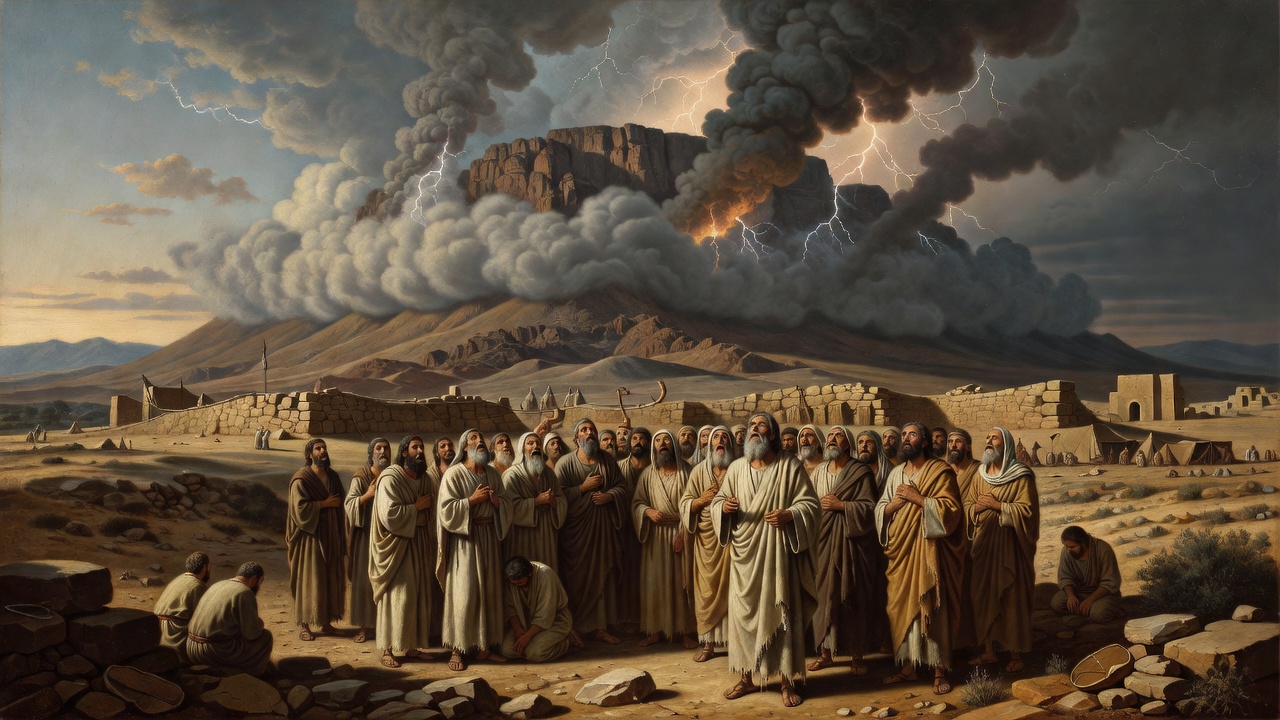
16And now the thridde day was comun, and the morewetid was cleer; and, lo! thundris bigunnen to be herd, and leitis to schyne, and a moost thicke cloude to hile the mounteyn; and `the sownyng of a clarioun made noise ful greetli, and the puple dredde, that was in the castels. 17And whanne Moises hadde led hem out in to the comyng of God, fro the place of castels, thei stoden at the rootis of the hil. 18Forsothe al the hil of Synai smokide, for the Lord hadde come doun theronne in fier; and smoke stiede therof as of a furneis, and al the hil was ferdful; 19and the `sown of a clarioun encreesside litil and litil, and was holdun forth lengere. Moises spak, and the Lord answeride to hym, 20and the Lord cam doun on the hil of Synay, in thilke cop of the hil, and clepide Moises to the cop therof. And whanne he hadde stied thidur, 21the Lord seide to hym, Go thou doun, and witnesse thou to the puple, lest perauenture it wole passe the termes to se the Lord, and ful greet multitude therof perische; 22also preestis, that neiyen to the Lord, be halewid, lest Y smyte hem. 23And Moises seide to the Lord, The comyn puple may not stie in to the hil of Synai; for thou hast witnessid, and hast comaundid, seiyinge, Sette thou termes aboute the hil, and halewe it. 24To whom the Lord seide, Go thou doun, and thou schalt stie, and Aaron with thee; forsothe the preestis and the puple passe not the termes, nethir stie thei to the Lord, lest perauenture he sle hem. 25Moises yede doun to the puple, and telde alle thingis to hem.
¿Sabías que…?
Israel en el monte Sinaí
- En el tercer mes después de salir de Egipto, los israelitas partieron de Refidim, entraron en el desierto de Sinaí y acamparon frente al monte. El Easton's Bible Dictionary (1897) identifica ese distrito montañoso como Sinaí, llamado también Horeb, explica el nombre como de Sin, el dios de la luna, y dice que permanecieron acampados cerca de un año tras un viaje de unas 150 millas desde el mar Rojo, incluyendo todos los recodos del camino.Fuentes: el propio texto bíblico · Mount Sinai · Sinai
- El Easton's Bible Dictionary (1897) sitúa Refidim, la estación que acababan de dejar, en el Wady Feiran, cerca de su unión con el Wady esh-Sheikh. Allí no se halló agua, y el pueblo estaba dispuesto a apedrear a Moisés; por orden de Dios, él golpeó la roca en Horeb, y los amalecitas que después atacaron el campamento fueron derrotados por completo.Fuentes: el propio texto bíblico · Rephidim
- El Easton's Bible Dictionary (1897) dice que los últimos veintidós capítulos de Éxodo, todo Levítico y Números 1-11 registran lo que ocurrió mientras Israel estaba acampado en esa región. Aarón, a quien Moisés recibe la orden de llevar consigo, era su hermano mayor, nacido en Egipto tres años antes que él, y había sido enviado para cooperar con él en llevar a cabo el éxodo.Fuentes: el propio texto bíblico · Mount Sinai · Aaron
Notas escritas con ayuda de IA a partir de fuentes abiertas (Theographic Bible Metadata, CC BY-SA 4.0; Easton’s Bible Dictionary, dominio público) y revisadas antes de publicarse.
Lugares de este capítulo
- Egypt · 30.129, 31.308 · versículos 1, 4
- Wilderness of Sinai · Hoy: about 50 km around Jebel Musa · 28.540, 33.973 · versículos 1, 2
Solo aparecen lugares identificados con alta confianza (90 % o más según las fuentes académicas reunidas por OpenBible). Mapa de la época: DARE (Digital Atlas of the Roman Empire), CC BY 4.0; mapa actual: © colaboradores de OpenStreetMap; lugares: OpenBible.info (CC BY 4.0).
Créditos y licencia de esta traducción
Wycliffe Bible
This is the Pentateuch and Gospels from The Holy Bible, containing the Old and New Testaments, with the apocryphal books, in the earliest English version made from the latin Vulgate by John Wycliffe and his followers. c.1395
Public Domain
Language: Middle English (English)
Dialect: Middle
Translation by: John Wycliffe
2016-11-08
Títulos de sección adaptados de la Berean Standard Bible (dominio público); no forman parte del texto bíblico de esta traducción.
Fuente: http://ebible.org/engWycliffe/ · eBible.org