Deuteronomio 14
Wycliffe Bible · Toca un versículo para ver sus referencias cruzadas.
Clean and Unclean Animals
1Be ye the sones of youre Lord God; ye schulen not kitte you, nether ye schulen make ballidnesse, 2on a deed man, for thou art an hooli puple to thi Lord God, and he chees thee that thou be to hym in to a special puple, of alle folkis that ben on erthe. 3Ete ye not tho thingis that ben vncleene. 4This is a beeste which ye schulen ete; an oxe, and a scheep, and a goet, an hert, 5a capret, a `wielde oxe, tregelafun, `that is, a beeste in parti lijk `a buk of geet, and in parti liik an hert, a figarde, an ostrich, a camelioun, `that is, a beeste lijk in the heed to a camel, and hath white spottis in the bodi as a parde, and `is lijk an hors in the necke, and in the feet is lijc a `wilde oxe, and a parde. 6Ye schulen ete ech beeste that departith the clee `in to twei partis, and chewith code. 7Sotheli ye schulen not ete these beestis, of these that chewen code, and departen not the clee; a camel, an hare, and a cirogrille, `that is, a beeste ful of prickis, and is more than an irchoun; for tho chewen code, and departen not the clee, tho schulen be vncleene to you; 8also a swyn, for it departith the clee, and chewith not code, schal be vncleene; ye schulen not ete the fleischis of tho, and ye schulen not touche the deed bodies. 9Ye schulen ete these thingis, of alle that dwellen in watris; ete ye tho thingis that han fynnes and scalis; 10ete ye not tho thingis that ben with out fynnes and scalis, for tho ben vncleene. 11Ete ye alle clene briddis; 12ete ye not vncleene briddis, that is, an egle, and a gripe, 13and an aliete, ixon, `that is, a whijt brid lesse than a vultur, and is of the `kynde of vultris, and a vultur, and a kite bi his kynde, 14and al thing of rauenys kynde, 15and a strucioun, and a nyyt crowe, and a lare, 16and an hauk bi his kynde, a fawcun, 17and a swan, and a siconye, and a dippere, a pursirioun, and a reremous, a cormeraunt, 18and a caladrie, alle in her kynde; also a lapwynke and a backe. 19And al thing that crepith, and hath fynnes, schal be vncleene, and schal not be etun. 20Ete ye al thing that is cleene; sotheli what euer thing is deed bi it silf, ete ye not therof. 21Yyue thou to the pilgrym which is with ynne thi yatis, that he ete, ether sille thou to hym, for thou art the hooli puple of thi Lord God. Thou schalt not sethe a kyde in `the mylk of his modir.
Giving Tithes
22Thou schalt departe the tenthe part of alle thi fruytis that comen forth in the lond bi ech yeer; 23and thou schal ete in the siyt of thi Lord God, in the place which he chees, that his name be clepid therynne; thou schalt offre the tithe of thi wheete, wyn, and oile, and the firste gendryd thingis of thi droues, and scheep, that thou lerne to drede thi Lord God in al tyme. 24Sotheli whanne the wei is lengere, and the place which thi Lord God chees is fer, and he hath blessid thee, and thou maist not bere alle these thingis to that place, 25thou schalt sille alle thingis, and schalt turne in to prijs, and thou schalt bere in thin hond, and thou schalt go to the place which thi Lord God chees; 26and thou schalt bie of the same money what euer thing plesith to thee, ethir of droues, ether of scheep; also thou schalt bie wyn, and sidur, and al thing that thi soule desirith; and thou schalt ete bifor thi Lord God, and thou schalt make feeste, 27thou, and thin hows, and the dekene which is withynne thi yatis; be thou war lest thou forsake hym, for he hath not other part in possessioun. 28In the thridde yeer thou schalt departe another dyme of alle thingis that growen to thee in that yeer, and thou schalt kepe withynne thi yatis. 29And the dekene schal come, whych hath noon other part nether possessioun with thee, and the pilgrym, and the fadirles, ether modirles child, and widue, that ben withynne thi yatis, `schulen come, and schulen ete, and be fillid, that thi Lord God blesse thee, in alle werkis of thin hondis whiche thou schalt do.
¿Sabías que…?
Leyes Alimentarias y Normas sobre el Diezmo
- Las leyes dietéticas de Deuteronomio 14 distinguen a los animales terrestres limpios de los inmundos mediante dos criterios físicos: tener la pezuña dividida y rumiar. Los animales acuáticos solo se consideraban aptos para el consumo si tenían tanto aletas como escamas.Fuentes: el propio texto bíblico
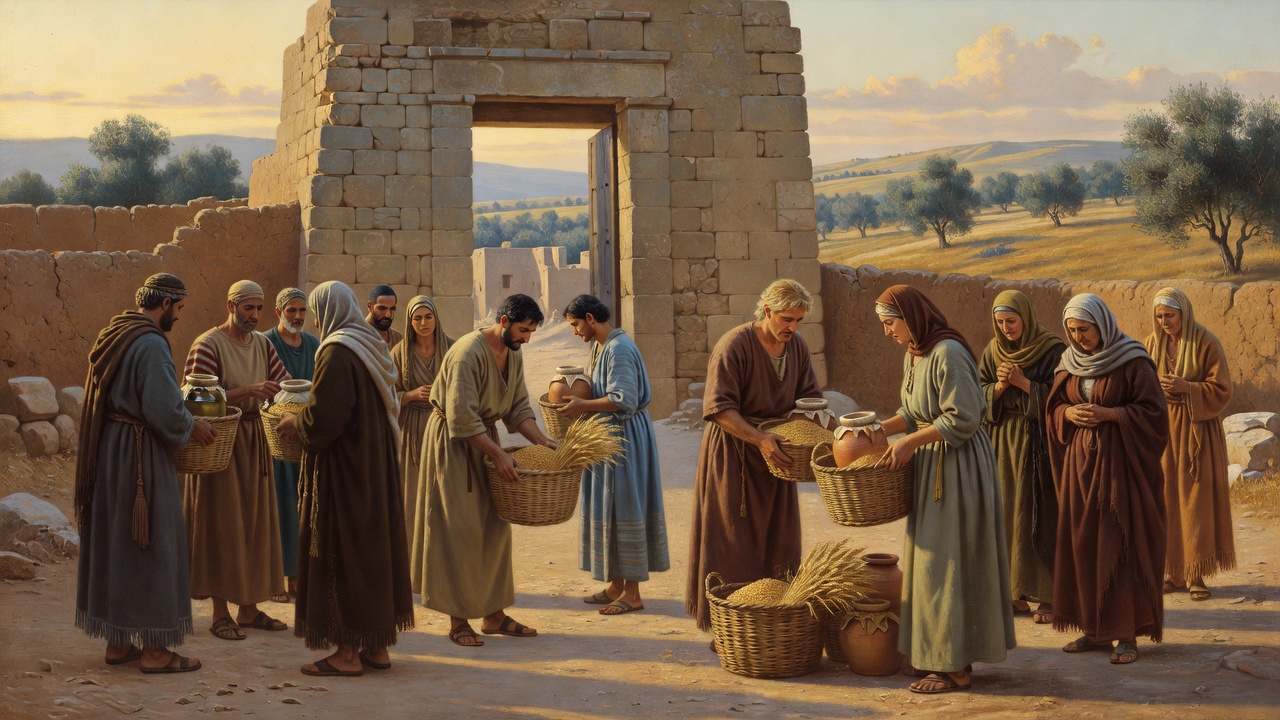
- Para facilitar el cumplimiento a quienes vivían lejos del santuario designado, la ley permitía cambiar los diezmos agrícolas por dinero para el viaje. Al llegar al lugar central, los fieles podían utilizar ese dinero para comprar alimentos festivos y celebrar con sus familias.Fuentes: el propio texto bíblico
- Cada tres años, el diezmo anual se almacenaba dentro de las ciudades locales en lugar de llevarse al santuario central. Estos alimentos se destinaban al sustento de los miembros de la comunidad sin herencia de tierras, específicamente los levitas, los extranjeros residentes, los huérfanos y las viudas.Fuentes: el propio texto bíblico
Notas escritas con ayuda de IA a partir de fuentes abiertas (Theographic Bible Metadata, CC BY-SA 4.0; Easton’s Bible Dictionary, dominio público) y revisadas antes de publicarse.
Créditos y licencia de esta traducción
Wycliffe Bible
This is the Pentateuch and Gospels from The Holy Bible, containing the Old and New Testaments, with the apocryphal books, in the earliest English version made from the latin Vulgate by John Wycliffe and his followers. c.1395
Public Domain
Language: Middle English (English)
Dialect: Middle
Translation by: John Wycliffe
2016-11-08
Títulos de sección adaptados de la Berean Standard Bible (dominio público); no forman parte del texto bíblico de esta traducción.
Fuente: http://ebible.org/engWycliffe/ · eBible.org