Números 19
Unlocked Literal Bible · Toca un versículo para ver sus referencias cruzadas.
The Red Heifer
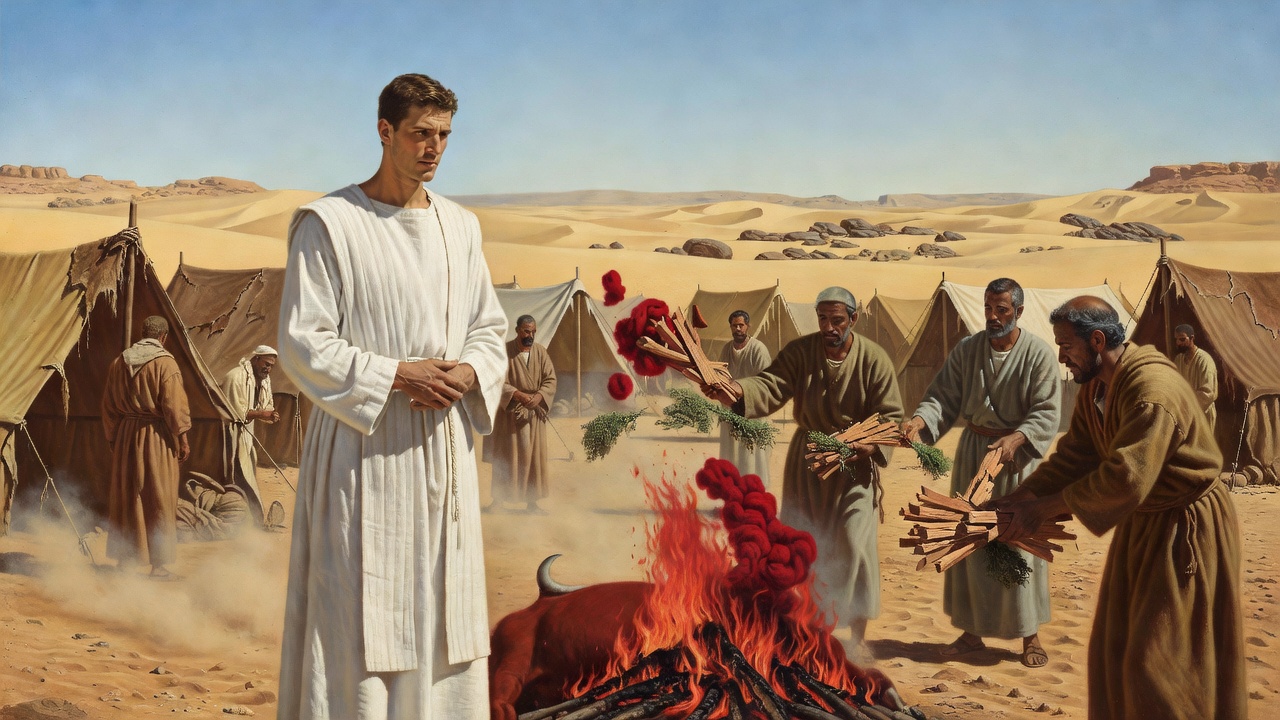
1Yahweh spoke to Moses and Aaron. He said, 2“This is a statute, a law which I am commanding you: Say to the people of Israel that they must bring to you a red heifer without flaw or blemish, and which has never carried a yoke. 3Give the heifer to Eleazar the priest. He must bring it outside the camp, and someone must kill it in front of him. 4Eleazar the priest must take some of its blood with his finger and sprinkle it seven times toward the front of the tent of meeting. 5Another priest must burn the heifer in his sight. He must burn its hide, flesh, and its blood with its dung. 6The priest must take cedarwood, hyssop, and scarlet wool, and throw it all into the middle of the burning heifer. 7Then he must wash his clothes and bathe in water. Then he may come into the camp, where he will remain unclean until the evening. 8The one who has burned the heifer must wash his clothes in water and bathe in water. He will remain unclean until the evening. 9Someone who is clean must gather up the heifer's ashes and put them outside the camp in a clean place. These ashes must be kept for the community of the people of Israel. They will mix the ashes with water for purification from sin, since the ashes were from a sin offering. 10The one who gathered the heifer's ashes must wash his clothes. He will remain unclean until the evening. This will be a permanent law for the people of Israel and the foreigners who stay with them.
Purification of the Unclean
11Whoever touches the dead body of any man will be unclean for seven days. 12Such a person must purify himself on the third day and on the seventh day. Then he will be clean. But if he does not purify himself the third day, then he will not be clean on the seventh day. 13Whoever touches a dead person, the body of a man who has died, and does not purify himself—this person defiles Yahweh's tabernacle. That person must be cut off from Israel because the water for impurity was not sprinkled on him. He will remain unclean; his uncleanness will remain on him.
14This is the law for when someone dies in a tent. Everyone who goes into the tent and everyone who is already in the tent will be unclean for seven days. 15Every open container with no cover becomes unclean. 16Similarly, anyone outside a tent who touches someone who has been killed with a sword, any other dead body, a human bone, or a grave—that person will be unclean for seven days. 17Do this for the unclean person: Take some ashes from the burnt sin offering and mix them in a jar with fresh water. 18Someone who is clean must then take hyssop, dip it in the water, and sprinkle it on the tent, on all the containers inside the tent, on the persons who were there, and on anyone who touched the bone, the one who was killed, the one who died, or the grave. 19On the third day and on the seventh day, the clean person must sprinkle the unclean person. On the seventh day the unclean person must purify himself. He must wash his clothes and bathe in water. At evening he will become clean.
20But anyone who remains unclean, who refuses to purify himself—that person will be cut off from the community, because he has defiled Yahweh's sanctuary. The water for impurity has not been sprinkled on him; he remains unclean. 21This will be an ongoing law concerning these situations. The one who sprinkles the water for impurity must wash his clothes. The one who touches the water for impurity will become unclean until evening. 22Whatever the unclean person touches will become unclean. The person who touches it will become unclean until evening.”
¿Sabías que…?
La novilla roja y la purificación de la impureza
- A diferencia de los sacrificios habituales presentados en el altar del tabernáculo, la novilla roja sin defecto y que nunca había llevado yugo era llevada fuera del campamento. Allí era sacrificada ante el sacerdote Eleazar y quemada por completo junto con madera de cedro, hisopo y lana escarlata.Fuentes: el propio texto bíblico · Eleazar
- Las cenizas de la novilla se guardaban fuera del campamento para preparar el agua de purificación. Paradójicamente, aunque esta mezcla purificaba a quienes contraían impureza por la muerte, todos los que manipulaban la novilla, recogían las cenizas o rociaban el agua quedaban ceremonialmente impuros hasta el anochecer.Fuentes: el propio texto bíblico
- Tocar un cadáver, un hueso humano, una tumba o permanecer en una tienda donde alguien había muerto causaba siete días de impureza ceremonial. Para purificarse, la persona debía ser rociada con el agua de purificación al tercer y al séptimo día, además de lavar sus vestiduras y bañarse.Fuentes: el propio texto bíblico
Notas escritas con ayuda de IA a partir de fuentes abiertas (Theographic Bible Metadata, CC BY-SA 4.0; Easton’s Bible Dictionary, dominio público) y revisadas antes de publicarse.
Créditos y licencia de esta traducción
Unlocked Literal Bible
The Holy Bible in English, Unlocked Literal Bible translation
copyright © 2017 Door43 World Missions Community
Language: English
Translation by: Door43 World Missions Community
Contributor: 'Alrick G. Headley, M.Div., Th.M.', 'Adam W. Nagelvoort, M.Div. Academic
Ministries, Columbia International University', 'Dave Statezni, BA Orig langs.,
M.Div. Fuller Theological Seminary', 'Bram van den Heuvel, M.A.', 'C. Harry
Harriss, M.Div.', 'David Trombold, M. Div.', 'Elizabeth Oakes, BA in Religious
Studies, Linguistics', 'George "Drew" Curley, M.Div., PhD, Professor of Biblical
Languages', Hendrik "Henry" de Vries, 'Henry Whitney, BA Linguistics', 'Jesse
Griffin, BA Biblical Studies, MA Biblical Languages', 'James N. Pohlig, M.Div.,
MA in Linguistics, D. Litt. in Biblical Languages', 'Larry T Brooks, M.Div.,
Assemblies of God Theological Seminary', 'Larry Sallee, D.Min.', 'Paul M Fahnestock,
M.Div. Reformed Theological Seminary, D. Min. Pittsburgh Theological Seminary',
'Perry Oakes, PhD in Old Testament, MA in Linguistics', 'Peter Smircich, BA Philosophy',
'Susan Quigley, MA in Linguistics', 'Thomas Warren, M.Div., Trinity Evangelical
Divinity School, D.Min, Reformed Theological Seminary', 'Timothy Neu, Ph.D.
Biblical Studies', 'Ward Pyles, M.Div., Western Baptist Theological Seminary',
David Trombold, Dean Ropp, Gene Mullen, James Vigen, Leonard Smith, Nicholas Alsop,
Michael Francis
This is an open-licensed update of the ASV, intended to provide a 'form-centric' understanding of the Bible. It increases the translator's understanding of the lexical and grammatical composition of the underlying text by adhering closely to the word order and structure of the originals.
This translation is made available to you under the terms of the
Creative Commons Attribution Share-Alike license 4.0.
You have permission to share and redistribute this Bible translation in any format and to make reasonable revisions and adaptations of this translation, provided that:
You include the above copyright and source information.
If you make any changes to the text, you must indicate that you did so in a way that makes it clear that the original licensor is not necessarily endorsing your changes.
If you redistribute this text, you must distribute your contributions under the same license as the original.
Pictures included with Scriptures and other documents on this site are licensed just for use with those Scriptures and documents.
For other uses, please contact the respective copyright owners.
Note that in addition to the rules above, revising and adapting God's Word involves a great responsibility to be true to God's Word. See Revelation 22:18-19.
2020-12-04
Títulos de sección adaptados de la Berean Standard Bible (dominio público); no forman parte del texto bíblico de esta traducción.
Fuente: http://ebible.org/engULB/ · eBible.org