Levítico 5
Unlocked Literal Bible · Toca un versículo para ver sus referencias cruzadas.
Sins Requiring a Sin Offering
1If anyone sins because he does not testify when he has witnessed something about which he is required to testify, whether he has seen it or heard about it, he will be responsible. 2Or if anyone touches anything God has designated as unclean, whether it be the carcass of an unclean wild animal or the carcass of any livestock that has died, or creeping animal, even if the person did not intend to touch it, he is unclean and guilty. 3Or if he touches the uncleanness of someone, whatever that uncleanness is, and if he is unaware of it, then he will be guilty when he learns about it. 4Or if anyone swears rashly with his lips to do evil, or to do good, whatever it is that a man swears rashly with an oath, even if he is unaware of it, when he learns about it, then he will be guilty, in any of these things. 5When someone is guilty in any of these things, he must confess whatever sin he has committed. 6Then he must bring his guilt offering to Yahweh for the sin that he has committed, a female animal from the flock, either a lamb or a goat, for a sin offering, and the priest will make atonement for him concerning his sin.
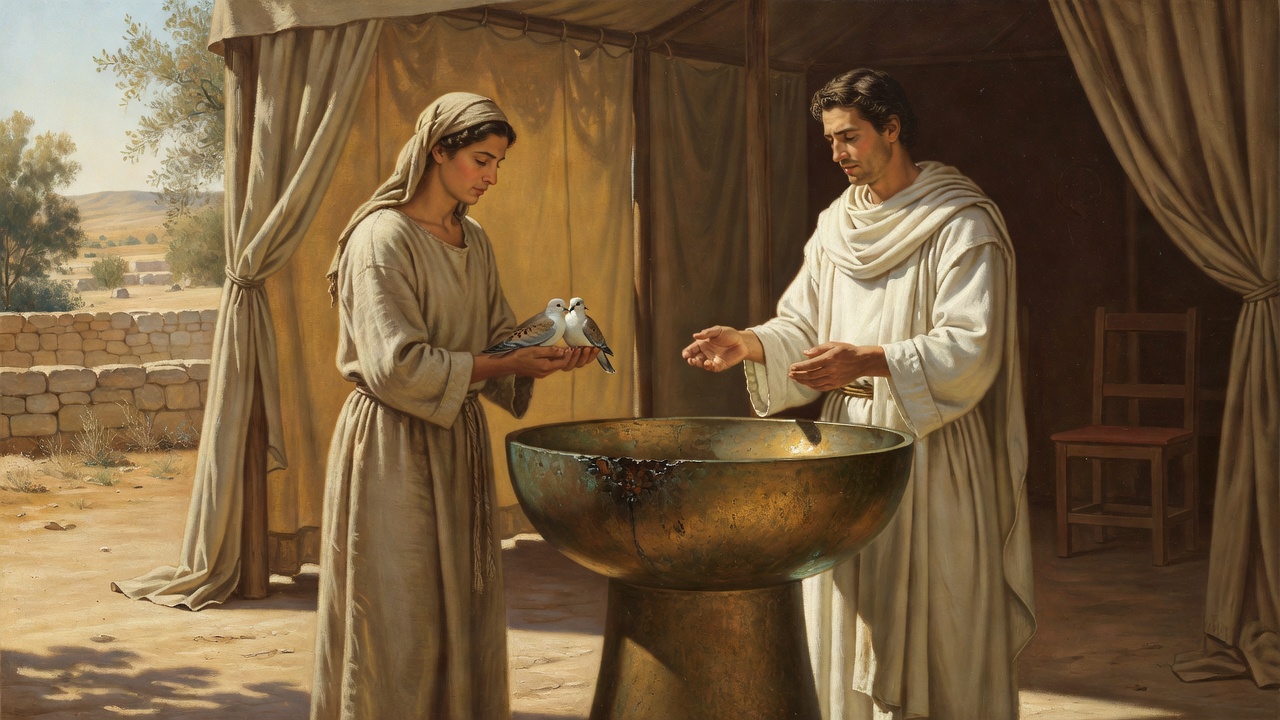
7If he cannot afford to buy a lamb, then he can bring as his guilt offering for his sin two doves or two young pigeons to Yahweh, one for a sin offering and the other for a burnt offering. 8He must bring them to the priest, who will offer one for the sin offering first—he will wring off its head from its neck but will not remove it completely from the body. 9Then he will sprinkle some of the blood of the sin offering on the side of the altar, and he will drain the rest of the blood out at the base of the altar. This is a sin offering. 10Then he must offer the second bird as a burnt offering, as described in the instructions, and the priest will make atonement for him for the sin that he has committed, and the person will be forgiven.
11But if he cannot afford to buy two doves or two young pigeons, then he must bring as his sacrifice for his sin a tenth of an ephah of fine flour for a sin offering. He must not put oil or any incense on it, for it is a sin offering. 12He must bring it to the priest, and the priest will take a handful of it as a representative offering and then burn it on the altar, on top of the offerings made by fire for Yahweh. This is a sin offering. 13The priest will make atonement for any sin that the person has committed, and that person will be forgiven. The leftovers from the offering will belong to the priest, as with the grain offering.'”
Laws for Guilt Offerings
14Then Yahweh spoke to Moses, saying, 15“If anyone sins and acts unfaithfully in regard to the things that belong to Yahweh, but did so unintentionally, then he must bring his guilt offering to Yahweh. This offering must be a ram without blemish from the flock; its value must be appraised in silver shekels—the shekel of the sanctuary—as a guilt offering. 16He must satisfy Yahweh for what he had done wrong in connection with what is holy, and he must add one-fifth to it and give it to the priest. Then the priest will make atonement for him with the ram of the guilt offering, and that person will be forgiven.
17If anyone sins and does anything that Yahweh has commanded not to be done, even if he was unaware of it, he is still guilty and must carry his own guilt. 18He must bring a ram without blemish out of the flock, worth the current value, as a guilt offering to the priest. Then the priest will make atonement for him concerning the sin he has committed, of which he was unaware, and he will be forgiven. 19It is a guilt offering, and he is certainly guilty before Yahweh.”
¿Sabías que…?
Ofrendas por la Culpa y Restitución
- Levítico 5 contempla a los adoradores de diversos recursos económicos al establecer una escala gradual para las ofrendas por el pecado. Quien no pudiera pagar una cordera o una cabra podía presentar dos tórtolas o dos pichones de paloma, y quien no pudiera costear las aves podía llevar una décima de efá de flor de harina sin aceite ni incienso.Fuentes: el propio texto bíblico
- En el caso de faltas involuntarias contra las cosas sagradas del Señor, el transgresor debía presentar un carnero sin defecto valorado en siclos del santuario como ofrenda por la culpa. Además, debía restituir por completo lo perjudicado y añadir una quinta parte (el veinte por ciento) entregada al sacerdote.Fuentes: el propio texto bíblico
- El capítulo resalta la responsabilidad comunitaria y el uso del habla, señalando faltas concretas como negarse a testificar tras escuchar una convocatoria pública y pronunciar juramentos apresurados o irreflexivos.Fuentes: el propio texto bíblico
Notas escritas con ayuda de IA a partir de fuentes abiertas (Theographic Bible Metadata, CC BY-SA 4.0; Easton’s Bible Dictionary, dominio público) y revisadas antes de publicarse.
Créditos y licencia de esta traducción
Unlocked Literal Bible
The Holy Bible in English, Unlocked Literal Bible translation
copyright © 2017 Door43 World Missions Community
Language: English
Translation by: Door43 World Missions Community
Contributor: 'Alrick G. Headley, M.Div., Th.M.', 'Adam W. Nagelvoort, M.Div. Academic
Ministries, Columbia International University', 'Dave Statezni, BA Orig langs.,
M.Div. Fuller Theological Seminary', 'Bram van den Heuvel, M.A.', 'C. Harry
Harriss, M.Div.', 'David Trombold, M. Div.', 'Elizabeth Oakes, BA in Religious
Studies, Linguistics', 'George "Drew" Curley, M.Div., PhD, Professor of Biblical
Languages', Hendrik "Henry" de Vries, 'Henry Whitney, BA Linguistics', 'Jesse
Griffin, BA Biblical Studies, MA Biblical Languages', 'James N. Pohlig, M.Div.,
MA in Linguistics, D. Litt. in Biblical Languages', 'Larry T Brooks, M.Div.,
Assemblies of God Theological Seminary', 'Larry Sallee, D.Min.', 'Paul M Fahnestock,
M.Div. Reformed Theological Seminary, D. Min. Pittsburgh Theological Seminary',
'Perry Oakes, PhD in Old Testament, MA in Linguistics', 'Peter Smircich, BA Philosophy',
'Susan Quigley, MA in Linguistics', 'Thomas Warren, M.Div., Trinity Evangelical
Divinity School, D.Min, Reformed Theological Seminary', 'Timothy Neu, Ph.D.
Biblical Studies', 'Ward Pyles, M.Div., Western Baptist Theological Seminary',
David Trombold, Dean Ropp, Gene Mullen, James Vigen, Leonard Smith, Nicholas Alsop,
Michael Francis
This is an open-licensed update of the ASV, intended to provide a 'form-centric' understanding of the Bible. It increases the translator's understanding of the lexical and grammatical composition of the underlying text by adhering closely to the word order and structure of the originals.
This translation is made available to you under the terms of the
Creative Commons Attribution Share-Alike license 4.0.
You have permission to share and redistribute this Bible translation in any format and to make reasonable revisions and adaptations of this translation, provided that:
You include the above copyright and source information.
If you make any changes to the text, you must indicate that you did so in a way that makes it clear that the original licensor is not necessarily endorsing your changes.
If you redistribute this text, you must distribute your contributions under the same license as the original.
Pictures included with Scriptures and other documents on this site are licensed just for use with those Scriptures and documents.
For other uses, please contact the respective copyright owners.
Note that in addition to the rules above, revising and adapting God's Word involves a great responsibility to be true to God's Word. See Revelation 22:18-19.
2020-12-04
Títulos de sección adaptados de la Berean Standard Bible (dominio público); no forman parte del texto bíblico de esta traducción.
Fuente: http://ebible.org/engULB/ · eBible.org