Ezequiel 46
Unlocked Literal Bible · Toca un versículo para ver sus referencias cruzadas.
The Prince’s Offerings
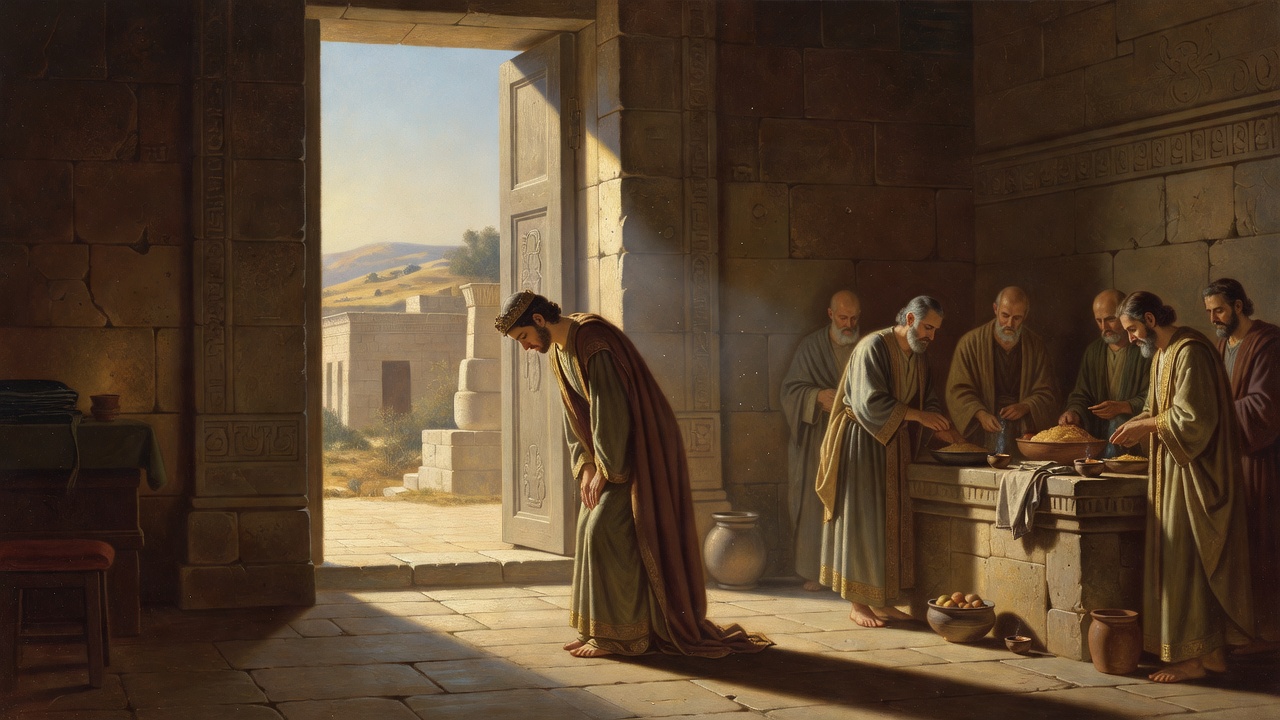
1The Lord Yahweh says this: The gate of the inner courtyard, facing east, will be shut for the six days of work, but on the Sabbath it will be opened, and on the day of the new moon it will be opened. 2The prince will enter the outer courtyard by the way of the gate and its portico from outside, and he will stand before the doorposts of the inner gate while the priests perform his burnt offering and peace offering. Then he will worship at the threshold of the inner gate and go out, but the gate will not be shut until evening. 3The people of the land will also worship before Yahweh at the entrance to this gate on the Sabbaths and new moons. 4The burnt offering that the prince offers to Yahweh on the Sabbath day will be six unblemished lambs and an unblemished ram. 5The grain offering with the ram will be an ephah, and the grain offering with the lambs will be what he wishes to give, and a hin of oil with each ephah of grain.
6On the day of the new moon he must offer an unblemished bull from a herd, six lambs, and an unblemished ram. 7He must make a grain offering of an ephah for the bull and an ephah for the ram, and what he wishes to give for the lambs, and a hin of oil for every ephah of grain. 8When the prince enters by the way of the gate and its portico, he must leave by the same way.
9But when the people of the land come before Yahweh at the appointed festivals, anyone entering through the north gate to worship must leave through the south gate; and anyone entering through the south gate must leave through the north gate. No one may turn back to the gate through which he entered, for he must go out straight ahead. 10The prince must be in their midst; when they go in, he must go in, and when they leave, he must leave. 11At the festivals, the grain offering must be an ephah of grain for the bull and an ephah for the ram, and whatever he wishes to give with the lambs, and a hin of oil for every ephah. 12When the prince gives a freewill offering, either a burnt offering or a peace offering to Yahweh, the gate facing east will be opened for him. He will offer his burnt offering offering or his peace offering as he does it on the Sabbath day. Then he must go out, and after he has gone out the gate will be shut.
13In addition, you will give an unblemished lamb one year old as a burnt offering to Yahweh daily; you will do this morning after morning. 14You will give a grain offering with it morning after morning, a sixth of an ephah and a third of a hin of oil to moisten the flour of the grain offering for Yahweh, according to a permanent statute. 15They will prepare the lamb, the grain offering, and the oil morning after morning, a permanent burnt offering.
16The Lord Yahweh says this: If the prince gives a gift to any of his sons, it is his inheritance. It will be the property of his sons, it is an inheritance. 17But if he gives a gift from his inheritance to one of his servants, then it will be that servant's until the year of liberty, and then it will return to the prince. His inheritance will certainly be for his sons. 18The prince will not take the people's inheritance away from their own property; he must provide for his sons from his own property so that my people will not be scattered, each man from his own property.'”
The Courts for Boiling and Baking
19Next the man brought me through the entrance at the gate to the holy rooms for the priests, which faced north and behold! There was a place toward the west. 20He said to me, “This is the place where the priests must boil the guilt offering and the sin offering and where they must bake the grain offering. They must not bring the offerings into the outer courtyard, for then the people would be consecrated.” 21Then he brought me to the outer courtyard and he led me past the four corners of that courtyard, and I saw that in at every corner of the courtyard there was a another court. 22In the four corners of the outer courtyard there were four small courtyards, forty cubits in length and thirty in width. There the same dimensions for all four of the courtyards. 23There was a row made of stone all around the four of them, and cooking hearths were under the stone row. 24The man said to me, “These are the places where the temple servants will boil the people's sacrifices.”
¿Sabías que…?
Culto, Deberes Reales y Cocinas del Templo
- La puerta oriental del atrio interior se mantenía cerrada durante los seis días de trabajo, pero se abría en el día de reposo y en el novilunio. El príncipe debía permanecer junto al poste de la puerta y adorar en el umbral mientras los sacerdotes presentaban sus ofrendas, tras lo cual la puerta permanecía abierta hasta la tarde.Fuentes: el propio texto bíblico
- Durante las fiestas señaladas, los fieles que entraban por la puerta norte debían salir por la del sur, y los que entraban por el sur debían salir por el norte. Asimismo, las leyes de propiedad prohibían que el príncipe despojara al pueblo de sus tierras, exigiéndole heredar únicamente de sus propias posesiones.Fuentes: el propio texto bíblico
- La visión describe áreas de cocina independientes: salas especiales en el extremo occidental para que los sacerdotes cocinaran las ofrendas por la culpa y el pecado, y cuatro atrios en las esquinas del atrio exterior donde los ministros del templo cocinaban los sacrificios del pueblo.Fuentes: el propio texto bíblico
Notas escritas con ayuda de IA a partir de fuentes abiertas (Theographic Bible Metadata, CC BY-SA 4.0; Easton’s Bible Dictionary, dominio público) y revisadas antes de publicarse.
Créditos y licencia de esta traducción
Unlocked Literal Bible
The Holy Bible in English, Unlocked Literal Bible translation
copyright © 2017 Door43 World Missions Community
Language: English
Translation by: Door43 World Missions Community
Contributor: 'Alrick G. Headley, M.Div., Th.M.', 'Adam W. Nagelvoort, M.Div. Academic
Ministries, Columbia International University', 'Dave Statezni, BA Orig langs.,
M.Div. Fuller Theological Seminary', 'Bram van den Heuvel, M.A.', 'C. Harry
Harriss, M.Div.', 'David Trombold, M. Div.', 'Elizabeth Oakes, BA in Religious
Studies, Linguistics', 'George "Drew" Curley, M.Div., PhD, Professor of Biblical
Languages', Hendrik "Henry" de Vries, 'Henry Whitney, BA Linguistics', 'Jesse
Griffin, BA Biblical Studies, MA Biblical Languages', 'James N. Pohlig, M.Div.,
MA in Linguistics, D. Litt. in Biblical Languages', 'Larry T Brooks, M.Div.,
Assemblies of God Theological Seminary', 'Larry Sallee, D.Min.', 'Paul M Fahnestock,
M.Div. Reformed Theological Seminary, D. Min. Pittsburgh Theological Seminary',
'Perry Oakes, PhD in Old Testament, MA in Linguistics', 'Peter Smircich, BA Philosophy',
'Susan Quigley, MA in Linguistics', 'Thomas Warren, M.Div., Trinity Evangelical
Divinity School, D.Min, Reformed Theological Seminary', 'Timothy Neu, Ph.D.
Biblical Studies', 'Ward Pyles, M.Div., Western Baptist Theological Seminary',
David Trombold, Dean Ropp, Gene Mullen, James Vigen, Leonard Smith, Nicholas Alsop,
Michael Francis
This is an open-licensed update of the ASV, intended to provide a 'form-centric' understanding of the Bible. It increases the translator's understanding of the lexical and grammatical composition of the underlying text by adhering closely to the word order and structure of the originals.
This translation is made available to you under the terms of the
Creative Commons Attribution Share-Alike license 4.0.
You have permission to share and redistribute this Bible translation in any format and to make reasonable revisions and adaptations of this translation, provided that:
You include the above copyright and source information.
If you make any changes to the text, you must indicate that you did so in a way that makes it clear that the original licensor is not necessarily endorsing your changes.
If you redistribute this text, you must distribute your contributions under the same license as the original.
Pictures included with Scriptures and other documents on this site are licensed just for use with those Scriptures and documents.
For other uses, please contact the respective copyright owners.
Note that in addition to the rules above, revising and adapting God's Word involves a great responsibility to be true to God's Word. See Revelation 22:18-19.
2020-12-04
Títulos de sección adaptados de la Berean Standard Bible (dominio público); no forman parte del texto bíblico de esta traducción.
Fuente: http://ebible.org/engULB/ · eBible.org