Hechos 7
Unlocked Literal Bible · Toca un versículo para ver sus referencias cruzadas.
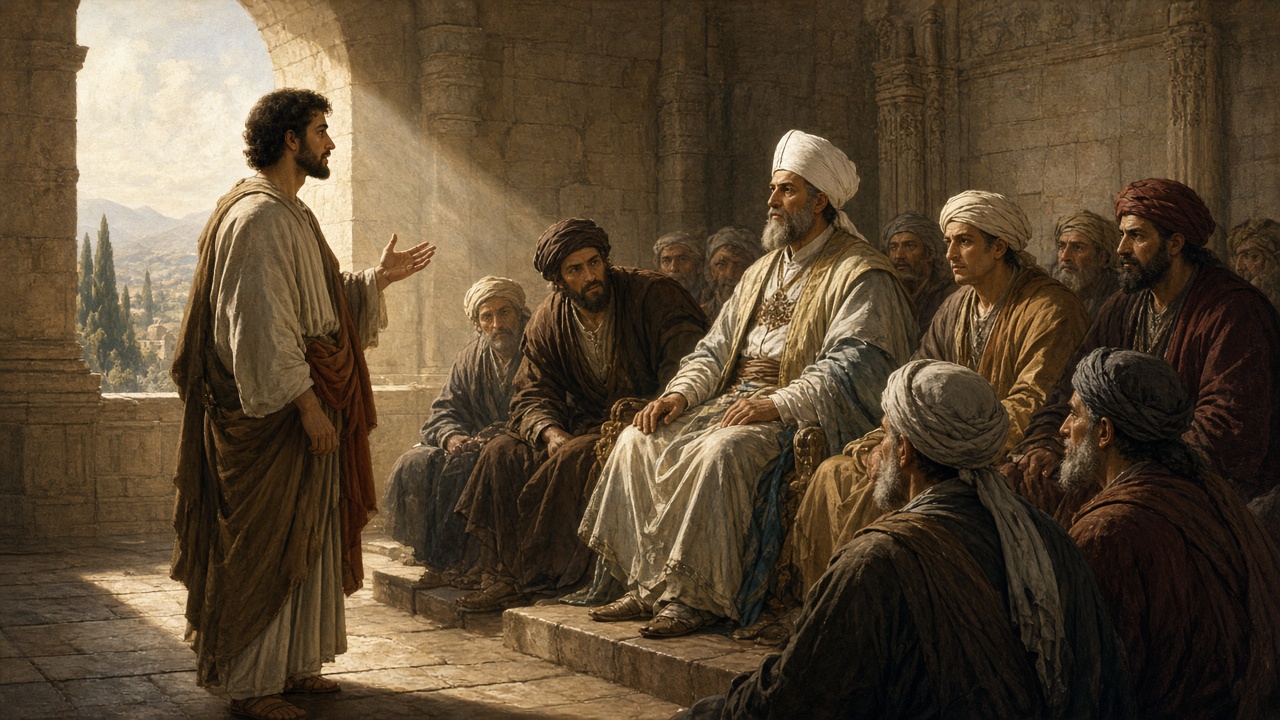
Stephen’s Address: The Call of Abraham
1The high priest said, “Are these things true?” 2Stephen said,
“Brothers and fathers, listen to me: The God of glory appeared to our father Abraham when he was in Mesopotamia, before he lived in Haran; 3he said to him, 'Leave your land and your relatives, and go into the land that I will show you.' 4Then he left the land of the Chaldeans and lived in Haran; from there, after his father died, God brought him into this land, where you live now. 5He gave none of it as an inheritance to him, no, not even enough to set a foot on. But he promised—even though Abraham had no child yet—that he would give the land as a possession to him and to his descendants after him. 6God was speaking to him like this, that his descendants would live for a while in a foreign land, and that the inhabitants there would bring them into slavery and treat them badly for four hundred years. 7'But I will judge the nation that they serve,' said God, 'and after that they will come out and worship me in this place.' 8Then God gave Abraham the covenant of circumcision, so Abraham became the father of Isaac and circumcised him on the eighth day; Isaac became the father of Jacob, and Jacob the father of the twelve patriarchs.
Joseph Sold into Egypt
9Because the patriarchs were jealous of Joseph, they sold him into Egypt; but God was with him 10and rescued him from all his troubles. He gave Joseph favor and wisdom in the presence of Pharaoh, king of Egypt, who had made him governor over Egypt and over all his household. 11Now there came a famine over all Egypt and Canaan, and great suffering, and our fathers could find no food. 12But when Jacob heard that there was grain in Egypt, he sent out our fathers on their first trip. 13On their second trip Joseph made himself known to his brothers, and Joseph's family became known to Pharaoh. 14Joseph sent his brothers back to tell Jacob his father to come to Egypt, along with all his relatives, seventy-five persons in all.
Israel Oppressed in Egypt
15So Jacob went down into Egypt, and he died, he and our fathers. 16They were carried over to Shechem and laid in the tomb that Abraham had bought for a price in silver from the sons of Hamor in Shechem. 17As the time of the promise approached, the promise that God had made to Abraham, the people grew and multiplied in Egypt, 18until there arose another king over Egypt, a king who did not know about Joseph. 19He deceived our people and forced our fathers to expose their newborn infants so they would not be kept alive.
The Birth and Adoption of Moses
20At that time Moses was born; he was very beautiful before God and was nourished for three months in his father's house. 21When he was placed outside, Pharaoh's daughter adopted him and raised him as her own son. 22Moses was educated in all the wisdom of the Egyptians, and he was mighty in his words and works.
The Rejection and Flight of Moses
23But when he was about forty years old, it came into his heart to visit his brothers, the children of Israel. 24Seeing an Israelite being mistreated, Moses defended him and avenged him who was oppressed by striking the Egyptian: 25he thought that his brothers would understand that God by his hand was rescuing them, but they did not understand. 26On the next day he came to some Israelites as they were quarreling; he tried to put them at peace with each other; he said, 'Men, you are brothers; why are you hurting one another?' 27But the one who had wronged his neighbor pushed him away, and said, 'Who made you a ruler and a judge over us? 28Would you like to kill me, as you killed the Egyptian yesterday?' 29Moses ran away after hearing this; he became a foreigner in the land of Midian, where he became the father of two sons.
The Call of Moses
30When forty years were past, an angel appeared to him in the wilderness of Mount Sinai, in a flame of fire in a bush. 31When Moses saw the fire, he marveled at the sight; and as he approached to look at it, there came a voice of the Lord, saying, 32'I am the God of your fathers, the God of Abraham, and of Isaac, and of Jacob.' Moses trembled and did not dare to look. 33The Lord said to him, 'Take off the sandals from your feet, for the place where you are standing is holy ground. 34I have certainly seen the suffering of my people who are in Egypt; I have heard their groaning, and I have come down to rescue them; now come, I will send you to Egypt.' 35This Moses whom they rejected, when they said, 'Who made you a ruler and a judge?'—he was the one whom God sent as both a ruler and deliverer. God sent him by the hand of the angel who appeared to Moses in the bush. 36Moses led them out of Egypt, after doing miracles and signs in Egypt and at the Sea of Reeds, and in the wilderness during forty years. 37It is the same Moses who said to the people of Israel, 'God will raise up a prophet for you from among your brothers, a prophet like me.' 38This is the man who was in the assembly in the wilderness with the angel who had spoken to him on Mount Sinai. This is the man who was with our fathers; this is the man who received living words to give to us.
The Rebellion of Israel
39This is the man whom our fathers refused to obey; they pushed him away from themselves, and in their hearts they turned back to Egypt. 40At that time they said to Aaron, 'Make us gods who will lead us. As for this Moses, who led us out of the land of Egypt, we do not know what has happened to him.' 41So they made a calf in those days and brought a sacrifice to the idol, and rejoiced because of the work of their hands. 42But God turned and gave them up to worship the stars in the sky, as it is written in the book of the prophets,
'Did you offer to me slain beasts and sacrifices
for forty years in the wilderness, house of Israel?
43You accepted the tabernacle of Molech
and the star of the god Rephan,
and the images that you made to worship them:
and I will carry you away beyond Babylon.'
The Tabernacle of the Testimony
44Our fathers had the tabernacle of the testimony in the wilderness, just as God commanded when he spoke to Moses, that he should make it like the pattern that he had seen. 45Later, our fathers, under Joshua, received the tabernacle and brought it with them when they took possession of the land. God took the land from the nations and drove them out before the face of our fathers. The tabernacle remained in the land until the time of David, 46who found favor in the sight of God, and he asked if he might find a dwelling place for the God of Jacob. 47But it was Solomon who built the house for God. 48However, the Most High does not live in houses made with hands, as the prophet says,
49'Heaven is my throne, and the earth is the footstool for my feet.
What kind of house can you build for me? says the Lord,
or what is the place for my rest?
50Did my hand not make all these things?'
51You people who are stiff-necked and uncircumcised in heart and ears, you always resist the Holy Spirit; you act just as your fathers acted. 52Which of the prophets did your fathers not persecute? They killed the prophets who appeared in advance of the coming of the Righteous One; and you have now become the betrayers and murderers of him also, 53you people who received the law that angels had established, but you did not keep it.”
The Stoning of Stephen
54Now when the council members heard these things, they were cut to the heart, and they ground their teeth at Stephen. 55But he, being full of the Holy Spirit, looked up intently into heaven and saw the glory of God; and he saw Jesus standing at the right hand of God. 56Stephen said, “Look, I see the heavens opened, and the Son of Man standing at the right hand of God.” 57At this the council members covered their ears, and shouting out with a loud voice, altogether they rushed at him. 58They dragged him out of the city where they began to stone him, and the witnesses laid down their outer clothing at the feet of a young man named Saul. 59As they were stoning Stephen, he was calling out to the Lord and saying, “Lord Jesus, receive my spirit.” 60He knelt down and called out with a loud voice, “Lord, do not hold this sin against them.” When he had said this, he fell asleep.
¿Sabías que…?
Esteban relata la historia de Israel
- Esteban abre su discurso con Abraham todavía en Mesopotamia, antes de establecerse en Harán, cuando se le ordenó dejar su tierra y sus parientes. Mesopotamia —en hebreo Aram-naharaim, “Siria de los dos ríos”— era el nombre que griegos y romanos daban a la región entre el Éufrates y el Tigris; en el Antiguo Testamento también se llama Padan-aram, “la llanura de Aram”, y el norte de esa meseta fue el hogar antiguo de los antepasados de los hebreos. El Easton's Bible Dictionary (1897) observa que ese primer llamado no se menciona en el Antiguo Testamento, aunque Génesis 12 lo da a entender, y que Abraham salió de Ur, en Caldea, y recorrió unas 300 millas al norte, hasta Harán.Fuentes: el propio texto bíblico · Mesopotamia · Abraham
- Esteban afirma que los huesos de Jacob y de los padres fueron llevados de vuelta a Siquem y depositados en la tumba que Abraham había comprado a los hijos de Hamor. El Easton's Bible Dictionary (1897) identifica a Hamor como un heveo cuyo nombre significa “asno”, señala que en Hechos 7:16 se le llama Emmor y dice que Jacob le compró el terreno de Siquem en el que después fue sepultado José. El artículo añade que Siquem, hijo de Hamor, fundó la ciudad que llevó su nombre.Fuentes: el propio texto bíblico · Hamor
- Esteban sitúa la zarza ardiente en el desierto, cerca del monte Sinaí, y dice que Moisés recibió allí palabras vivas del ángel que le habló en el monte. El Easton's Bible Dictionary (1897) trata Sinaí —nombre ligado a Sin, un dios lunar— como el mismo distrito montañoso llamado también Horeb. Según el artículo, los hebreos llegaron a esa región al tercer mes después del Éxodo, tras un viaje de unas 150 millas desde el mar Rojo, con todos los recodos del camino, y permanecieron acampados cerca de un año.Fuentes: el propio texto bíblico · Mount Sinai
Notas escritas con ayuda de IA a partir de fuentes abiertas (Theographic Bible Metadata, CC BY-SA 4.0; Easton’s Bible Dictionary, dominio público) y revisadas antes de publicarse.
Lugares de este capítulo
- Haran · Hoy: Harran · 36.864, 39.033 · versículos 2, 4
- Mesopotamia · Hoy: Aram-naharaim · 36.864, 39.033 · versículo 2
- Chaldea · 30.962, 46.104 · versículo 4
- Egypt · 30.129, 31.308 · versículos 9, 10, 11, 12, 14, 15, 17, 18, 34, 36, 39, 40
- Canaan · 32.767, 35.333 · versículo 11
- Shechem · Hoy: Tell Balatah · 32.214, 35.282 · versículo 16
- Nile · Hoy: Nile River · 31.465, 30.367 · versículo 19
- Midian · 28.495, 35.012 · versículo 29
- Babylon · 32.543, 44.422 · versículo 43
Solo aparecen lugares identificados con alta confianza (90 % o más según las fuentes académicas reunidas por OpenBible). Mapa de la época: DARE (Digital Atlas of the Roman Empire), CC BY 4.0; mapa actual: © colaboradores de OpenStreetMap; lugares: OpenBible.info (CC BY 4.0).
Créditos y licencia de esta traducción
Unlocked Literal Bible
The Holy Bible in English, Unlocked Literal Bible translation
copyright © 2017 Door43 World Missions Community
Language: English
Translation by: Door43 World Missions Community
Contributor: 'Alrick G. Headley, M.Div., Th.M.', 'Adam W. Nagelvoort, M.Div. Academic
Ministries, Columbia International University', 'Dave Statezni, BA Orig langs.,
M.Div. Fuller Theological Seminary', 'Bram van den Heuvel, M.A.', 'C. Harry
Harriss, M.Div.', 'David Trombold, M. Div.', 'Elizabeth Oakes, BA in Religious
Studies, Linguistics', 'George "Drew" Curley, M.Div., PhD, Professor of Biblical
Languages', Hendrik "Henry" de Vries, 'Henry Whitney, BA Linguistics', 'Jesse
Griffin, BA Biblical Studies, MA Biblical Languages', 'James N. Pohlig, M.Div.,
MA in Linguistics, D. Litt. in Biblical Languages', 'Larry T Brooks, M.Div.,
Assemblies of God Theological Seminary', 'Larry Sallee, D.Min.', 'Paul M Fahnestock,
M.Div. Reformed Theological Seminary, D. Min. Pittsburgh Theological Seminary',
'Perry Oakes, PhD in Old Testament, MA in Linguistics', 'Peter Smircich, BA Philosophy',
'Susan Quigley, MA in Linguistics', 'Thomas Warren, M.Div., Trinity Evangelical
Divinity School, D.Min, Reformed Theological Seminary', 'Timothy Neu, Ph.D.
Biblical Studies', 'Ward Pyles, M.Div., Western Baptist Theological Seminary',
David Trombold, Dean Ropp, Gene Mullen, James Vigen, Leonard Smith, Nicholas Alsop,
Michael Francis
This is an open-licensed update of the ASV, intended to provide a 'form-centric' understanding of the Bible. It increases the translator's understanding of the lexical and grammatical composition of the underlying text by adhering closely to the word order and structure of the originals.
This translation is made available to you under the terms of the
Creative Commons Attribution Share-Alike license 4.0.
You have permission to share and redistribute this Bible translation in any format and to make reasonable revisions and adaptations of this translation, provided that:
You include the above copyright and source information.
If you make any changes to the text, you must indicate that you did so in a way that makes it clear that the original licensor is not necessarily endorsing your changes.
If you redistribute this text, you must distribute your contributions under the same license as the original.
Pictures included with Scriptures and other documents on this site are licensed just for use with those Scriptures and documents.
For other uses, please contact the respective copyright owners.
Note that in addition to the rules above, revising and adapting God's Word involves a great responsibility to be true to God's Word. See Revelation 22:18-19.
2020-12-04
Títulos de sección adaptados de la Berean Standard Bible (dominio público); no forman parte del texto bíblico de esta traducción.
Fuente: http://ebible.org/engULB/ · eBible.org