Hechos 27
Unlocked Literal Bible · Toca un versículo para ver sus referencias cruzadas.
Paul Sails for Rome
1When it was decided that we should sail for Italy, they put Paul and some other prisoners under the charge of a centurion named Julius of the Imperial Regiment. 2We boarded a ship from Adramyttium, which was about to sail along the coast of Asia. So we went to sea. Aristarchus from Thessalonica in Macedonia went with us. 3The next day we landed at the city of Sidon, where Julius treated Paul kindly and allowed him to go to his friends to receive their care. 4From there we went to sea and sailed under the lee of Cyprus, close to the island, because the winds were against us. 5Then we had sailed across the sea and were near the coast of Cilicia and Pamphylia, we landed at Myra, a city of Lycia. 6There, the centurion found a ship from Alexandria that was going to sail to Italy. He put us in it. 7When we had sailed slowly for many days and had finally arrived with difficulty near Cnidus, the wind no longer allowed us to go that way, so we sailed along the sheltered side of Crete, opposite Salmone. 8We sailed along the coast with difficulty, until we came to a certain place called Fair Havens, which is near the city of Lasea.
9We had now taken much time, the time of the Jewish fast also had passed, and it had now become dangerous to sail. So Paul warned them, 10and said, “Men, I see that the voyage we are about to take will be with injury and much loss, not only of the cargo and the ship, but also of our lives.” 11But the centurion paid more attention to the master and to the owner of the ship than to those things that were spoken by Paul. 12Because the harbor was not easy to spend the winter in, most of the sailors advised to sail from there, if by any means we could reach the city of Phoenix, to spend the winter there. Phoenix is a harbor in Crete, and it faces northeast and southeast.
The Storm at Sea
13When the south wind began to blow gently, the sailors thought that they had what they needed. So they weighed anchor and sailed along Crete, close to the shore. 14But after a short time a wind of hurricane force, called the northeaster, began to beat down from the island. 15When the ship was caught by the storm and could no longer head into the wind, we had to give way to the storm and were driven along by the wind. 16We sailed along the lee of a small island called Cauda, and with difficulty we were able to secure the lifeboat. 17When they had hoisted the lifeboat up, they used its ropes to bind the hull of the ship. They were afraid that they should run upon the sandbars of Syrtis, so they lowered the sea anchor and were driven along. 18We took such a violent battering by the storm that the next day they began throwing the cargo overboard. 19On the third day the sailors threw overboard the ship's equipment with their own hands. 20When the sun and stars did not shine on us for many days, and the great storm still beat upon us, any more hope that we should be saved was abandoned. 21When they had gone long without food, then Paul stood up among the sailors and said, “Men, you should have listened to me, and not have set sail from Crete, so as to get this injury and loss. 22Now I urge you to take courage, for there will be no loss of life among you, but only the loss of the ship. 23For last night an angel of the God to whom I belong, whom also I worship—his angel stood beside me 24and said, 'Do not be afraid, Paul. You must stand before Caesar, and see, God in his kindness has given to you all those who are sailing with you.' 25Therefore be cheerful, men! For I trust God that it will happen just as it was told to me. 26But we must run aground upon some island.”
The Shipwreck
27When the fourteenth night had come, as we were driven this way and that in the Adriatic Sea, about midnight the sailors thought that they were approaching some land. 28They took soundings and found twenty fathoms; after a little while, they took more soundings and found fifteen fathoms. 29They were afraid that we might crash on the rocks, so they lowered four anchors from the stern and prayed that morning would come soon. 30The sailors were looking for a way to abandon the ship and had lowered the lifeboat into the sea, and pretended that they would throw down the anchors from the bow. 31But Paul said to the centurion and to the soldiers, “Unless these men stay in the ship, you cannot be saved.” 32Then the soldiers cut away the ropes of the boat and let it drift away. 33When daylight was coming on, Paul urged them all to take some food. He said, “This day is the fourteenth day that you wait and do not eat; you have eaten nothing. 34So I urge you to share some food, for this is necessary for you to survive. For not one of you will lose a single hair from his head.” 35When he had said this, he took bread and he thanked God in the sight of everyone. Then he broke the bread and began to eat. 36Then they were all encouraged and they also took food. 37We were 276 people in the ship. 38When they had eaten enough, they made the ship lighter by throwing out the wheat into the sea. 39When it was day, they did not recognize the land, but they saw a bay with a beach, and they discussed whether they could drive the ship onto it. 40So they cut loose the anchors and left them in the sea. At the same time they loosed the ropes of the rudders and raised the foresail to the wind; and so they headed to the beach. 41But they came to a place where two currents met, and the ship ran into the ground. The bow of the ship stuck there and remained unmovable, but the stern began to break up because of the waves' violence. 42The soldiers' plan was to kill the prisoners so that none of them could swim away and escape. 43But the centurion wanted to save Paul, so he stopped their plan; and he ordered those who could swim to jump overboard first and get to land. 44Then the rest of the men should follow, some on planks, and some on other things from the ship. In this way it happened that all of us came safely to land.
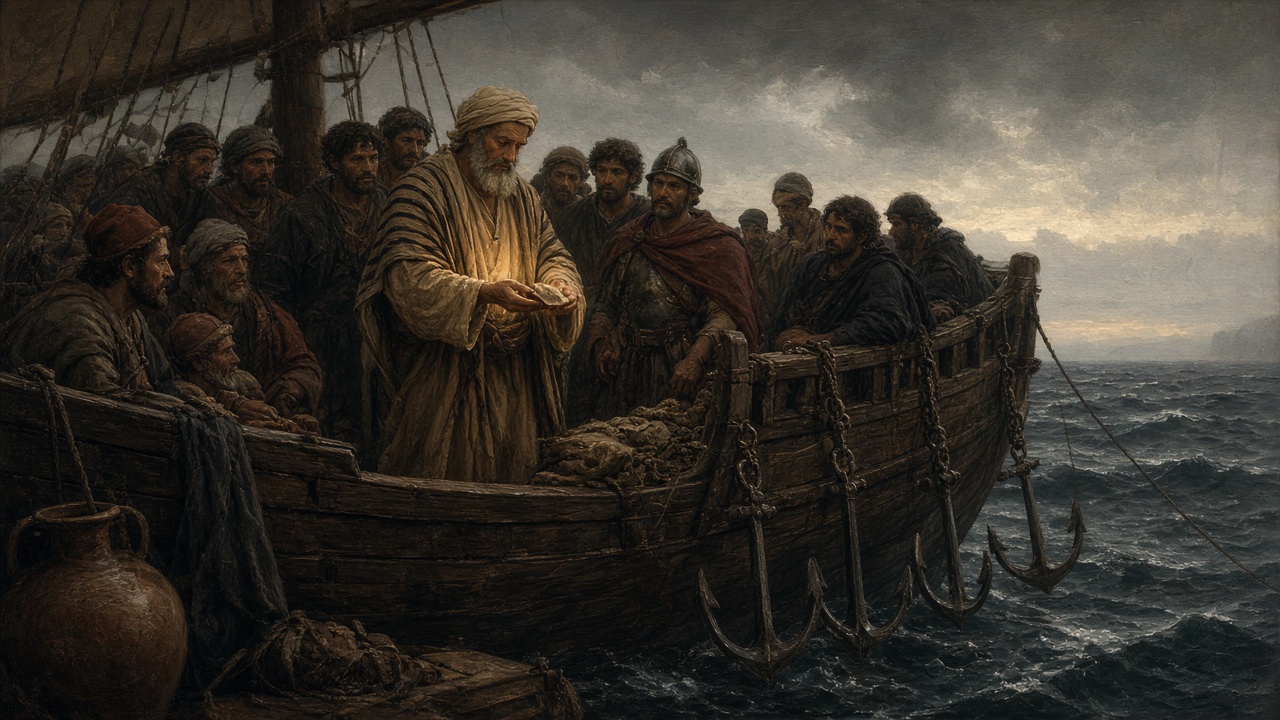
¿Sabías que…?
Tormenta y naufragio camino a Roma
- Pablo y los demás prisioneros no navegaron directo a Italia. En Cesarea abordaron un barco de Adramitio, ciudad de la costa de Misia, en Asia Menor, con rumbo a puertos a lo largo de la costa de Asia, nombre que el Easton's Bible Dictionary entiende en este versículo probablemente como Asia Menor, y ese barco los llevó solo hasta Mira, en Licia. Allí el centurión los hizo subir a un barco alejandrino que navegaba hacia Italia; el diccionario señala que era raro que un barco zarpara de cualquier puerto de Palestina directo a Italia.Fuentes: Adramyttium · Asia · el propio texto bíblico
- Los prisioneros fueron entregados a Julio, centurión del Regimiento Imperial. El Easton's Bible Dictionary lo identifica como centurión de la cohorte Augusta, o de la guardia personal del emperador, y describe el trato cortés que tuvo con Pablo. En Sidón, a unas veinticinco millas al norte de Tiro, le permitió visitar a sus amigos y recibir atención; más tarde impidió el plan de los soldados de matar a los prisioneros, para que se salvara la vida de Pablo.Fuentes: Julius · Sidon · el propio texto bíblico
- Después de Gnido, el barco avanzó a lo largo de Creta, una de las islas más grandes del Mediterráneo, de unas 140 millas de largo y 35 de ancho, que Pablo visitó en este viaje a Roma. El relato dice que el viaje ya se había vuelto peligroso porque era después del Ayuno, y que Buenos Puertos no era adecuado para invernar. Una cronología fecha el inicio del viaje a Roma en el año 56 d.C. y el naufragio en la tormenta en el 57 d.C.Fuentes: Crete · Journey to Rome begins · Paul is shipwrecked by a storm · el propio texto bíblico
Notas escritas con ayuda de IA a partir de fuentes abiertas (Theographic Bible Metadata, CC BY-SA 4.0; Easton’s Bible Dictionary, dominio público) y revisadas antes de publicarse.
Lugares de este capítulo
- Italy · 41.892, 12.485 · versículos 1, 6
- Adramyttium · Hoy: Oren · 39.501, 26.933 · versículo 2
- Asia · 38.400, 28.300 · versículo 2
- Thessalonica · Hoy: Thessaloniki · 40.638, 22.946 · versículo 2
- Sidon · Hoy: Sandikli archaeological site in Sidon · 33.561, 35.372 · versículo 3
- Cyprus · 35.000, 33.000 · versículo 4
- Cilicia · 36.913, 34.892 · versículo 5
- Lycia · 36.733, 29.900 · versículo 5
- Myra · 36.259, 29.985 · versículo 5
- Pamphylia · 37.000, 31.000 · versículo 5
- Alexandria · 31.183, 29.896 · versículo 6
- Cnidus · 36.686, 27.375 · versículo 7
- Crete · 35.310, 24.893 · versículos 7, 8, 12, 13, 14, 21
- Salmone · Hoy: Cape Sideros · 35.316, 26.312 · versículo 7
- Fair Havens · Hoy: Kaloi Limenes · 34.930, 24.800 · versículos 8, 12
- Lasea · Hoy: Lasaea · 34.941, 24.811 · versículo 8
- Cauda · Hoy: Gavdos · 34.833, 24.083 · versículo 16
- Syrtis · Hoy: Sidra · 31.500, 18.000 · versículo 17
- Adriatic Sea · Hoy: Adriatic and Ionian Seas · 38.000, 19.000 · versículo 27
Solo aparecen lugares identificados con alta confianza (90 % o más según las fuentes académicas reunidas por OpenBible). Mapa de la época: DARE (Digital Atlas of the Roman Empire), CC BY 4.0; mapa actual: © colaboradores de OpenStreetMap; lugares: OpenBible.info (CC BY 4.0).
Créditos y licencia de esta traducción
Unlocked Literal Bible
The Holy Bible in English, Unlocked Literal Bible translation
copyright © 2017 Door43 World Missions Community
Language: English
Translation by: Door43 World Missions Community
Contributor: 'Alrick G. Headley, M.Div., Th.M.', 'Adam W. Nagelvoort, M.Div. Academic
Ministries, Columbia International University', 'Dave Statezni, BA Orig langs.,
M.Div. Fuller Theological Seminary', 'Bram van den Heuvel, M.A.', 'C. Harry
Harriss, M.Div.', 'David Trombold, M. Div.', 'Elizabeth Oakes, BA in Religious
Studies, Linguistics', 'George "Drew" Curley, M.Div., PhD, Professor of Biblical
Languages', Hendrik "Henry" de Vries, 'Henry Whitney, BA Linguistics', 'Jesse
Griffin, BA Biblical Studies, MA Biblical Languages', 'James N. Pohlig, M.Div.,
MA in Linguistics, D. Litt. in Biblical Languages', 'Larry T Brooks, M.Div.,
Assemblies of God Theological Seminary', 'Larry Sallee, D.Min.', 'Paul M Fahnestock,
M.Div. Reformed Theological Seminary, D. Min. Pittsburgh Theological Seminary',
'Perry Oakes, PhD in Old Testament, MA in Linguistics', 'Peter Smircich, BA Philosophy',
'Susan Quigley, MA in Linguistics', 'Thomas Warren, M.Div., Trinity Evangelical
Divinity School, D.Min, Reformed Theological Seminary', 'Timothy Neu, Ph.D.
Biblical Studies', 'Ward Pyles, M.Div., Western Baptist Theological Seminary',
David Trombold, Dean Ropp, Gene Mullen, James Vigen, Leonard Smith, Nicholas Alsop,
Michael Francis
This is an open-licensed update of the ASV, intended to provide a 'form-centric' understanding of the Bible. It increases the translator's understanding of the lexical and grammatical composition of the underlying text by adhering closely to the word order and structure of the originals.
This translation is made available to you under the terms of the
Creative Commons Attribution Share-Alike license 4.0.
You have permission to share and redistribute this Bible translation in any format and to make reasonable revisions and adaptations of this translation, provided that:
You include the above copyright and source information.
If you make any changes to the text, you must indicate that you did so in a way that makes it clear that the original licensor is not necessarily endorsing your changes.
If you redistribute this text, you must distribute your contributions under the same license as the original.
Pictures included with Scriptures and other documents on this site are licensed just for use with those Scriptures and documents.
For other uses, please contact the respective copyright owners.
Note that in addition to the rules above, revising and adapting God's Word involves a great responsibility to be true to God's Word. See Revelation 22:18-19.
2020-12-04
Títulos de sección adaptados de la Berean Standard Bible (dominio público); no forman parte del texto bíblico de esta traducción.
Fuente: http://ebible.org/engULB/ · eBible.org