Hechos 15
Unlocked Literal Bible · Toca un versículo para ver sus referencias cruzadas.
Narración generada por IA · texto: Unlocked Literal Bible (CC BY-SA)
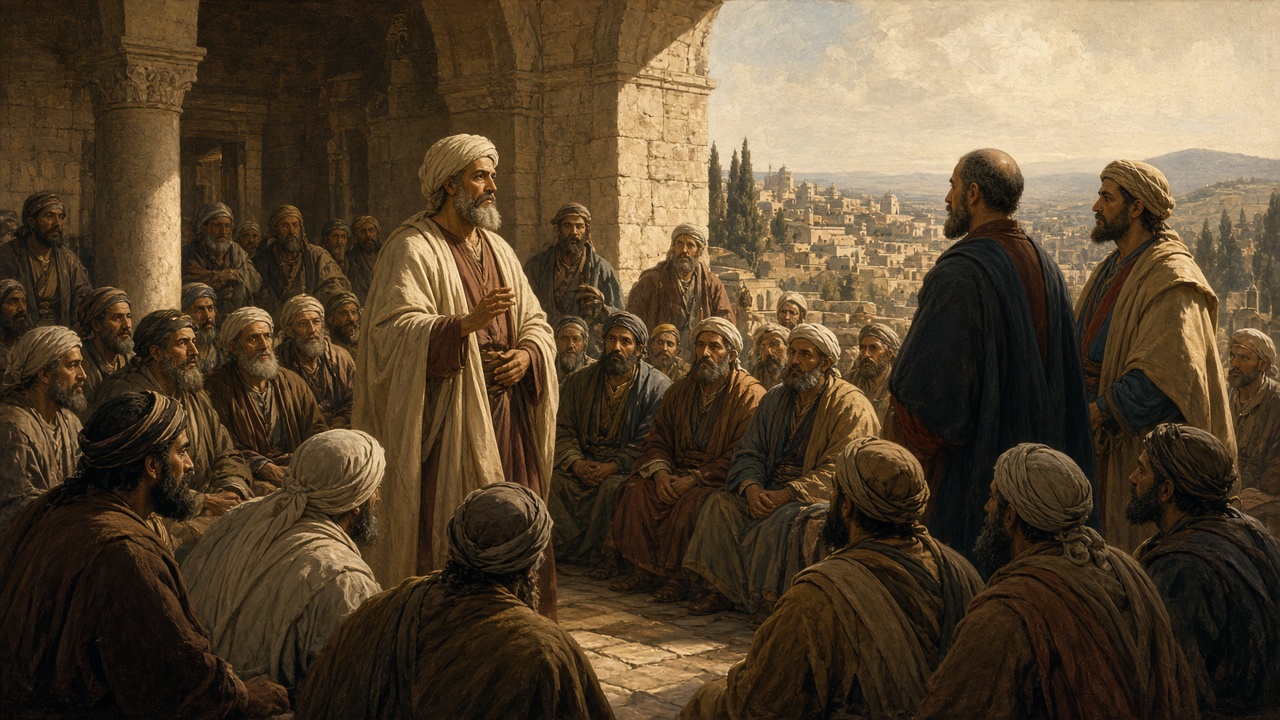
1Some men came down from Judea to Antioch and taught the brothers, saying, “Unless you are circumcised according to the custom of Moses, you cannot be saved.” 2This brought Paul and Barnabas into a sharp dispute and debate with them. So Paul and Barnabas along with some others from among them were appointed to go up to Jerusalem to meet with the apostles and elders about this question. 3They therefore, being sent by the church, passed through both Phoenicia and Samaria and announced the conversion of the Gentiles. They brought great joy to all the brothers. 4When they came to Jerusalem, they were welcomed by the church and the apostles and the elders, and they reported all the things that God had done with them. 5But certain men who believed, who belonged to the group of Pharisees, stood up and said, “It is necessary to circumcise them and to command them to keep the law of Moses.” 6So the apostles and the elders gathered together to consider this matter. 7After much debate, Peter stood up and said to them, “Brothers, you know that a good while ago God made a choice among you, that by my mouth the Gentiles should hear the word of the gospel, and believe. 8God, who knows the heart, witnesses to them, giving them the Holy Spirit, just as he did to us; 9and he made no distinction between us and them, making their hearts clean by faith. 10Now therefore why do you test God, that you should put a yoke upon the neck of the disciples which neither our fathers nor we were able to bear? 11But we believe that we shall be saved through the grace of the Lord Jesus, just as they were.” 12All the multitude kept silent while they listened to Barnabas and Paul report the signs and wonders God had worked among the Gentiles through them. 13After they stopped speaking, James answered, saying, “Brothers, listen to me. 14Simon has told how God first graciously helped the Gentiles in order to take from them a people for his name. 15The words of the prophets agree with this, as it is written, 16'After these things I will return, and I will build again the tent of David, which has fallen down; I will set up and restore its ruins again, 17so that the remnant of men may seek the Lord, including all the Gentiles called by my name.' 18This is what the Lord says, who has done these things that have been known from ancient times. 19Therefore, my opinion is, that we should not trouble those of the Gentiles who turn to God. 20But we will write to them that they must keep away from the pollution of idols, from sexual immorality, and from the meat of strangled animals, and from blood. 21For Moses has been proclaimed in every city from the ancient times and he is read in the synagogues every Sabbath.” 22Then it seemed good to the apostles and the elders, with the whole church, to choose Judas called Barsabbas, and Silas, who were leaders of the church, and send them to Antioch with Paul and Barnabas. 23They wrote this: “From the apostles and elders, your brothers, to the Gentile brothers in Antioch, Syria, and Cilicia: Greetings! 24We have heard that certain men have gone out from us, with no orders from us, and have disturbed you with teachings that upset your souls. 25This being so, all of us have agreed to choose men and to send them to you along with our beloved Barnabas and Paul, 26men who have risked their lives for the name of our Lord Jesus Christ. 27Therefore we are sending Judas and Silas, who will tell you the same thing themselves in their own words. 28For it seemed good to the Holy Spirit and to us, to lay upon you no greater burden than these necessary things: 29that you abstain from things sacrificed to idols, blood, things strangled, and from sexual immorality. If you keep yourselves from these, it shall be well with you. Farewell.” 30So they, when they were dismissed, came down to Antioch; after they gathered the multitude together, they delivered the letter. 31When they had read it, they rejoiced because of the encouragement. 32Judas and Silas, also prophets, encouraged the brothers with many words and strengthened them. 33After they had spent some time there, they were sent away in peace from the brothers to those who had sent them. 35But Paul and Barnabas stayed in Antioch along with many others, where they taught and proclaimed the word of the Lord. 36After some days Paul said to Barnabas, “Let us return now and visit the brothers in every city where we proclaimed the word of the Lord, and see how they are.” 37Barnabas wanted to also take with them John who was called Mark. 38But Paul thought it was not good to take Mark, who had left them in Pamphylia and did not go further with them in the work. 39Then there arose a sharp disagreement, so that they separated from each other, and Barnabas took Mark with him and sailed away to Cyprus. 40But Paul chose Silas and left, after he was entrusted by the brothers to the grace of the Lord. 41Then he went through Syria and Cilicia, strengthening the churches.
¿Sabías que…?
El concilio sobre los creyentes gentiles
- La controversia comenzó en Antioquía, a orillas del Orontes, unas trescientas millas al norte de Jerusalén, ciudad que entonces ocupaba el tercer lugar entre las ciudades del Imperio romano, después de Roma y Alejandría. De camino al concilio, Pablo y Bernabé pasaron por Fenicia, una franja costera de unas ciento veinte millas, y por Samaria. Una nota cronológica fecha el Concilio de Jerusalén en el año 46 d. C.Fuentes: Antioch (Syria) · Phenicia · el propio texto bíblico · Jerusalem Council
- El Easton's Bible Dictionary (1897) afirma que Santiago, a quien llama hermano o pariente cercano de Jesús, dirigía la iglesia en Jerusalén y presidió el concilio sobre los gentiles. La carta que siguió iba dirigida a los creyentes gentiles de Antioquía, Siria y Cilicia. Cilicia, provincia de origen de Pablo y provincia marítima romana en el sureste de Asia Menor desde el 67 a. C., incluía su ciudad natal, Tarso.Fuentes: James (Brother of Jesus) · el propio texto bíblico · Cilicia · Paul
- Judas, llamado Barsabás, y Silas, también conocido como Silvano, eran profetas y hombres destacados de la iglesia de Jerusalén, enviados para confirmar en persona la decisión del concilio. Un desacuerdo posterior y agudo por Juan Marcos, primo de Bernabé, separó a los dos misioneros: Bernabé se llevó a Marcos y zarpó hacia Chipre, mientras Pablo eligió a Silas. Una nota cronológica fecha esa separación en el año 47 d. C.Fuentes: el propio texto bíblico · Silas · John Mark · Paul and Barnabas part ways
Notas escritas con ayuda de IA a partir de fuentes abiertas (Theographic Bible Metadata, CC BY-SA 4.0; Easton’s Bible Dictionary, dominio público) y revisadas antes de publicarse.
Lugares de este capítulo
- Antioch · Hoy: Antioch on the Orontes · 36.227, 36.172 · versículos 1, 22, 23, 30, 35
- Judea · Hoy: Judea 1 · 31.777, 35.234 · versículo 1
- Jerusalem · 31.777, 35.234 · versículos 2, 3, 4, 22, 23, 33
- Phoenicia · 33.271, 35.196 · versículo 3
- Samaria · Hoy: Samaria 2 · 32.276, 35.195 · versículo 3
- Cilicia · 36.913, 34.892 · versículos 23, 41
- Syria · Hoy: Syria 2 · 33.511, 36.306 · versículos 23, 41
- Pamphylia · 37.000, 31.000 · versículo 38
- Cyprus · 35.000, 33.000 · versículo 39
Solo aparecen lugares identificados con alta confianza (90 % o más según las fuentes académicas reunidas por OpenBible). Mapa de la época: DARE (Digital Atlas of the Roman Empire), CC BY 4.0; mapa actual: © colaboradores de OpenStreetMap; lugares: OpenBible.info (CC BY 4.0).
Créditos y licencia de esta traducción
Unlocked Literal Bible
The Holy Bible in English, Unlocked Literal Bible translation
copyright © 2017 Door43 World Missions Community
Language: English
Translation by: Door43 World Missions Community
Contributor: 'Alrick G. Headley, M.Div., Th.M.', 'Adam W. Nagelvoort, M.Div. Academic
Ministries, Columbia International University', 'Dave Statezni, BA Orig langs.,
M.Div. Fuller Theological Seminary', 'Bram van den Heuvel, M.A.', 'C. Harry
Harriss, M.Div.', 'David Trombold, M. Div.', 'Elizabeth Oakes, BA in Religious
Studies, Linguistics', 'George "Drew" Curley, M.Div., PhD, Professor of Biblical
Languages', Hendrik "Henry" de Vries, 'Henry Whitney, BA Linguistics', 'Jesse
Griffin, BA Biblical Studies, MA Biblical Languages', 'James N. Pohlig, M.Div.,
MA in Linguistics, D. Litt. in Biblical Languages', 'Larry T Brooks, M.Div.,
Assemblies of God Theological Seminary', 'Larry Sallee, D.Min.', 'Paul M Fahnestock,
M.Div. Reformed Theological Seminary, D. Min. Pittsburgh Theological Seminary',
'Perry Oakes, PhD in Old Testament, MA in Linguistics', 'Peter Smircich, BA Philosophy',
'Susan Quigley, MA in Linguistics', 'Thomas Warren, M.Div., Trinity Evangelical
Divinity School, D.Min, Reformed Theological Seminary', 'Timothy Neu, Ph.D.
Biblical Studies', 'Ward Pyles, M.Div., Western Baptist Theological Seminary',
David Trombold, Dean Ropp, Gene Mullen, James Vigen, Leonard Smith, Nicholas Alsop,
Michael Francis
This is an open-licensed update of the ASV, intended to provide a 'form-centric' understanding of the Bible. It increases the translator's understanding of the lexical and grammatical composition of the underlying text by adhering closely to the word order and structure of the originals.
This translation is made available to you under the terms of the
Creative Commons Attribution Share-Alike license 4.0.
You have permission to share and redistribute this Bible translation in any format and to make reasonable revisions and adaptations of this translation, provided that:
You include the above copyright and source information.
If you make any changes to the text, you must indicate that you did so in a way that makes it clear that the original licensor is not necessarily endorsing your changes.
If you redistribute this text, you must distribute your contributions under the same license as the original.
Pictures included with Scriptures and other documents on this site are licensed just for use with those Scriptures and documents.
For other uses, please contact the respective copyright owners.
Note that in addition to the rules above, revising and adapting God's Word involves a great responsibility to be true to God's Word. See Revelation 22:18-19.
2020-12-04
Fuente: http://ebible.org/engULB/ · eBible.org