Lucas 23
Plain English Version · Toca un versículo para ver sus referencias cruzadas.
Pilate sent Jesus to the big boss called Herod
5The Jewish leaders kept on blaming Jesus. They told Pilate, “He gets people everywhere to go wild. He started to do that in Galilee country, then in Judea country, and now he is doing it here in Jerusalem.”
6When Pilate heard them say that, he asked them, “Is he from Galilee country?”
7They said, “Yes, he is from Galilee.”
The big boss over Galilee was called Herod, and he was visiting Jerusalem right at that time. So Pilate sent Jesus to him, to let Herod be his judge.
8Herod was very happy to see Jesus. You see, a long time before that day, Herod heard about Jesus, so he always wanted to meet him. He wanted to see Jesus do something powerful. 9So Herod asked him a lot of questions, but Jesus didn’t answer any of them. 10The bosses of the Jewish ceremonies and the Jewish law teachers, they stood there all that time, shouting out and blaming Jesus. 11Then Herod and his soldiers started laughing at Jesus and rubbishing him. They put a pretty coat on him, the sort that a big boss wears. Then they sent him back to Pilate.
12You know, before that day Herod and Pilate didn’t like each other, but on that day they became friends.
Jesus told the Jerusalem women that something bad will happen
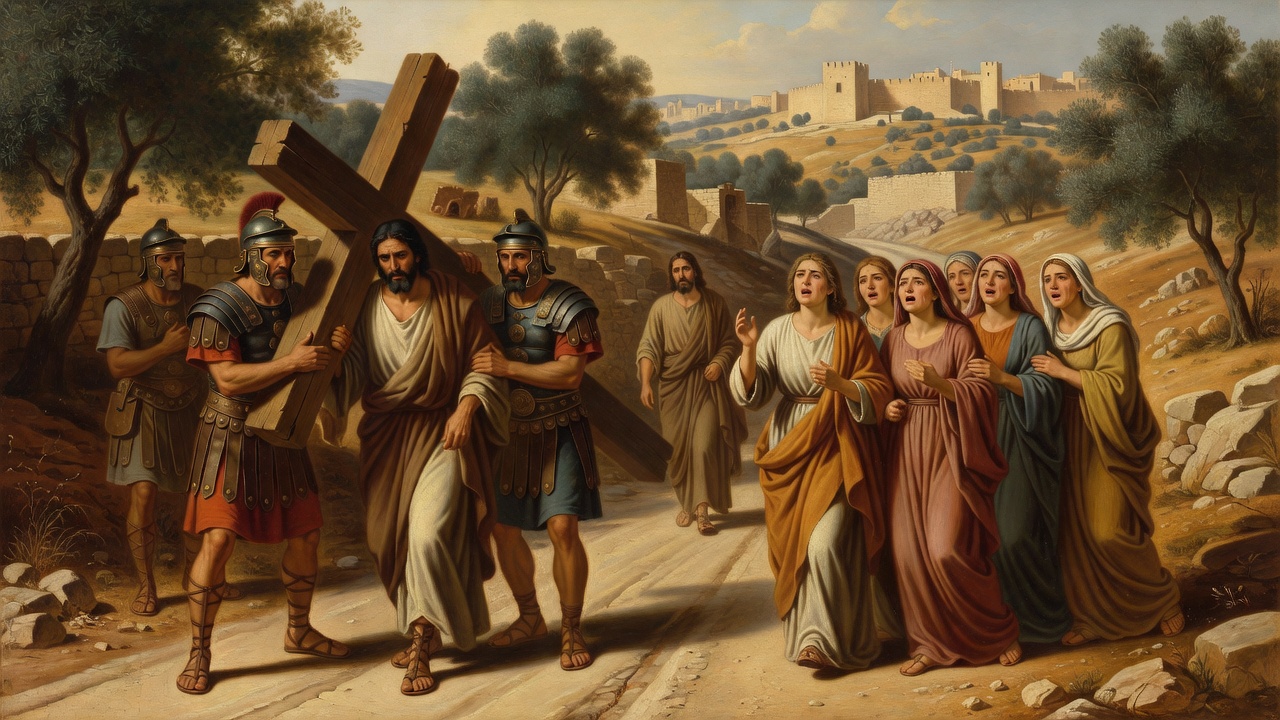
27A big mob of people followed Jesus. There were a lot of women among them. They were really sad. They were crying really loud, and they were hitting themselves. 28So Jesus turned around and said to them, “You women that live here in Jerusalem, don’t cry for me, but cry for yourselves, and for your kids. 29Listen, soon bad things will happen to everybody. The time will come when people will say, ‘Those women that can’t have babies, and those women that don’t have to feed babies, they are the lucky ones.’ 30Things will be so bad that people will want to die, so they will ask the mountains to fall on top of them and kill them. And they will ask the hills to bury them.
31You see, I didn’t do anything wrong and people are hurting me. But you mob do bad things, so people will hurt you a lot more.”
One criminal believed in Jesus
39One of the criminals hanging on a cross beside Jesus was rubbishing him, and said, “You reckon you are the Christ, the special man that God promised to send to save us. All right, if you are God’s man, then save yourself, and save us too. But I reckon you can’t do it.”
40But the other criminal hanging on a cross said, “Don’t talk like that. Have a bit of respect for God. Listen, they are killing the 3 of us together. 41They are killing you and me because we did really bad things, but this man, Jesus, he didn’t do anything wrong.”
42Then that criminal talked to Jesus. He said, “Jesus, you are going to get God’s people together into one family, and you will be their leader. When you do that, don’t forget me. I want to be there with you too.”
43Jesus said, “All right. Listen, you will be with me today, in God’s good place called Paradise. That’s for sure.”
¿Sabías que…?
Juicio, cruz y sepultura
- Poncio Pilato, identificado por el Diccionario Bíblico de Easton (1897) como el sexto procurador romano de Judea (26–36 d.C.), tenía su sede en Cesarea, pero subía con frecuencia a Jerusalén. Las acusaciones del consejo en este capítulo son políticas: que Jesús subvertía a la nación, prohibía el pago de impuestos al César y se proclamaba el Cristo, un rey.Fuentes: Pontius Pilate · el propio texto bíblico
- Cuando Pilato supo que Jesús era galileo y estaba bajo la jurisdicción de Herodes, lo envió a Herodes Antipas, hijo de Herodes con Maltace, que entonces estaba en Jerusalén. Herodes hacía tiempo que quería ver a Jesús y esperaba un milagro, pero Jesús no respondió a sus preguntas. Después de que Herodes y sus soldados se burlaron de Jesús y lo vistieron con un manto fino, lo enviaron de vuelta, y aquel día Herodes y Pilato, que habían sido enemigos, se hicieron amigos.Fuentes: Herod Antipas · el propio texto bíblico
- El lugar de la crucifixión se llama la Calavera; la forma latina Calvaria traducía el griego Kranion, que vertía el hebreo Gulgoleth. Probablemente recibió ese nombre por su forma, una elevación baja, redondeada y desnuda, algo parecida a un cráneo humano, y la Escritura en ningún lugar lo llama colina. La crucifixión tuvo lugar fuera de los muros de la ciudad y cerca de un camino público.Fuentes: Skull · el propio texto bíblico
Notas escritas con ayuda de IA a partir de fuentes abiertas (Theographic Bible Metadata, CC BY-SA 4.0; Easton’s Bible Dictionary, dominio público) y revisadas antes de publicarse.
Lugares de este capítulo
- Galilee · 32.760, 35.527 · versículos 5, 6, 7, 49, 55
- Jerusalem · 31.777, 35.234 · versículos 5, 7, 19, 28
- Judea · Hoy: Judea 1 · 31.777, 35.234 · versículos 5, 51
- Cyrene · 32.821, 21.851 · versículo 26
Solo aparecen lugares identificados con alta confianza (90 % o más según las fuentes académicas reunidas por OpenBible). Mapa de la época: DARE (Digital Atlas of the Roman Empire), CC BY 4.0; mapa actual: © colaboradores de OpenStreetMap; lugares: OpenBible.info (CC BY 4.0).
Créditos y licencia de esta traducción
Plain English Version
Portions of the Holy Bible in the Plain English Version translation for Australian Aboriginal people who speak English as a second language
Copyright © 2026 Wycliffe Bible Translators Australia
Language: Aboriginal English (English)
Dialect: Australian Aboriginal
Plain English Version © 2026 by Wycliffe Bible Translators Australia, licensed under Creative Commons Attribution-Share Alike 4.0 International (CC BY SA 4.0)
This licence allows you to copy and redistribute the material in any medium or format, even commercially. You may adapt, remix, transform, and build upon the material for any purpose, but if you do so, you must distribute your contributions under the same license as the original. You must always give appropriate credit, provide a link to the license, and indicate if changes were made. You may not suggest that Wycliffe Bible Translators endorses you or your use.
For full details of the licence, visit: creativecommons.org/licenses/by-sa/4.0/legalcode
This translation is made available to you under the terms of the
Creative Commons Attribution Share-Alike license 4.0.
You have permission to share and redistribute this Bible translation in any format and to make reasonable revisions and adaptations of this translation, provided that:
You include the above copyright and source information.
If you make any changes to the text, you must indicate that you did so in a way that makes it clear that the original licensor is not necessarily endorsing your changes.
If you redistribute this text, you must distribute your contributions under the same license as the original.
Pictures included with Scriptures and other documents on this site are licensed just for use with those Scriptures and documents.
For other uses, please contact the respective copyright owners.
Note that in addition to the rules above, revising and adapting God's Word involves a great responsibility to be true to God's Word. See Revelation 22:18-19.
2026-10-02
Fuente: http://ebible.org/engPEV/ · eBible.org