Génesis 8
Plain English Version · Toca un versículo para ver sus referencias cruzadas.
The flood water went down
1And then God thought about Noah and the animals with him in that big boat. And he made a strong wind blow on the flood water to help it to go down. 2And God stopped the water from coming up from under the ground, and he stopped the rain falling from the sky.
3The flood water went down slowly, and after 5 months it was a lot lower. 4So 5 months after the start of the flood, the big boat got stuck in the mountains called the Ararat mountains. 5The flood water kept going down for the next 2½ months, and then they saw the tops of the mountains, sticking up out of the water.
Noah let some birds go out of the boat to fly around
6Then, 40 days later, Noah opened a window in the big boat. He wanted to find out if the water went down, and if a bird could find some dry ground. 7So he let a crow go out of the window. The crow didn’t come back to the big boat. It just kept on flying around until the flood waters dried up.
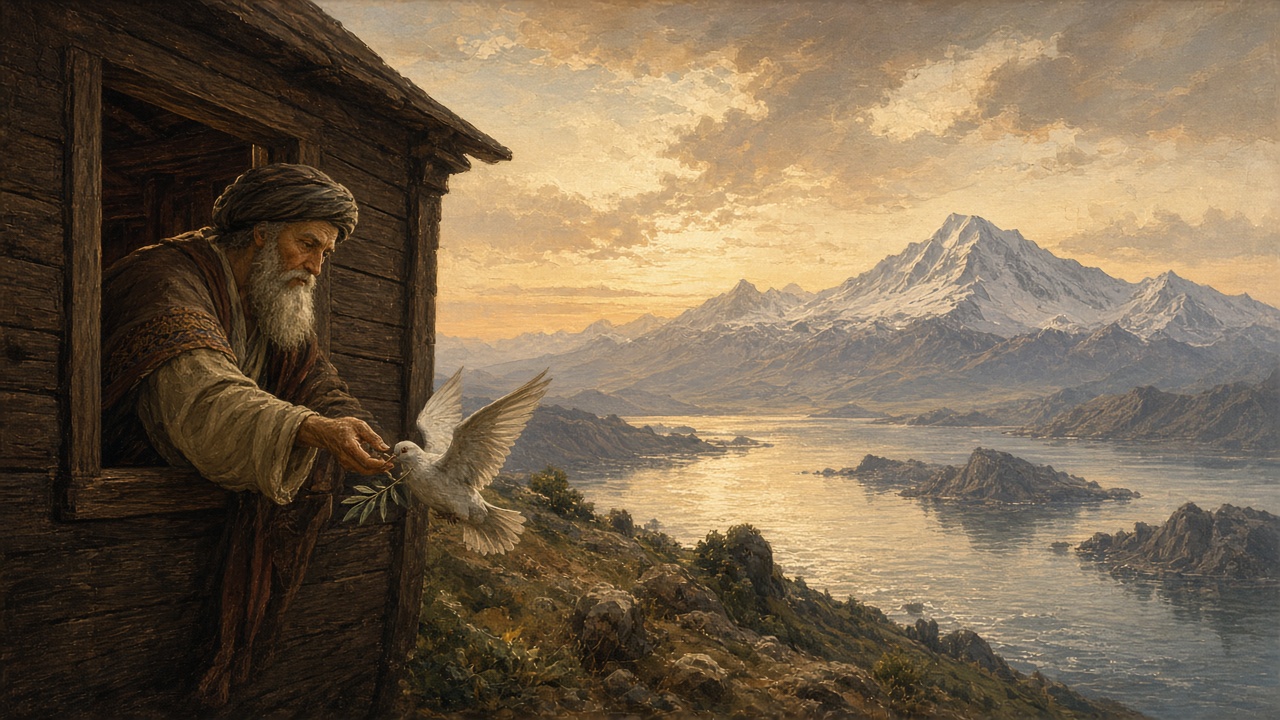
8So Noah let a pigeon go out of the window. But the flood water still covered the ground, and the pigeon couldn’t find a place to stop and rest, so it went back to the big boat. Noah held out his hand for the bird, and he helped it back into the boat.
10Noah waited for 7 more days, and then he let the pigeon go out of the boat again. 11This time the pigeon came back just before night time. It had a fresh leaf from an olive tree in its mouth. Then Noah knew the flood water was getting lower, and the trees were growing again. The pigeon came back to Noah with an olive tree leaf|src="01_Gen 8_Noah & Dove.tif" size="col" ref="8:11" 12Noah waited 7 more days, then he sent the pigeon out again. This time the pigeon didn’t come back to the big boat.
Everyone left the boat
13Noah was 601 years old at that time.
The water was still going down, and on the 1st day of the new year, Noah took off some of the roof from the big boat and looked around. He could see that the ground was getting dry. 14After another 2 months, the earth was dry. 15Then God said to Noah, 16“You can go out of the big boat now. You can all go out, you, and your wife, and your sons, and their wives too. 17And bring all the animals out of the big boat. Bring out all the animals, and the birds, and the animals that crawl around on the ground. They can all come out, so they can live on the earth and have lots of young ones, so that they will go everywhere on the earth.”
18So Noah, and his wife, and his sons, and their wives, they all came out of the big boat. And all the animals and all the birds came out of the big boat too. They came out in groups. Each sort of animal was in its family group.
Noah said thank you to God
20Then Noah piled up stones to make a special table with a flat top, and he got one of each sort of animal and bird that are the right sorts to give to God, and he killed them, and he put them on that special table, and he burned them there. He did that to give them to God, to say thank you to God. Noah killed animals and burned them to say thank you to God|src="01008020 210 - Genesis 8 20 - Noah built and alter unto the Lord.tif" size="col" ref="8:20"
21God smelled the meat cooking on that stone table, and he was happy. Then God said to himself, “People always just want to do bad things. They do that all their lives, from when they are little kids, right up until the time they die. But I will never again punish them the same way that I did this time. I will never again finish up everything that breathes air, and I will never again curse the earth. While the earth is still here, the seasons will stay the same. There will always be day and night, and every year there will be a hot time and a cold time, a wet season and a dry season. There will always be a right time to plant seeds for food, and a right time to get the food from those plants.”
¿Sabías que…?
Las aguas retroceden
- El arca se detuvo sobre los montes de Ararat, nombre que significa “tierra sagrada” o “tierra alta” y designa un país en cuyas montañas el arca reposó después del diluvio. El Easton's Bible Dictionary (1897) sugiere que esos montes eran, probablemente, la cordillera kurda del sur de Armenia, aunque el nombre también se aplica comúnmente a un pico alto y casi inaccesible que se alza desde la llanura del Araxes. En 2 Reyes 19:37 e Isaías 37:38, la Authorized Version traduce el nombre como “Armenia” y la Revised Version como “tierra de Ararat”, mientras que Jeremías 51:27 lo usa para la Armenia central o meridional.Fuentes: Ararat · el propio texto bíblico
- El nombre hebreo de Noé significa “descanso”, y en este capítulo la propia arca llega a reposar mientras bajan las aguas. Era hijo de Lamec y nieto de Matusalén, y padre de Sem, Cam y Jafet. El Easton's Bible Dictionary lo describe como el vínculo entre el mundo antiguo y el nuevo, y como un segundo gran progenitor de la familia humana.Fuentes: Noah · el propio texto bíblico
- Unas notas cronológicas sitúan el Gran Diluvio en 2347 a. C., con una duración de un año; el descenso de las aguas en 2346 a. C., a lo largo de 220 días; y la salida del arca en 2346 a. C., en un solo día. En el propio capítulo, las aguas ya han bajado después de 150 días y el arca reposa el día diecisiete del mes séptimo; el día primero del mes primero del año seiscientos uno de Noé las aguas se han secado, y para el día veintisiete del mes segundo la tierra está completamente seca.Fuentes: The Great Flood · The flood subsides · Leaving the Ark · el propio texto bíblico
Notas escritas con ayuda de IA a partir de fuentes abiertas (Theographic Bible Metadata, CC BY-SA 4.0; Easton’s Bible Dictionary, dominio público) y revisadas antes de publicarse.
Lugares de este capítulo
- Ararat · Hoy: Urartu · 39.703, 44.300 · versículo 4
Solo aparecen lugares identificados con alta confianza (90 % o más según las fuentes académicas reunidas por OpenBible). Mapa de la época: DARE (Digital Atlas of the Roman Empire), CC BY 4.0; mapa actual: © colaboradores de OpenStreetMap; lugares: OpenBible.info (CC BY 4.0).
Créditos y licencia de esta traducción
Plain English Version
Portions of the Holy Bible in the Plain English Version translation for Australian Aboriginal people who speak English as a second language
Copyright © 2026 Wycliffe Bible Translators Australia
Language: Aboriginal English (English)
Dialect: Australian Aboriginal
Plain English Version © 2026 by Wycliffe Bible Translators Australia, licensed under Creative Commons Attribution-Share Alike 4.0 International (CC BY SA 4.0)
This licence allows you to copy and redistribute the material in any medium or format, even commercially. You may adapt, remix, transform, and build upon the material for any purpose, but if you do so, you must distribute your contributions under the same license as the original. You must always give appropriate credit, provide a link to the license, and indicate if changes were made. You may not suggest that Wycliffe Bible Translators endorses you or your use.
For full details of the licence, visit: creativecommons.org/licenses/by-sa/4.0/legalcode
This translation is made available to you under the terms of the
Creative Commons Attribution Share-Alike license 4.0.
You have permission to share and redistribute this Bible translation in any format and to make reasonable revisions and adaptations of this translation, provided that:
You include the above copyright and source information.
If you make any changes to the text, you must indicate that you did so in a way that makes it clear that the original licensor is not necessarily endorsing your changes.
If you redistribute this text, you must distribute your contributions under the same license as the original.
Pictures included with Scriptures and other documents on this site are licensed just for use with those Scriptures and documents.
For other uses, please contact the respective copyright owners.
Note that in addition to the rules above, revising and adapting God's Word involves a great responsibility to be true to God's Word. See Revelation 22:18-19.
2026-10-02
Fuente: http://ebible.org/engPEV/ · eBible.org