Génesis 50
Plain English Version · Toca un versículo para ver sus referencias cruzadas.
Joseph had a big funeral for his father
1Then Joseph bent down and hugged his father’s body. He cried, and he kissed his father’s face. 2Then Joseph talked to some of his workers. Joseph said to them, “My father Jacob died. Now I want you to get his body ready for the funeral. I want you to look after his body in that special way that you do for important people.”
So those men worked on Jacob’s body to get it ready, then they put special oils and perfumes on his body, so that it will not rot away. Then they wrapped his body in long bits of cloth, and they put it in a special coffin. Some Egypt people put special oils on Jacob’s body and wrapped it in long bits of cloth|alt="(BING AI image creator)" src="Bing mummification.jpg" size="col" copy="N/A (AI)" ref="50:2" 3It took them 40 days to finish doing all those things.
The Egypt people cried for Jacob for 70 days.
4At the end of those 70 days, Joseph talked to Pharaoh’s important workers. Joseph said to them, “I want you to do something for me. Please be good to me, and do this thing that I ask. Please go to Pharaoh, and tell him that I said, 5‘My father talked to me before he died. He said, “I am going to die very soon. After I die, I want you to take my body to Canaan country, and put it in that grave that I got ready for myself.” And my father got me to promise that I will do that. So now, please let me go to Canaan country, so that I can bury my father there, just like he said. Then I will come back here.’”
6So Pharaoh’s workers went to Pharaoh, and they said everything Joseph asked them to say. And Pharaoh told them to say to Joseph, “Yes, you can go to Canaan country, and you can bury your father there, just like you promised him.”
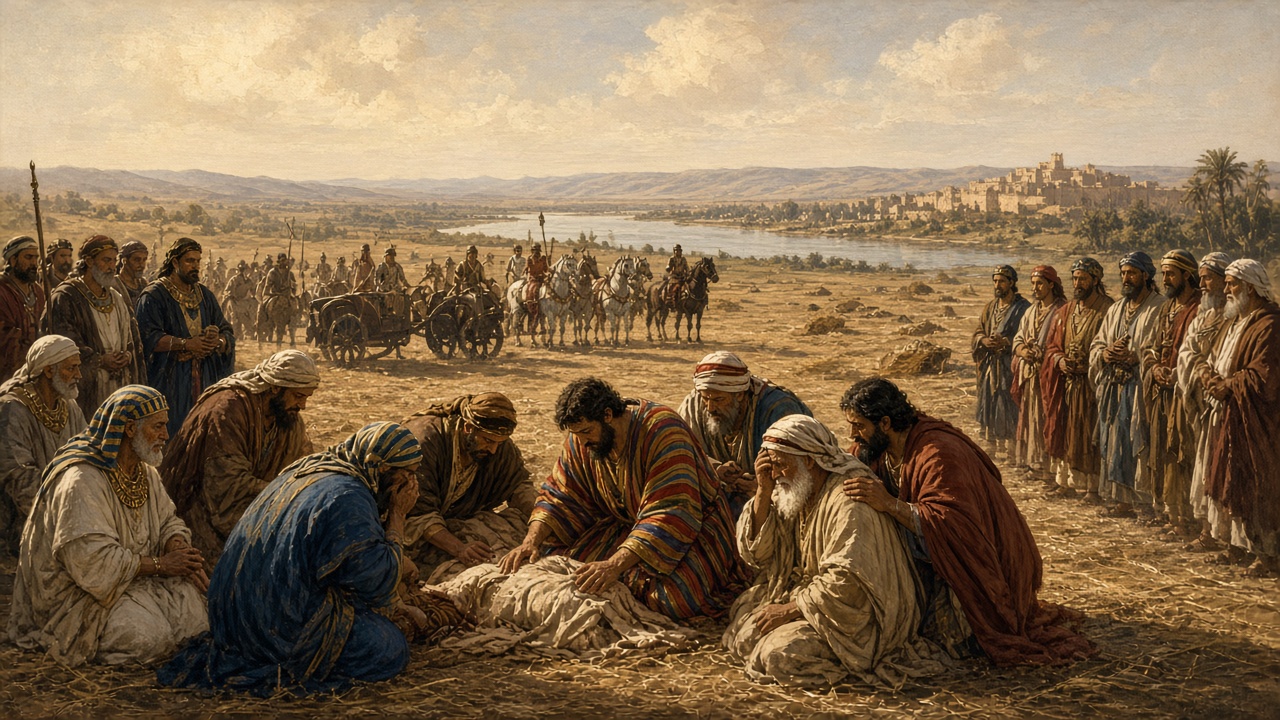
7So Joseph left Egypt, and he started to go towards Canaan country. He took his father’s coffin with him, so that he could bury him in Canaan country. And lots of people went with Joseph. All of Pharaoh’s important workers went with him, and all the boss men from Egypt country went with him. 8And Joseph’s brothers, and the rest of his family, and his father’s relatives, they all went with Joseph too. Only the little kids and the animals stayed in Egypt country, that was all. They stayed there in the place where they were living, called Goshen. Everybody else went with Joseph to Canaan country. 9And some of Pharaoh’s soldiers went with Joseph too. Some of those soldiers rode on horses, and some of them rode in trailers with horses pulling them. All of that mob went with Joseph to Canaan country. It was a really big mob of people.
10After a while, Joseph and his mob got to the place called Atad, near the Jordan River. There was a place there with flat ground, where farmers sometimes sorted their plants. Joseph and his mob stopped there, and they cried loudly for Joseph’s father. Joseph and his mob cried for 7 days, and they did other things to show that they were very sad.
11The Canaan people lived in that land. They saw Joseph and his mob crying at the place called Atad, near the Jordan River. And they said to each other, “Look at that mob that came here from Egypt country. They are really sad.” So the Canaan people gave that place a new name. They called it Abel-Mizrayim. That name means the Egypt people are sad.
12Then Joseph and his brothers took their father’s coffin to the place in Canaan country that their father told them about. They put his coffin in the cave there, just like he told them to. Jacob’s family owned that cave and the land around it. You see, a long time before this, Abraham bought that land and that cave from a man from the Heth tribe. That man’s name was Efron. Abraham bought that cave to use it as a grave. It was at a place called Makpelah, to the east of Mamreh.
14That’s the story about how Joseph buried his father. After that, Joseph went back to Egypt country with his brothers, and with everybody else that came to Canaan country with him.
Joseph did not do payback to his brothers
15After Jacob died, Joseph’s brothers started to worry, and they said to each other, “When our father was alive, Joseph was good to us. But maybe Joseph is still angry about all those bad things that we did to him. Now our father is dead, maybe Joseph will do payback to us.”
16So Joseph’s brothers sent a message to Joseph. This is what they said in that message, “Joseph, our father talked to us before he died. 17He told us to say to you, ‘I know that your brothers did really bad things to you. They went wrong, and they hurt you. Please let go of all those bad things that your brothers did, and don’t do payback to them.’”
Joseph’s brothers also said this in their message, “Please let go of all those bad things that we did, and don’t do payback to us. We respect God, just like our father did.”
Joseph listened to that message from his brothers, and he started to cry.
18Then his brothers came to him, and they quickly got down on their knees and put their faces near the ground, to show respect to Joseph. And they said to Joseph, “You are our boss, and we are your work-men.”
19But Joseph said to his brothers, “Don’t be frightened. God is the only true judge. I’m not God, so I will not judge you mob.”
20Then Joseph said, “You know, a long time ago, you mob made a plan to hurt me. But God had a plan too. His plan was good, and it was more powerful than your plan. You did bad things, but God used them to make good things happen. Yes, he brought me here to Egypt country, so that I helped lots of people stay alive when the food plants didn’t grow. And those people are still alive today. 21So don’t be frightened. I will not do payback to you mob. No, I will keep on looking after you and your little kids, and I will make sure that you always have enough food to eat.” Joseph told his brothers that he will not do payback to them|src="Bible0331 - edited.jpg" size="col" copy="Read'n Grow Picture Bible" ref="50:21"
In that way, Joseph talked in a friendly way to his brothers, and he helped them feel happy again.
Joseph got old and died
22After that, Joseph kept on living in Egypt, and all his father’s family lived there too. And Joseph lived until he was 110 years old.
23While Joseph was still alive, his sons Ephraim and Manasseh had kids, and some of those kids had kids too. So Joseph got to see his great grand-kids. One of Manasseh’s sons was called Makir, and later on, Makir had his own kids. Then Joseph adopted Makir’s kids into his family, and they became like his own kids.
24Then one day, Joseph said to his brothers, “I am going to die very soon. But don’t worry. God is going to help you mob in a powerful way. Yes, one day, God will take all our mob out of this country, and he will give our mob all the land in Canaan country, just like he promised to our great grand-father Abraham, and our grand-father Isaac, and our father Jacob.”
25Then Joseph got his brothers to make a strong promise. He said, “You have to promise that you will not leave my body here in Egypt country. When God takes our mob back to Canaan country, they have to take my body with them.”
26Then Joseph died. He was 110 years old. The Egypt people put special oils and perfumes on Joseph’s body, so that it will not rot away. Then they wrapped his body in long bits of cloth, and they put it in a coffin in Egypt country.
¿Sabías que…?
El entierro de Jacob y la muerte de José
- La era de Atad, donde la comitiva se lamentó a gritos durante siete días al otro lado del Jordán, toma su nombre de una palabra que significa espino cerval. Los cananeos que vieron el duelo llamaron al lugar Abel-mizraim, 'prado de Egipto' o 'duelo de Egipto'. El Diccionario Bíblico de Easton sitúa Abel-mizraim al oeste del Jordán y dice que su ubicación es desconocida, mientras describe Atad como probablemente cercano a Hebrón.Fuentes: el propio texto bíblico
- Los hijos de Jacob lo sepultaron en la cueva de Macpela, en el campo cerca de Mamre, el sitio de entierro que Abraham había comprado a Efrón el hitita. El Diccionario Bíblico de Easton identifica a Efrón como hijo de Zohar y registra el precio de cuatrocientos siclos de plata.Fuentes: el propio texto bíblico
- José permaneció en Egipto y vivió hasta los ciento diez años, lo suficiente para ver a los hijos de Efraín hasta la tercera generación. Los hijos de Maquir, hijo de Manasés, fueron criados sobre las rodillas de José —frase que la Revised Version inglesa traduce como 'nacidos sobre las rodillas de José' y que el Diccionario Bíblico de Easton explica como una adopción desde el nacimiento. Él dijo a sus hermanos que Dios los haría subir a la tierra prometida a Abraham, Isaac y Jacob, e hizo jurar a los hijos de Israel que subirían sus huesos desde Egipto; cuando murió, lo embalsamaron y lo pusieron en un ataúd allí.Fuentes: el propio texto bíblico
Notas escritas con ayuda de IA a partir de fuentes abiertas (Theographic Bible Metadata, CC BY-SA 4.0; Easton’s Bible Dictionary, dominio público) y revisadas antes de publicarse.
Lugares de este capítulo
- Canaan · 32.767, 35.333 · versículos 5, 13
- Egypt · 30.129, 31.308 · versículos 7, 14, 22, 24, 26
- Goshen · Hoy: Goshen 1 · 30.799, 31.834 · versículo 8
- Atad · Hoy: near the mouth of the Jordan River · 31.915, 35.530 · versículos 10, 11
- Jordan · Hoy: Jordan River · 31.761, 35.558 · versículos 10, 11
- Machpelah · Hoy: Cave of the Patriarchs · 31.525, 35.111 · versículo 13
Solo aparecen lugares identificados con alta confianza (90 % o más según las fuentes académicas reunidas por OpenBible). Mapa de la época: DARE (Digital Atlas of the Roman Empire), CC BY 4.0; mapa actual: © colaboradores de OpenStreetMap; lugares: OpenBible.info (CC BY 4.0).
Créditos y licencia de esta traducción
Plain English Version
Portions of the Holy Bible in the Plain English Version translation for Australian Aboriginal people who speak English as a second language
Copyright © 2026 Wycliffe Bible Translators Australia
Language: Aboriginal English (English)
Dialect: Australian Aboriginal
Plain English Version © 2026 by Wycliffe Bible Translators Australia, licensed under Creative Commons Attribution-Share Alike 4.0 International (CC BY SA 4.0)
This licence allows you to copy and redistribute the material in any medium or format, even commercially. You may adapt, remix, transform, and build upon the material for any purpose, but if you do so, you must distribute your contributions under the same license as the original. You must always give appropriate credit, provide a link to the license, and indicate if changes were made. You may not suggest that Wycliffe Bible Translators endorses you or your use.
For full details of the licence, visit: creativecommons.org/licenses/by-sa/4.0/legalcode
This translation is made available to you under the terms of the
Creative Commons Attribution Share-Alike license 4.0.
You have permission to share and redistribute this Bible translation in any format and to make reasonable revisions and adaptations of this translation, provided that:
You include the above copyright and source information.
If you make any changes to the text, you must indicate that you did so in a way that makes it clear that the original licensor is not necessarily endorsing your changes.
If you redistribute this text, you must distribute your contributions under the same license as the original.
Pictures included with Scriptures and other documents on this site are licensed just for use with those Scriptures and documents.
For other uses, please contact the respective copyright owners.
Note that in addition to the rules above, revising and adapting God's Word involves a great responsibility to be true to God's Word. See Revelation 22:18-19.
2026-10-02
Fuente: http://ebible.org/engPEV/ · eBible.org