Génesis 25
Plain English Version · Toca un versículo para ver sus referencias cruzadas.
Abraham had other sons
1Abraham married another woman too. Her name was Keturah. 2Abraham and Keturah had 6 sons together. Their names were Zimran, Jokshan, Medan, Midian, Ishbak, and Shuwah.
3After Jokshan grew up, he had 2 sons. Their names were Sheba and Dedan. The tribes that were from Dedan and his family were the Ashur mob, the Letush mob, and the Leyum mob.
4After Midian grew up, he had 5 sons. Their names were Efah, Efer, Hanok, Abida, and Eldah.
All of those men were Keturah’s sons and grand-sons.
5One day Abraham said, “After I die, I want my son Isaac to have everything that I own. He is the son of my 1st wife Sarah.” 6But Abraham wanted to be good to his other sons too, those sons that he had with his other wives. So Abraham gave presents to those other sons. Then he sent them to go and live in a country to the east, a long way away from his son Isaac.
Abraham died
7Abraham lived a long time, until he was a very old man. He lived until he was 175 years old. He had a good long life, then he breathed for the last time, and he died.
9Then Abraham’s 2 oldest sons, Isaac and Ishmael, they took Abraham’s body to the cave at the place called Makpelah, to the east of the place called Mamreh. You see, a long time before that, Abraham bought that cave and the land around it from a man called Efron. Efron’s father was called Zohar, and they were from the Heth tribe. And Abraham put his wife Sarah’s body in that cave. So after Abraham died, Isaac and Ishmael put his body in that cave, next to Sarah’s body.
11After that, Abraham’s son Isaac went to live near the water-hole called the water-hole that belongs to God, he is alive and sees me. And God kept on being good to Isaac.
The story of Ishmael’s family
12This is the story about Ishmael’s family. Ishmael was Abraham’s oldest son, and his mother’s name was Hagar. Hagar was from Egypt country, and she worked for Abraham’s wife Sarah.
13Ishmael had 12 sons. His oldest son was called Nebayoth, and his next son was called Kedar, then Adbeel, Mibsam, 14Mishma, Dumah, Massa, 15Hadad, Tema, Jetur, Nafish, and Kedemah. 16Later on, those 12 sons of Ishmael became the bosses of 12 tribes, and all those tribes lived in their own camps.
17Ishmael lived until he was 137 years old. Then he breathed for the last time, and he died.
18Ishmael’s sons and their tribes, they went and lived far away from their other relatives. They went and lived between the place called Havilah and the place called Shur, near Egypt country. Shur is also near the place called Ashur.
Isaac and Rebekah had 2 sons
19This is the story about Abraham’s son Isaac and his family.
20When Isaac was 40 years old, he married Rebekah. Her family was from the Aram tribe, and they lived in Paddan Aram country. Her father’s name was Bethuel, and her brother’s name was Laban.
21At first, after Isaac and Rebekah got married, they didn’t have any kids. Rebekah just couldn’t have a baby. So Isaac prayed strongly to God. He said, “Please let Rebekah have a baby.” God listened to Isaac, and God made 2 baby boys start growing inside Rebekah. 22But while those babies were still inside her, they started to fight with each other. Rebekah felt them moving inside her, and she was worried about it. So she said to God, “Why is this happening to me?”
23God said to Rebekah,
“There are 2 babies inside you. They will grow up and have kids, and their kids will become 2 nations.
Right from the start, those 2 nations will fight against each other.
One of those nations will be stronger than the other nation.
Yes, the younger son’s nation will be stronger, and his nation will be boss over the older son’s nation.”
24Later on, the time came for Rebekah to have her babies, and 2 boys were born. 25The 1st baby that was born, his skin colour was a bit red. He also had hair all over his body, like an animal skin. Isaac and Rebekah named that baby Esau. 26Straight away, the 2nd baby was born. And when that baby came out, he was holding the back of Esau’s foot. So Isaac and Rebekah named that baby Jacob. That name means he holds the back of the foot.
Isaac was 60 years old when Rebekah had those 2 babies.
Esau let Jacob be the next leader for their family
27Isaac and Rebekah’s sons grew up and became men. Their son Esau became a good hunter. He liked to go out bush and catch wild animals to eat. But their son Jacob was a quiet man, and he liked to stay at their camp.
28Isaac loved to eat the wild animals that Esau caught. So Isaac loved Esau more than Jacob. But Rebekah loved Jacob more than Esau.
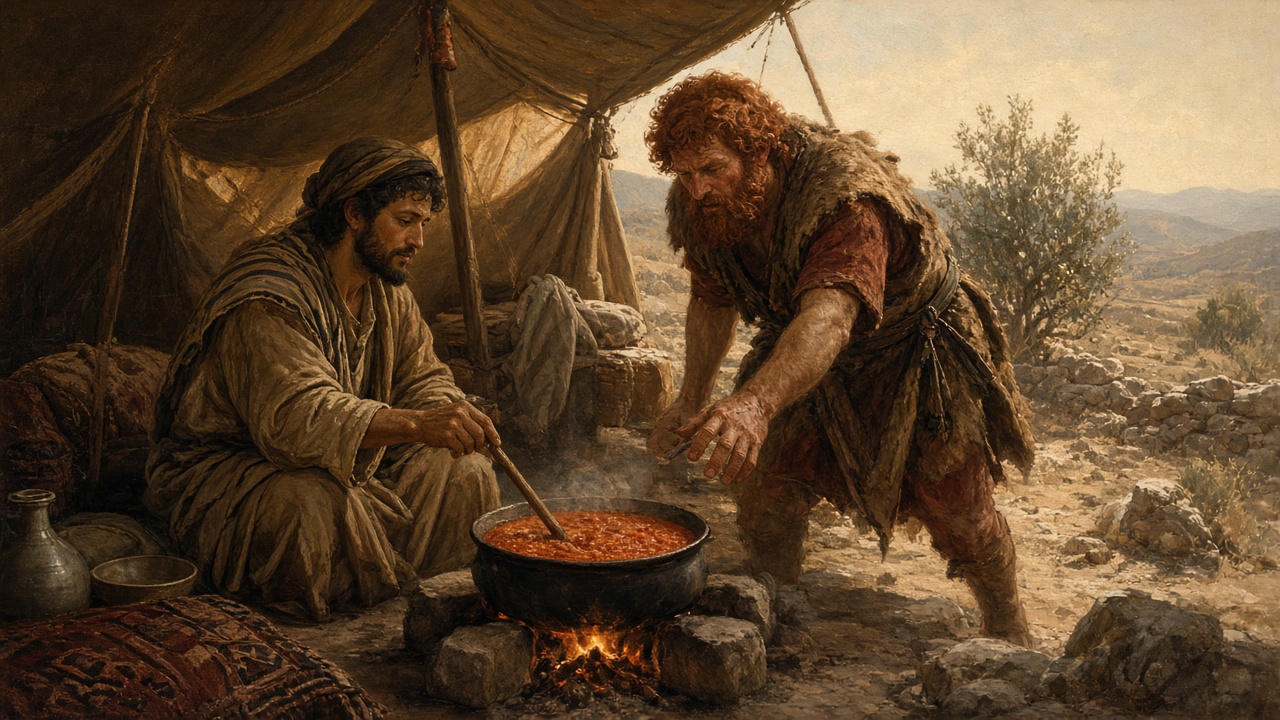
29One day, while Esau was out bush, Jacob cooked some soup with red beans in it. While Jacob was cooking that soup, Esau came back home, and he was really tired and hungry. 30So Esau said to Jacob, “Please let me eat some of that red soup right now. I’m really tired and hungry.”
Jacob said to Esau, “First, I want you to do something for me. You are the oldest son in our family. That means you are the most important son, and you will be the next leader for our family. But I want to be the most important son, instead of you. I want to be the next leader for our family. So you have to promise that you will let me be the most important son now, instead of you. Then you can eat some soup.”
Esau said, “Look, I’m so tired and hungry that I’m going to die. So it doesn’t matter if I stop being the next leader for our family. I just need some food right now.” Esau really wanted some soup, so he promised that Jacob can be the next leader for their family|src="CO00674B.TIF" size="col" copy="David C Cook" ref="25:30-34"
But Jacob said, “First, you have to make me that strong promise.” So Esau did what Jacob asked. He said to Jacob, “I promise that you can be the most important son in our family, instead of me, and you can be the next leader for our family.” Then Jacob gave Esau some of that soup with red beans in it, and some bread. Esau ate that red soup and bread, and then he got up and left.
That’s the story about how Esau let Jacob be the most important son. So Esau wasn’t the most important son any more, but he didn’t care.
Later on, people sometimes called Esau a different name. They called him Edom. That name means red, like that red soup.
¿Sabías que…?
Los herederos de Abraham y los hermanos gemelos
- Cetura, cuyo nombre el Easton's Bible Dictionary (1897) explica como “incienso”, aparece aquí como otra esposa de Abraham. Ese diccionario dice que probablemente se casó con ella después de la muerte de Sara, aunque se desconoce su nacionalidad, y señala que 1 Crónicas la llama concubina. Ella le dio seis hijos, entre ellos Jocsán y Madián, padre de los madianitas; mientras Abraham aún vivía, dio regalos a los hijos de sus concubinas y los alejó de Isaac, enviándolos a la tierra de oriente.Fuentes: Keturah · Midian · el propio texto bíblico
- Isaac e Ismael juntos enterraron a Abraham en la cueva de Macpela, cerca de Mamre, en el campo que Abraham había comprado a Efrón el hitita, donde Sara ya había sido enterrada. El Easton's Bible Dictionary (1897) explica Macpela como “porción” o “cueva doble”, situada en la ladera de un monte al este de Hebrón y frente a Mamre, un lugar llamado las encinas —o, en un margen, los terebintos— de Mamre.Fuentes: Machpelah · Mamre · el propio texto bíblico
- Esaú, el gemelo primogénito de Rebeca, nació rojizo y cubierto de pelo como un abrigo de piel. El Easton's Bible Dictionary (1897) vincula el otro nombre, Edom, “rojo”, con el guiso rojo de lentejas por el que vendió el derecho de primogenitura, y explica a Jacob como “el que sigue los talones de otro” o “suplantador”, en consonancia con el relato de que Jacob nació agarrado al talón de Esaú. Esaú creció como un cazador hábil y hombre del campo, mientras que Jacob era un hombre tranquilo que se quedaba en casa.Fuentes: Esau (Edom) · Jacob (Israel) · el propio texto bíblico
Notas escritas con ayuda de IA a partir de fuentes abiertas (Theographic Bible Metadata, CC BY-SA 4.0; Easton’s Bible Dictionary, dominio público) y revisadas antes de publicarse.
Lugares de este capítulo
- East · Hoy: region around Amman · 31.955, 35.934 · versículo 6
- Machpelah · Hoy: Cave of the Patriarchs · 31.525, 35.111 · versículo 9
- Negeb · 31.245, 34.841 · versículo 11
- Assyria · 36.359, 43.153 · versículo 18
- Egypt · 30.129, 31.308 · versículo 18
Solo aparecen lugares identificados con alta confianza (90 % o más según las fuentes académicas reunidas por OpenBible). Mapa de la época: DARE (Digital Atlas of the Roman Empire), CC BY 4.0; mapa actual: © colaboradores de OpenStreetMap; lugares: OpenBible.info (CC BY 4.0).
Créditos y licencia de esta traducción
Plain English Version
Portions of the Holy Bible in the Plain English Version translation for Australian Aboriginal people who speak English as a second language
Copyright © 2026 Wycliffe Bible Translators Australia
Language: Aboriginal English (English)
Dialect: Australian Aboriginal
Plain English Version © 2026 by Wycliffe Bible Translators Australia, licensed under Creative Commons Attribution-Share Alike 4.0 International (CC BY SA 4.0)
This licence allows you to copy and redistribute the material in any medium or format, even commercially. You may adapt, remix, transform, and build upon the material for any purpose, but if you do so, you must distribute your contributions under the same license as the original. You must always give appropriate credit, provide a link to the license, and indicate if changes were made. You may not suggest that Wycliffe Bible Translators endorses you or your use.
For full details of the licence, visit: creativecommons.org/licenses/by-sa/4.0/legalcode
This translation is made available to you under the terms of the
Creative Commons Attribution Share-Alike license 4.0.
You have permission to share and redistribute this Bible translation in any format and to make reasonable revisions and adaptations of this translation, provided that:
You include the above copyright and source information.
If you make any changes to the text, you must indicate that you did so in a way that makes it clear that the original licensor is not necessarily endorsing your changes.
If you redistribute this text, you must distribute your contributions under the same license as the original.
Pictures included with Scriptures and other documents on this site are licensed just for use with those Scriptures and documents.
For other uses, please contact the respective copyright owners.
Note that in addition to the rules above, revising and adapting God's Word involves a great responsibility to be true to God's Word. See Revelation 22:18-19.
2026-10-02
Fuente: http://ebible.org/engPEV/ · eBible.org