Hechos 13
Plain English Version · Toca un versículo para ver sus referencias cruzadas.
1Barnabas and Saul, and some other men in the church in Antioch, used to tell people God’s messages and teach them God’s word. Those other men were Simeon (his other name was Niger), and Lucius from the country called Cyrene, and Manen (he grew up with Herod, the big boss). 2At one time, Barnabas and Saul, and those other men, they stopped eating food for a while, and they prayed to God. At that time, the Holy Spirit said to them, “Pick out Barnabas and Saul for me now. I’ve got special work for them to do.”
3So those men kept on praying and not eating any food for a bit longer. Then they put their hands on Barnabas and Saul, and they prayed for them and told them, “You can go now and do God’s work.”
Barnabas and Saul went to Cyprus Island
4The Holy Spirit told Barnabas and Saul the places they had to go to. So they went to the town called Selushia, and then they got on a ship and sailed to the island called Cyprus. |src="PEV map Acts 13.jpg" size="span" ref="13:4" 5They took John Mark with them to help them in their work. They got off the ship at a town called Salamis, on Cyprus Island, and they went to the Jewish meeting houses in that town, and they told the people God’s message about Jesus.
6Then Barnabas, and Saul, and John Mark went over to the other side of the island, to the town called Pafos. (Saul had another name. They called him Paul.) The Roman boss over that island lived in Pafos. His name was Sergius Paulus. He was a man that could think properly, and he wanted to hear God’s message, so he sent men to bring Barnabas and Saul to him. There was a Jewish man there that worked for Sergius Paulus. His Jewish name was Bar-Jesus, and his Greek name was Elimas. He was a magic man, and he used to reckon that he was telling people God’s messages, but he was lying.
Elimas tried to stop Barnabas and Paul from telling God’s message to Sergius Paulus. He kept on telling his Roman boss, “Don’t listen to them.”
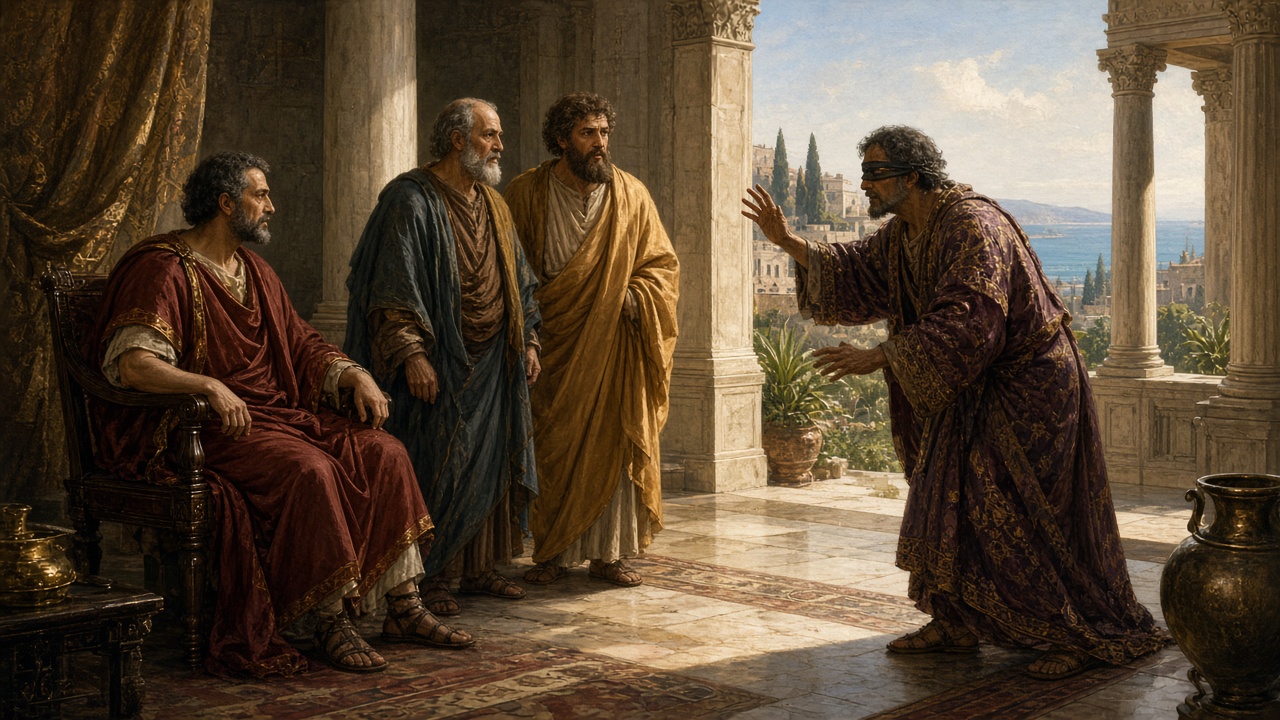
But the Holy Spirit was with Paul and gave him power. He looked straight at Elimas 10and said, “You are just like the devil, the boss over the bad spirits. You tell a lot of lies, and you do a lot of bad things. You try to stop everything that is good, and you try to change God’s true story, and you lie about him. You are trying to trick people. You have to stop doing that. 11God will punish you now. He will make you blind, and you will not see the sunlight for a while.” Suddenly Elimas felt himself going blind, and he walked around asking somebody to hold his hand and take him to the place he wanted to go to.
12The Roman boss saw all that happen, and he heard everything Paul said about our leader Jesus. He thought, “Wow. This message is really good.” So he believed in Jesus.
Paul and Barnabas went to another place called Antioch
13Paul and his friends got on a ship and left Pafos, on Cyprus Island, and they sailed to the town called Perga, in the country called Pamfilia. Then John Mark left them there, and he went back to Jerusalem.
14Paul and Barnabas went on from Perga to another town called Antioch, in the country called Pisidia. Then on Saturday, the day the Jews get together to show respect to God, Paul and Barnabas went into the Jewish meeting house, and they sat down with the men there. 15Some of the leaders in that meeting read from God’s book. They read words from the law that Moses wrote, and they read other words that God’s men wrote a long time ago. Then the leaders said to Paul and Barnabas, “Friends, if you have something to say that will help the people here, go ahead and say it.”
Paul told the Antioch people the message about Jesus
16So Paul stood up and lifted up his hand to get the people to be quiet and listen to him. Then he said, “All you Jewish men and all you other people that respect God, listen to me. Paul went to the Jewish meeting house in Antioch and told people about Jesus|src="lll8-16.tif" size="col" ref="13:16" 17A long time ago, the God of us Jewish people picked our grand-fathers to be his own people. They went to the country called Egypt to live, and while they were there, God made them strong, and they had a lot of kids. So they became a really big mob of people. Then God used his great power to take them out of that country. 18Then they were in the desert country for 40 years. Sometimes they didn’t listen to God, but he looked after them anyway. 19Then they got to the country called Canaan, and God helped them fight against 7 different tribes, and they won. They killed all their enemies, and God gave that country to his own people to keep.
20It was about 450 years from the time they went to Egypt, to the time they got that country. Then God picked leaders for them, so they always had a leader to look after them. After lots of other leaders, God picked Samuel to be their leader. He was a man that told God’s messages to the people. 21Samuel was their leader, but the people wanted a big boss that would always tell them what to do. So God gave them Saul. He was the son of Kish. Saul belonged to the Benjamin tribe, and he was the big boss over the Israel people for 40 years.
22Then God stopped Saul from being their big boss, and God picked David, and he made David the big boss over the Israel people. And God said this, ‘Look at this man, David, the son of Jesse. He is a man that makes me happy. He will do everything that I want him to do.’ 23And God promised that a man from David’s family will come to save us Israel people. And now that man has come. His name is Jesus.
24But before Jesus came, John the Baptiser came and talked to us Israel people. He said, ‘Stop doing bad things. Turn around. Turn back to God, and then I will baptise you.’ 25And John said, ‘Who do you reckon I am? Do you think I’m that special man that God promised to send to save his people? No way. He will come later. I am nothing. I’m not good enough to touch his feet or untie his shoes.’ That’s what John told everyone when he was finishing his work.
26Listen, friends. Some of you are Jews that belong to our grand-father Abraham’s family, and some of you are not Jews but you respect our God. All of you have to listen to this message that God sent to us. It is about how God wants to save us. 27A long time ago, the men that told God’s messages to people wrote those words in his book. They said that God will send a special man, but people will kill him. And people read those words from God’s book in their meetings every Saturday, but they don’t understand them. The people in Jerusalem and their leaders didn’t know that Jesus was that special man, and they said, ‘We have to kill him.’ 28So, even though he didn’t do anything wrong, they asked Pilate, the Roman judge, to kill him anyway. 29That’s how Jesus died, just like those men wrote in God’s book.
And after they killed Jesus, they took him down from the cross and put him into a grave. 30But then God made Jesus alive again, 31and Jesus’s followers saw him a lot of times. They were the mob that were in Galilee country with him, and they came to Jerusalem with him. And now those people are telling everyone about Jesus.
32And we are telling you the same good news about Jesus. You see, a long time ago, God promised our grand-fathers that he will do something good for them, 33and God did it for us, their grand-kids. He made Jesus alive again. You see, we can read it in God’s book, in the part called Psalm number 2. God said,
‘You are my son.
Now people will know that I am your father.’
34You see, God made Jesus alive, so Jesus will never rot in the grave. We know that is right because we can read that God told his son,
‘I made special promises to David,
and I’m making those same promises to you.’
35And in another psalm in God’s book, David said to God,
‘You will not let your special person rot in the grave.’
36But David was not saying that he was that special person. You see, at that time, David did God’s work, and then he died, and people buried him next to his grand-fathers. His body rotted in that grave. 37But Jesus’s body didn’t rot in a grave. God made him alive again. So those words in God’s book were not about David. They were about Jesus.
38You see, my friends, I’m telling you this message. Jesus died for us, so if we believe in him, God will say we are not guilty of the bad things we did. Jesus will make us right and good. The law that Moses gave us can’t do that, it can’t make us right and good. 40A long time ago, God told some of his men to write about that, and it is in God’s book. And now you people be careful. Don’t be like the people that those men wrote about in God’s book. One of them wrote,
41‘Listen all of you people that make fun of God,
he will do something that you will not believe,
even if somebody tells you about it.
You will be really shocked, but you will not believe it,
and then you will die.’
Don’t let that happen to you. You have to believe the things God does.” That’s the message that Paul told the people in that meeting in Antioch.
42Then the meeting finished, and Paul and Barnabas started to go out of that meeting house. Some of the people said to them, “Can you come back next Saturday and tell us more about those things?” And a lot of Jews and other people that respected God followed Paul and Barnabas. Paul and Barnabas talked with them and told them to keep on trusting God, and to keep on letting him help them.
44The next Saturday, nearly all the people in that town came together to hear God’s message about Jesus. 45But the Jewish leaders saw those big mobs of people, and they got really jealous. They started saying bad things to the people about Paul, and they told them, “Paul is telling lies. His message about Jesus is not true.”
46Paul and Barnabas were not frightened of them. They said, “God sent us to tell his message to you Jews first. But you didn’t listen to it, and that shows us that you don’t want to live with God for ever. So now we will tell God’s message to people that are not Jews. 47You see, God told us to do this. It’s in God’s book. He said,
‘I gave you this job, to be like a light for the people that are not Jews.
You will tell people everywhere in the world that I can save them.’”
48Those people that were not Jews heard those words, and they were very happy. They said, “Thank you God for this message. It is really good.” And a lot of people there believed in Jesus. You see, a long time before that, God picked those people to live with him for ever. 49And those people told God’s message about Jesus to other people, and a lot of people all over that country heard God’s message.
50But the Jewish leaders made trouble for Paul and Barnabas. There were some important women in that town that were not Jews, but they respected God. And there were some important men there too. The Jewish leaders told them bad things about Paul and Barnabas, so those important people made big trouble for Paul and Barnabas. They made so much trouble that Paul and Barnabas had to leave that town. 51As they left, they shook the dirt off their feet to show those Jewish people that they were wrong. Then Paul and Barnabas went to the town called Iconium. 52But the people there in Antioch that believed in Jesus were very happy, and they kept on letting the Holy Spirit control them.
¿Sabías que…?
La misión enviada desde Antioquía
- El Diccionario Bíblico de Easton (1897) describe a Antioquía de Siria como la tercera ciudad en importancia del Imperio romano, después de Roma y Alejandría; fue la iglesia de allí la que apartó a Bernabé y a Saulo. Entre sus profetas y maestros estaban Simeón, llamado Níger, un sobrenombre que significa negro, quizá por su tez oscura, y Lucio de Cirene, en el norte de África.Fuentes: Antioch (Syria) · el propio texto bíblico · Simeon · Lucius
- En Pafos, capital de Chipre y residencia del gobernador romano, un hechicero judío llamado Barjesús, también conocido como Elimas, un nombre árabe que significa mago o hechicero, intentó apartar de la fe al procónsul Sergio Paulo. Es aquí donde Saulo también es llamado Pablo; el Diccionario Bíblico de Easton (1897) dice que el nombre Pablo probablemente le fue dado en la infancia para usarlo en el mundo gentil, mientras que Saulo era su nombre hebreo de casa.Fuentes: Paphos · Elymas · Paul · el propio texto bíblico
- Enviados desde Antioquía, bajaron a Seleucia, el puerto de la ciudad cerca de la desembocadura del Orontes, y navegaron hasta Chipre; después desembarcaron en Perge, capital de Panfilia, a orillas del río Cestro. Allí Juan los dejó y regresó a Jerusalén; su nombre romano, Marcos, poco a poco llegó a reemplazar su nombre judío, y era primo de Bernabé.Fuentes: Seleucia · Perga · John Mark · el propio texto bíblico
Notas escritas con ayuda de IA a partir de fuentes abiertas (Theographic Bible Metadata, CC BY-SA 4.0; Easton’s Bible Dictionary, dominio público) y revisadas antes de publicarse.
Lugares de este capítulo
- Antioch · Hoy: Antioch on the Orontes · 36.227, 36.172 · versículo 1
- Cyrene · 32.821, 21.851 · versículo 1
- Cyprus · 35.000, 33.000 · versículo 4
- Seleucia · Hoy: Seleucia Pieria · 36.124, 35.922 · versículo 4
- Salamis · 35.185, 33.902 · versículo 5
- Paphos · Hoy: New Paphos · 34.756, 32.404 · versículos 6, 13
- Jerusalem · 31.777, 35.234 · versículos 13, 27, 31
- Pamphylia · 37.000, 31.000 · versículo 13
- Perga · 36.960, 30.854 · versículos 13, 14
- Antioch · Hoy: Antioch in Pisidia · 38.306, 31.189 · versículo 14
- Pisidia · 38.306, 31.189 · versículo 14
- Egypt · 30.129, 31.308 · versículo 17
- Canaan · 32.767, 35.333 · versículo 19
- Galilee · 32.760, 35.527 · versículo 31
- Iconium · Hoy: Konya · 37.872, 32.492 · versículo 51
Solo aparecen lugares identificados con alta confianza (90 % o más según las fuentes académicas reunidas por OpenBible). Mapa de la época: DARE (Digital Atlas of the Roman Empire), CC BY 4.0; mapa actual: © colaboradores de OpenStreetMap; lugares: OpenBible.info (CC BY 4.0).
Créditos y licencia de esta traducción
Plain English Version
Portions of the Holy Bible in the Plain English Version translation for Australian Aboriginal people who speak English as a second language
Copyright © 2026 Wycliffe Bible Translators Australia
Language: Aboriginal English (English)
Dialect: Australian Aboriginal
Plain English Version © 2026 by Wycliffe Bible Translators Australia, licensed under Creative Commons Attribution-Share Alike 4.0 International (CC BY SA 4.0)
This licence allows you to copy and redistribute the material in any medium or format, even commercially. You may adapt, remix, transform, and build upon the material for any purpose, but if you do so, you must distribute your contributions under the same license as the original. You must always give appropriate credit, provide a link to the license, and indicate if changes were made. You may not suggest that Wycliffe Bible Translators endorses you or your use.
For full details of the licence, visit: creativecommons.org/licenses/by-sa/4.0/legalcode
This translation is made available to you under the terms of the
Creative Commons Attribution Share-Alike license 4.0.
You have permission to share and redistribute this Bible translation in any format and to make reasonable revisions and adaptations of this translation, provided that:
You include the above copyright and source information.
If you make any changes to the text, you must indicate that you did so in a way that makes it clear that the original licensor is not necessarily endorsing your changes.
If you redistribute this text, you must distribute your contributions under the same license as the original.
Pictures included with Scriptures and other documents on this site are licensed just for use with those Scriptures and documents.
For other uses, please contact the respective copyright owners.
Note that in addition to the rules above, revising and adapting God's Word involves a great responsibility to be true to God's Word. See Revelation 22:18-19.
2026-10-02
Fuente: http://ebible.org/engPEV/ · eBible.org