Cantares 2
Douay-Rheims 1899 · Toca un versículo para ver sus referencias cruzadas.
The Bride’s Admiration
The Bride
1I am the flower of the field, and the lily of the valleys.
The Bridegroom
2As the lily among thorns, so is my love among the daughters.
The Bride
3As the apple tree among the trees of the woods, so is my beloved among the sons. I sat down under his shadow, whom I desired: and his fruit was sweet to my palate. 4He brought me into the cellar of wine, he set in order charity in me. 5Stay me up with flowers, compass me about with apples: because I languish with love. 6His left hand is under my head, and his right hand shall embrace me. 7I adjure you, O ye daughters of Jerusalem, by the roes, and the harts of the, fields, that you stir not up, nor make the beloved to awake, till she please. 8The voice of my beloved, behold he cometh leaping upon the mountains, skipping over the hills. 9My beloved is like a roe, or a young hart. Behold he standeth behind our wall, looking through the windows, looking through the lattices. 10Behold my beloved speaketh to me: Arise, make haste, my love, my dove, my beautiful one, and come. 11For winter is now past, the rain is over and gone. 12The flowers have appeared in our land, the time of pruning is come: the voice of the turtle is heard in our land: 13The fig tree hath put forth her green figs: the vines in flower yield their sweet smell. Arise, my love, my beautiful one, and come:
The Bridegroom
14My dove in the clefts of the rock, in the hollow places of the wall, shew me thy face, let thy voice sound in my ears: for thy voice is sweet, and thy face comely.
The Friends
15Catch us the little foxes that destroy the vines: for our vineyard hath flourished.
The Bride
16My beloved to me, and I to him who feedeth among the lilies, 17Till the day break, and the shadows retire. Return: be like, my beloved, to a roe, or to a young hart upon the mountains of Bether.
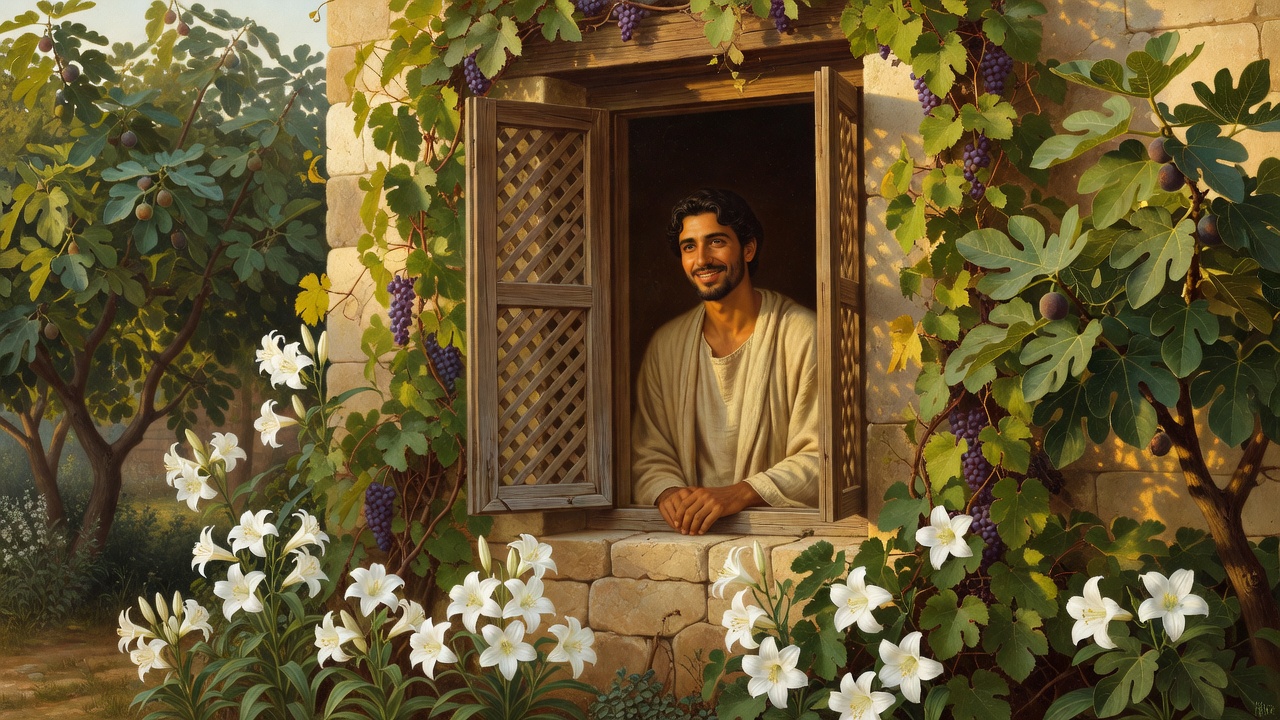
¿Sabías que…?
La Primavera y el Despertar del Amor
- Sarón era una fértil llanura costera que se extendía entre el mar Mediterráneo y las colinas al oeste de Jerusalén, célebre por su belleza y vegetación, lo que dio origen a metáforas como la rosa de Sarón.Fuentes: Saron · el propio texto bíblico
- El poema describe la llegada de la primavera mediante señales campestres, tales como el cese de las lluvias invernales, el arrullo de las tórtolas, los higos que maduran y las viñas en flor que debían cuidarse de los zorros.Fuentes: el propio texto bíblico
- La mujer apela repetidamente a las hijas de Jerusalén, formulando sus advertencias sobre el amor a través de figuras de la fauna silvestre, como gacelas y ciervas del campo.Fuentes: Jerusalem · el propio texto bíblico
Notas escritas con ayuda de IA a partir de fuentes abiertas (Theographic Bible Metadata, CC BY-SA 4.0; Easton’s Bible Dictionary, dominio público) y revisadas antes de publicarse.
Lugares de este capítulo
Solo aparecen lugares identificados con alta confianza (90 % o más según las fuentes académicas reunidas por OpenBible). Mapa de la época: DARE (Digital Atlas of the Roman Empire), CC BY 4.0; mapa actual: © colaboradores de OpenStreetMap; lugares: OpenBible.info (CC BY 4.0).
Créditos y licencia de esta traducción
Douay-Rheims 1899
The Holy Bible in English, Douay-Rheims American Edition of 1899, translated from the Latin Vulgate
Public Domain
Language: English
Dialect: archaic American
Translation by: English College, Douai
This Public Domain Bible text is brought to you courtesy of eBible.org.
Help support free Bible access at https://eBible.org/give.php .
2022-11-03
Títulos de sección adaptados de la Berean Standard Bible (dominio público); no forman parte del texto bíblico de esta traducción.
Fuente: http://ebible.org/engDRA/ · eBible.org