Salmos 89
Douay-Rheims 1899 · Toca un versículo para ver sus referencias cruzadas.
I Will Sing of His Love Forever
1A prayer of Moses the man of God. Lord, thou hast been our refuge from generation to generation.
2Before the mountains were made, or the earth and the world was formed; from eternity and to eternity thou art God.
3Turn not man away to be brought low: and thou hast said: Be converted, O ye sons of men.
4For a thousand years in thy sight are as yesterday, which is past. And as a watch in the night,
5Things that are counted nothing, shall their years be.
6In the morning man shall grow up like grass; in the morning he shall flourish and pass away: in the evening he shall fall, grow dry, and wither.
7For in thy wrath we have fainted away: and are troubled in thy indignation.
8Thou hast set our iniquities before thy eyes: our life in the light of thy countenance.
9For all our days are spent; and in thy wrath we have fainted away. Our years shall be considered as a spider:
10The days of our years in them are threescore and ten years. But if in the strong they be fourscore years: and what is more of them is labour and sorrow. For mildness is come upon us: and we shall be corrected.
11Who knoweth the power of thy anger, and for thy fear
12Can number thy wrath? So make thy right hand known: and men learned in heart, in wisdom.
13Return, O Lord, how long? and be entreated in favour of thy servants.
14We are filled in the morning with thy mercy: and we have rejoiced, and are delighted all our days.
15We have rejoiced for the days in which thou hast humbled us: for the years in which we have seen evils.
16Look upon thy servants and upon their works: and direct their children.
17And let the brightness of the Lord our God be upon us: and direct thou the works of our hands over us; yea, the work of our hands do thou direct.
¿Sabías que…?
El pacto con David y la corona caída
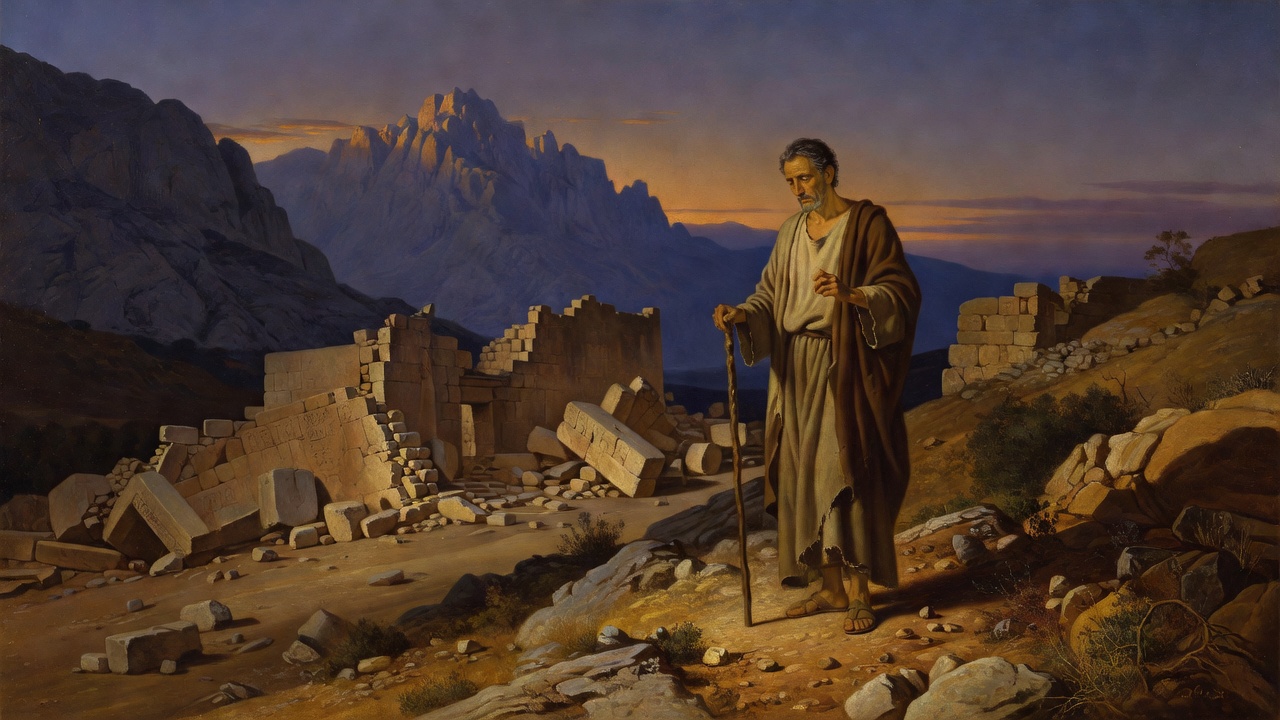
- Atribuido a Etán ezraíta, el Salmo 89 recuerda el pacto perpetuo de Dios que prometía afirmar el trono del rey David para siempre, a la vez que lamenta la posterior derrota del gobernante davídico y la ruina de sus fortalezas.Fuentes: David · el propio texto bíblico
- El nombre Rahab en el versículo 10 es un término poético que significa soberbia u orgullo, utilizado en la poesía bíblica para representar al imperio de Egipto.Fuentes: Rahab · el propio texto bíblico
- El versículo 12 une poéticamente el monte Tabor, un prominente pico cónico al oeste del mar de Galilea, con el monte Hermón, la imponente cumbre en la frontera norte de Canaán, como símbolos de la creación que se regocija en Dios.Fuentes: Tabor (Mountain) · Hermon · el propio texto bíblico
Notas escritas con ayuda de IA a partir de fuentes abiertas (Theographic Bible Metadata, CC BY-SA 4.0; Easton’s Bible Dictionary, dominio público) y revisadas antes de publicarse.
Lugares de este capítulo
- Mount Hermon · 33.400, 35.850 · versículo 12
- Mount Tabor · Hoy: Jebel et Tur · 32.686, 35.393 · versículo 12
Solo aparecen lugares identificados con alta confianza (90 % o más según las fuentes académicas reunidas por OpenBible). Mapa de la época: DARE (Digital Atlas of the Roman Empire), CC BY 4.0; mapa actual: © colaboradores de OpenStreetMap; lugares: OpenBible.info (CC BY 4.0).
Créditos y licencia de esta traducción
Douay-Rheims 1899
The Holy Bible in English, Douay-Rheims American Edition of 1899, translated from the Latin Vulgate
Public Domain
Language: English
Dialect: archaic American
Translation by: English College, Douai
This Public Domain Bible text is brought to you courtesy of eBible.org.
Help support free Bible access at https://eBible.org/give.php .
2022-11-03
Títulos de sección adaptados de la Berean Standard Bible (dominio público); no forman parte del texto bíblico de esta traducción.
Fuente: http://ebible.org/engDRA/ · eBible.org