Jonás 4
Douay-Rheims 1899 · Toca un versículo para ver sus referencias cruzadas.
Jonah’s Anger at the LORD’s Compassion
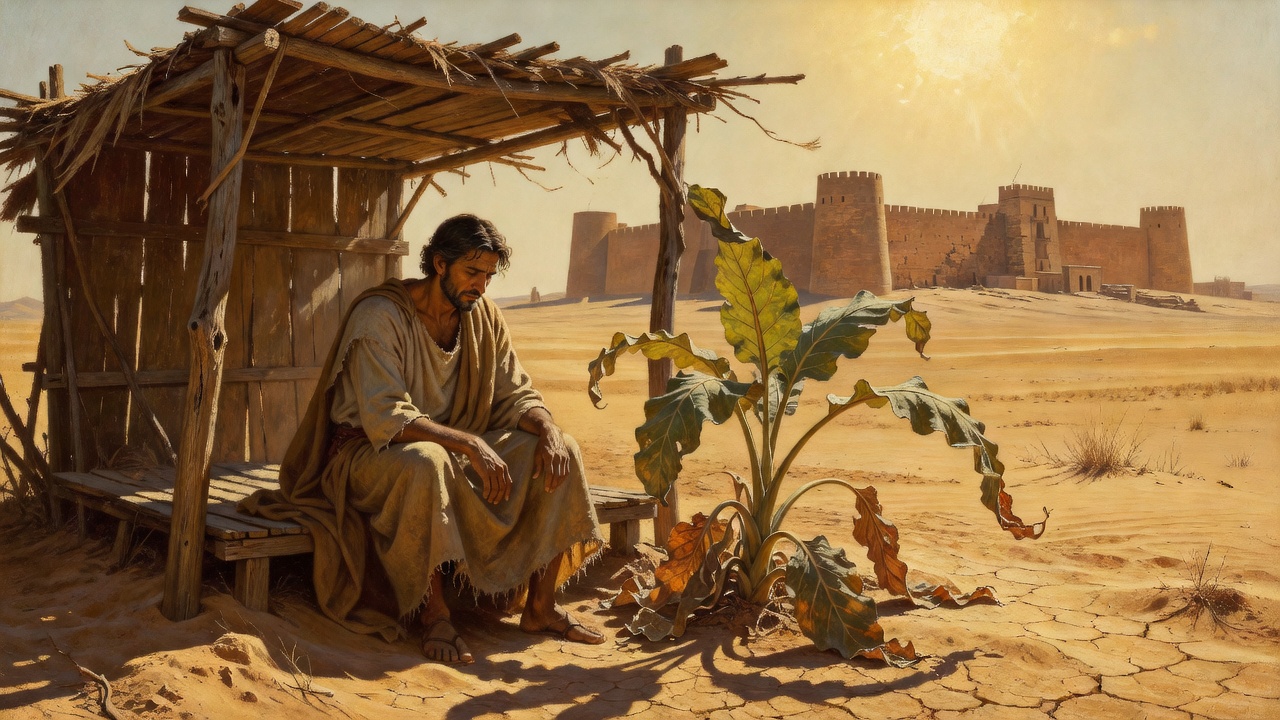
1And Jonas was exceedingly troubled, and was angry: 2And he prayed to the Lord, and said: I beseech thee, O Lord, is not this what I said, when I was yet in my own country? therefore I went before to flee into Tharsis: for I know that thou art a gracious and merciful God, patient, and of much compassion, and easy to forgive evil. 3And now, O Lord, I beseech thee take my life from me: for it is better for me to die than to live. 4And the Lord said: Dost thou think thou hast reason to be angry? 5Then Jonas went out of the city, and sat toward the east side of the city: and he made himself a booth there, and he sat under it in the shadow, till he might see what would befall the city. 6And the Lord God prepared an ivy, and it came up over the head of Jonas, to be a shadow over his head, and to cover him (for he was fatigued), and Jonas was exceeding glad of the ivy. 7But God prepared a worm, when the morning arose on the following day: and it struck the ivy and it withered. 8And when the sun was risen, the Lord commanded a hot and burning wind: and the sun beat upon the head of Jonas, and he broiled with the heat: and he desired for his soul that he might die, and said: It is better for me to die than to live. 9And the Lord said to Jonas: Dost thou think thou hast reason to be angry, for the ivy? And he said: I am angry with reason even unto death. 10And the Lord said: Thou art grieved for the ivy, for which thou hast not laboured, nor made it to grow, which in one night came up, and in one night perished. 11And shall not I spare Ninive, that great city, in which there are more than a hundred and twenty thousand persons that know not how to distinguish between their right hand and their left, and many beasts?
¿Sabías que…?
El enojo de Jonás y la compasión de Dios
- Jonás admite que originalmente intentó huir hacia Tarsis precisamente porque sabía que Dios es clemente, compasivo, lento para la ira y dispuesto a desistir de enviar calamidades. Su aflicción surgió cuando Dios decidió perdonar a Nínive en lugar de destruirla.Fuentes: el propio texto bíblico · Tarshish
- Nínive, la floreciente capital del Imperio Asirio, se describe al final del libro con más de 120.000 personas que no saben distinguir entre su mano derecha y su izquierda, además de muchos animales. Dios resalta esta inmensa población para contrastar la compasión divina con el apego de Jonás a una sola planta marchita.Fuentes: el propio texto bíblico · Nineveh
Notas escritas con ayuda de IA a partir de fuentes abiertas (Theographic Bible Metadata, CC BY-SA 4.0; Easton’s Bible Dictionary, dominio público) y revisadas antes de publicarse.
Lugares de este capítulo
- Nineveh · 36.359, 43.153 · versículo 11
Solo aparecen lugares identificados con alta confianza (90 % o más según las fuentes académicas reunidas por OpenBible). Mapa de la época: DARE (Digital Atlas of the Roman Empire), CC BY 4.0; mapa actual: © colaboradores de OpenStreetMap; lugares: OpenBible.info (CC BY 4.0).
Créditos y licencia de esta traducción
Douay-Rheims 1899
The Holy Bible in English, Douay-Rheims American Edition of 1899, translated from the Latin Vulgate
Public Domain
Language: English
Dialect: archaic American
Translation by: English College, Douai
This Public Domain Bible text is brought to you courtesy of eBible.org.
Help support free Bible access at https://eBible.org/give.php .
2022-11-03
Títulos de sección adaptados de la Berean Standard Bible (dominio público); no forman parte del texto bíblico de esta traducción.
Fuente: http://ebible.org/engDRA/ · eBible.org