Cantares 4
Darby Translation · Toca un versículo para ver sus referencias cruzadas.
Solomon Admires His Bride
The Bridegroom
1Behold, thou art fair, my love; behold, thou art fair; Thine eyes are doves behind thy veil; Thy hair is as a flock of goats, On the slopes of mount Gilead. 2Thy teeth are like a flock of shorn sheep, Which go up from the washing; Which have all borne twins, And none is barren among them. 3Thy lips are like a thread of scarlet, And thy speech is comely; As a piece of a pomegranate are thy temples Behind thy veil. 4Thy neck is like the tower of David, Built for an armoury: A thousand bucklers hang thereon, All shields of mighty men. 5Thy two breasts are like two fawns, twins of a gazelle, Which feed among the lilies. 6Until the day dawn, and the shadows flee away, I will get me to the mountain of myrrh, And to the hill of frankincense. 7Thou art all fair, my love; And there is no spot in thee. 8[Come] with me, from Lebanon, [my] spouse, With me from Lebanon, — Come, look from the top of Amanah, From the top of Senir and Hermon, From the lions' dens, From the mountains of the leopards. 9Thou hast ravished my heart, my sister, [my] spouse; Thou hast ravished my heart with one of thine eyes, With one chain of thy neck. 10How fair is thy love, my sister, [my] spouse! How much better is thy love than wine! And the fragrance of thine ointments than all spices! 11Thy lips, [my] spouse, drop [as] the honeycomb; Honey and milk are under thy tongue; And the smell of thy garments is like the smell of Lebanon. 12A garden enclosed is my sister, [my] spouse; A spring shut up, a fountain sealed. 13Thy shoots are a paradise of pomegranates, with precious fruits; Henna with spikenard plants; 14Spikenard and saffron; Calamus and cinnamon, with all trees of frankincense; Myrrh and aloes, with all the chief spices: 15A fountain in the gardens, A well of living waters, Which stream from Lebanon.
The Bride
16Awake, north wind, and come, [thou] south; Blow upon my garden, [that] the spices thereof may flow forth. Let my beloved come into his garden, And eat its precious fruits.
¿Sabías que…?
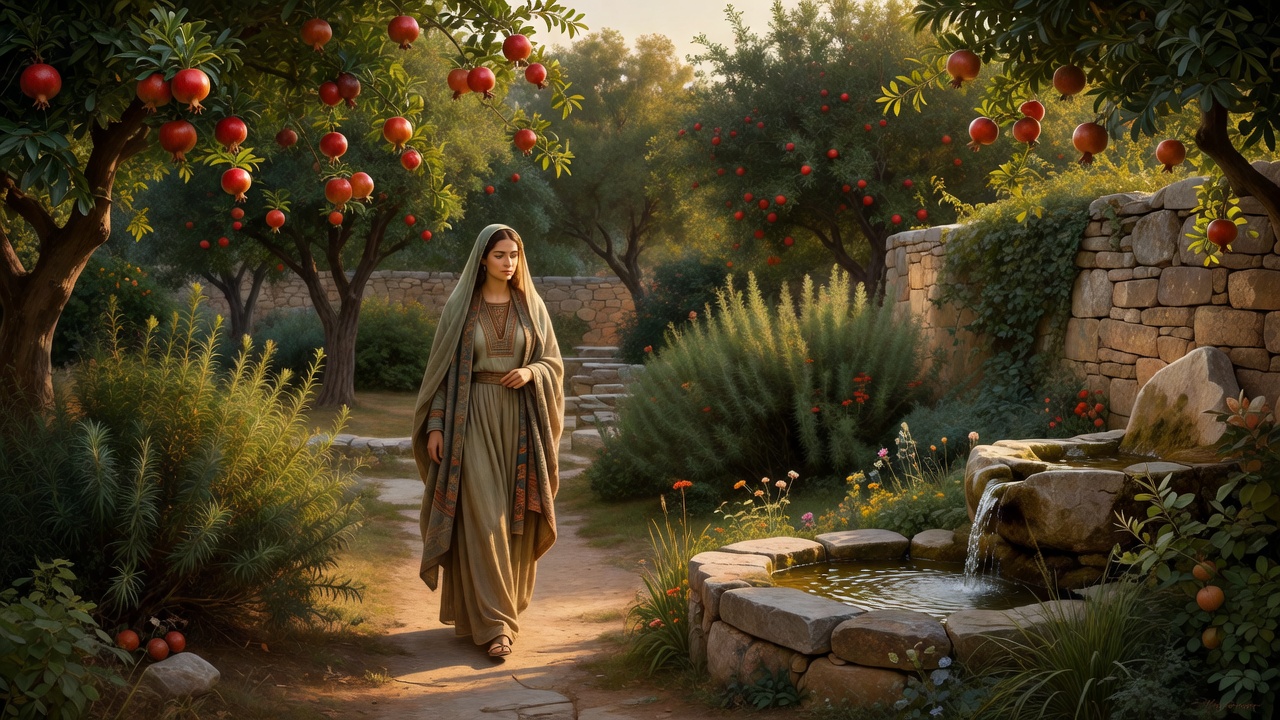
La belleza de la novia y el huerto de especias
- El poema invita a la novia a descender de las imponentes cordilleras del norte en el Líbano, que incluyen Amana, Senir y el monte Hermón. El monte Hermón es la cumbre más alta del Antilíbano, y las fuentes bíblicas señalan que Senir era el nombre amorreo para este monte.Fuentes: el propio texto bíblico · Hermon · Senir · Lebanon
- El cabello de la amada se compara con un rebaño de cabras que desciende por el monte Galaad, una región fértil y montañosa situada al este del río Jordán.Fuentes: el propio texto bíblico · Gilead
- La novia es descrita como un huerto cerrado, una fuente sellada y un vergel repleto de valiosas especias como nardo, azafrán, canela e incienso, lo que evoca exclusividad, frescura y fragancia.Fuentes: el propio texto bíblico
Notas escritas con ayuda de IA a partir de fuentes abiertas (Theographic Bible Metadata, CC BY-SA 4.0; Easton’s Bible Dictionary, dominio público) y revisadas antes de publicarse.
Lugares de este capítulo
- Gilead · Hoy: Gilead 1 · 32.187, 35.692 · versículo 1
- Lebanon · 33.540, 35.584 · versículos 8, 11, 15
- Mount Hermon · 33.400, 35.850 · versículo 8
- Senir · Hoy: Mount Hermon · 33.400, 35.850 · versículo 8
Solo aparecen lugares identificados con alta confianza (90 % o más según las fuentes académicas reunidas por OpenBible). Mapa de la época: DARE (Digital Atlas of the Roman Empire), CC BY 4.0; mapa actual: © colaboradores de OpenStreetMap; lugares: OpenBible.info (CC BY 4.0).
Créditos y licencia de esta traducción
Darby Translation
The Holy Scriptures, a New Translation from the Original Languages by J. N. Darby
Public Domain
Language: English
Dialect: archaic British
Translation by: J. N. Darby
2019-11-15
Títulos de sección adaptados de la Berean Standard Bible (dominio público); no forman parte del texto bíblico de esta traducción.
Fuente: http://ebible.org/engDBY/ · eBible.org