Jonás 4
Darby Translation · Toca un versículo para ver sus referencias cruzadas.
Jonah’s Anger at the LORD’s Compassion
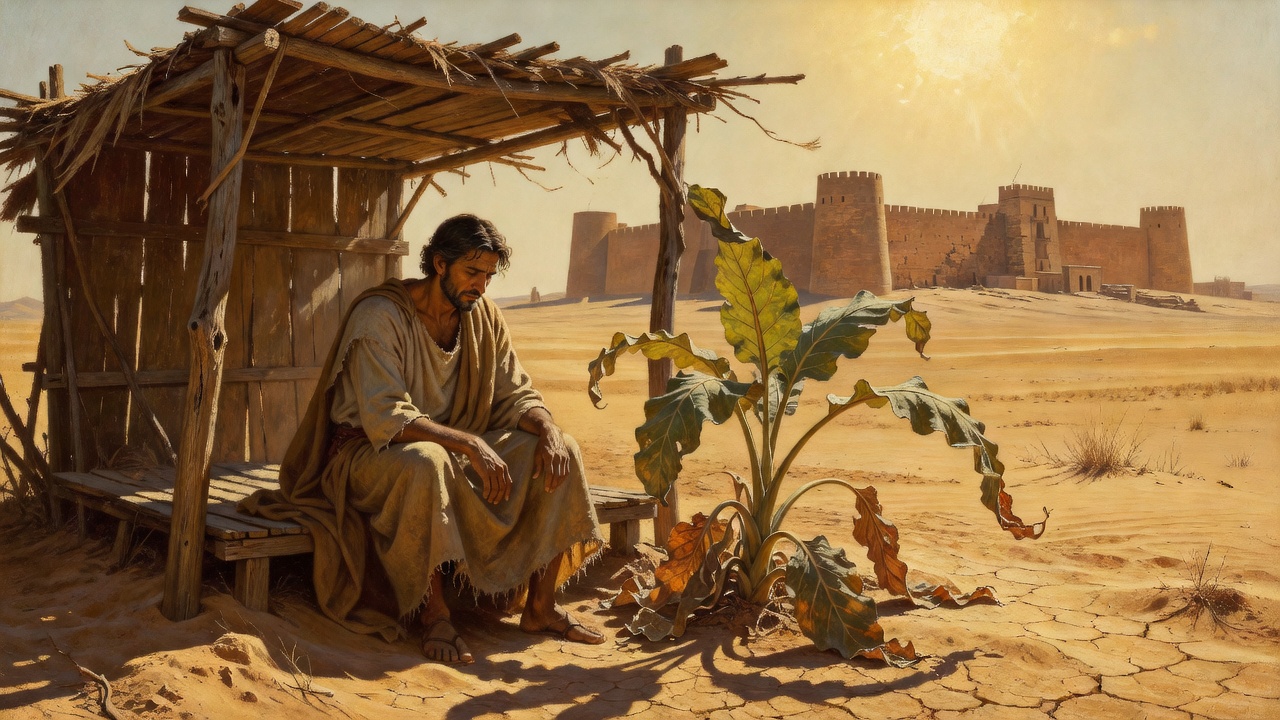
1And it displeased Jonah exceedingly, and he was angry. 2And he prayed unto Jehovah, and said, Ah, Jehovah, was not this my saying when I was yet in my country? Therefore I was minded to flee at first unto Tarshish; for I knew that thou art a gracious God, and merciful, slow to anger, and of great loving-kindness, and repentest thee of the evil. 3And now, Jehovah, take, I beseech thee, my life from me, for it is better for me to die than to live. 4And Jehovah said, Doest thou well to be angry? 5And Jonah went out of the city, and sat on the east side of the city, and there made him a booth, and sat under it in the shade, till he might see what would become of the city. 6And Jehovah Elohim prepared a gourd, and made it to come up over Jonah, that it might be a shade over his head, to deliver him from his trouble. And Jonah was exceeding glad because of the gourd. 7But God prepared a worm when the morning rose the next day, and it smote the gourd, that it withered. 8And it came to pass, when the sun arose, that God prepared a sultry east wind; and the sun beat upon the head of Jonah, so that he fainted; and he requested for himself that he might die, and said, It is better for me to die than to live. 9And God said to Jonah, Doest thou well to be angry for the gourd? And he said, I do well to be angry, unto death. 10And Jehovah said, Thou hast pity on the gourd, for which thou hast not laboured, neither madest it grow; which came up in a night, and perished in a night: 11and I, should not I have pity on Nineveh, the great city, wherein are more than a hundred and twenty thousand persons that cannot discern between their right hand and their left hand; and also much cattle?
¿Sabías que…?
El enojo de Jonás y la compasión de Dios
- Jonás admite que originalmente intentó huir hacia Tarsis precisamente porque sabía que Dios es clemente, compasivo, lento para la ira y dispuesto a desistir de enviar calamidades. Su aflicción surgió cuando Dios decidió perdonar a Nínive en lugar de destruirla.Fuentes: el propio texto bíblico · Tarshish
- Nínive, la floreciente capital del Imperio Asirio, se describe al final del libro con más de 120.000 personas que no saben distinguir entre su mano derecha y su izquierda, además de muchos animales. Dios resalta esta inmensa población para contrastar la compasión divina con el apego de Jonás a una sola planta marchita.Fuentes: el propio texto bíblico · Nineveh
Notas escritas con ayuda de IA a partir de fuentes abiertas (Theographic Bible Metadata, CC BY-SA 4.0; Easton’s Bible Dictionary, dominio público) y revisadas antes de publicarse.
Lugares de este capítulo
- Nineveh · 36.359, 43.153 · versículo 11
Solo aparecen lugares identificados con alta confianza (90 % o más según las fuentes académicas reunidas por OpenBible). Mapa de la época: DARE (Digital Atlas of the Roman Empire), CC BY 4.0; mapa actual: © colaboradores de OpenStreetMap; lugares: OpenBible.info (CC BY 4.0).
Créditos y licencia de esta traducción
Darby Translation
The Holy Scriptures, a New Translation from the Original Languages by J. N. Darby
Public Domain
Language: English
Dialect: archaic British
Translation by: J. N. Darby
2019-11-15
Títulos de sección adaptados de la Berean Standard Bible (dominio público); no forman parte del texto bíblico de esta traducción.
Fuente: http://ebible.org/engDBY/ · eBible.org