Hechos 13
Darby Translation · Toca un versículo para ver sus referencias cruzadas.
Paul’s First Missionary Journey Begins
1Now there were in Antioch, in the assembly which was [there], prophets and teachers: Barnabas, and Simeon who was called Niger, and Lucius the Cyrenian, and Manaen, foster-brother of Herod the tetrarch, and Saul. 2And as they were ministering to the Lord and fasting, the Holy Spirit said, Separate me now Barnabas and Saul for the work to which I have called them. 3Then, having fasted and prayed, and having laid [their] hands on them, they let [them] go.
On Cyprus
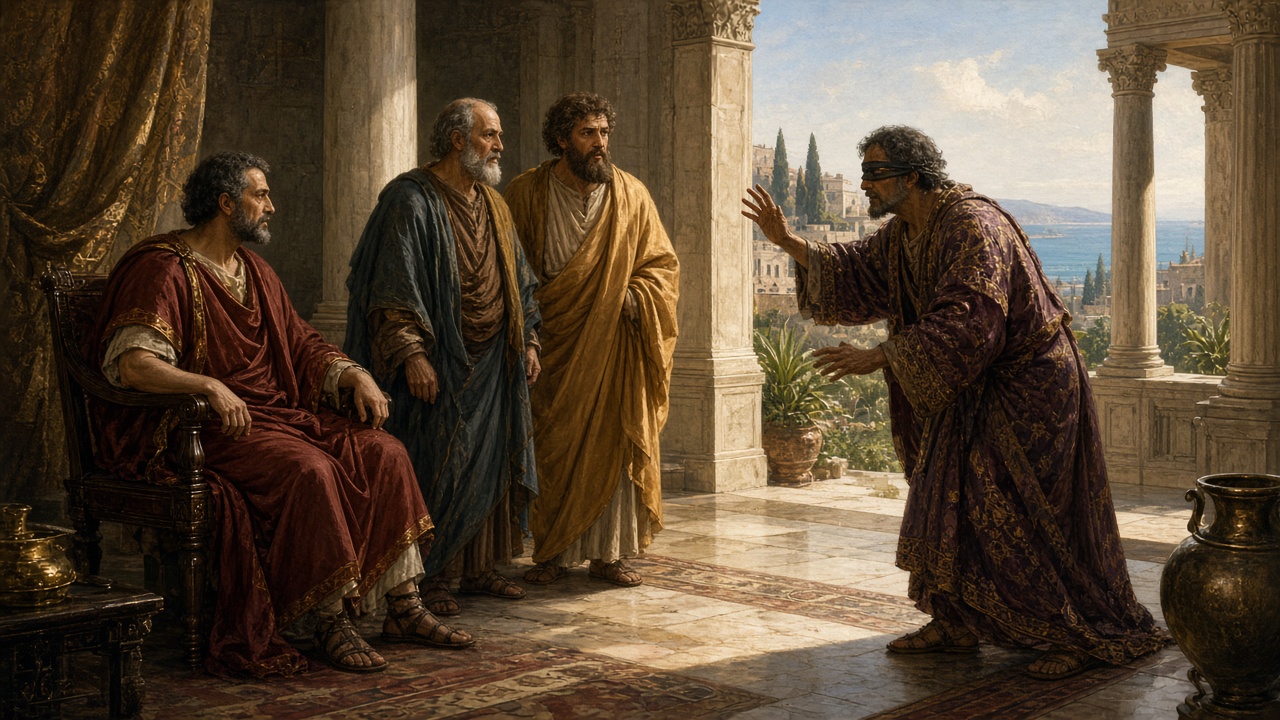
4They therefore, having been sent forth by the Holy Spirit, went down to Seleucia, and thence sailed away to Cyprus. 5And being in Salamis, they announced the word of God in the synagogues of the Jews. And they had John also as [their] attendant. 6And having passed through the whole island as far as Paphos, they found a certain man a magician, a false prophet, a Jew, whose name was Bar-jesus, 7who was with the proconsul Sergius Paulus, an intelligent man. He, having called Barnabas and Saul to [him], desired to hear the word of God. 8But Elymas the magician (for so his name is by interpretation) opposed them, seeking to turn away the proconsul from the faith. 9But Saul, who also [is] Paul, filled with [the] Holy Spirit, fixing his eyes upon him, 10said, O full of all deceit and all craft: son of [the] devil, enemy of all righteousness; wilt thou not cease perverting the right paths of [the] Lord? 11And now behold, [the] Lord's hand [is] upon thee, and thou shalt be blind, not seeing the sun for a season. And immediately there fell upon him a mist and darkness; and going about he sought persons who should lead him by the hand. 12Then the proconsul, seeing what had happened, believed, being amazed at the teaching of the Lord.
In Pisidian Antioch
13And having sailed from Paphos, Paul and his company came to Perga of Pamphylia; and John separated from them and returned to Jerusalem. 14But they, passing through from Perga, came to Antioch of Pisidia; and entering into the synagogue on the sabbath day they sat down. 15And after the reading of the law and the prophets, the rulers of the synagogue sent to them, saying, Brethren, if ye have any word of exhortation to the people, speak. 16And Paul, rising up and making a sign with the hand, said, Israelites, and ye that fear God, hearken. 17The God of this people Israel chose our fathers, and exalted the people in their sojourn in [the] land of Egypt, and with a high arm brought them out of it, 18and for a time of about forty years he nursed them in the desert. 19And having destroyed seven nations in the land of Canaan, he gave them their land as an inheritance. 20And after these things he gave [them] judges till Samuel the prophet, [to the end of] about four hundred and fifty years. 21And then they asked for a king, and God gave to them Saul, son of Kis, a man of the tribe of Benjamin, during forty years. 22And having removed him he raised up to them David for king, of whom also bearing witness he said, I have found David, the son of Jesse, a man after my heart, who shall do all my will. 23Of this man's seed according to promise has God brought to Israel a Saviour, Jesus; 24John having proclaimed before the face of his entry [among the people] [the] baptism of repentance to all the people of Israel. 25And as John was fulfilling his course he said, Whom do ye suppose that I am? I am not [he]. But behold, there comes one after me, the sandal of whose feet I am not worthy to loose. 26Brethren, sons of Abraham's race, and those who among you fear God, to you has the word of this salvation been sent: 27for those who dwell in Jerusalem, and their rulers, not having known him, have fulfilled also the voices of the prophets which are read on every sabbath, [by] judging [him]. 28And having found no cause of death [in him], they begged of Pilate that he might be slain. 29And when they had fulfilled all things written concerning him, they took him down from the cross and put him in a sepulchre; 30but God raised him from among [the] dead, 31who appeared for many days to those who had come up with him from Galilee to Jerusalem, who are now his witnesses to the people. 32And we declare unto you the glad tidings of the promise made to the fathers, 33that God has fulfilled this to us their children, having raised up Jesus; as it is also written in the second psalm, Thou art my Son: this day have I begotten thee. 34But that he raised him from among [the] dead, no more to return to corruption, he spoke thus: I will give to you the faithful mercies of David. 35Wherefore also he says in another, Thou wilt not suffer thy gracious one to see corruption. 36For David indeed, having in his own generation ministered to the will of God, fell asleep, and was added to his fathers and saw corruption. 37But he whom God raised up did not see corruption. 38Be it known unto you, therefore, brethren, that through this man remission of sins is preached to you, 39and from all things from which ye could not be justified in the law of Moses, in him every one that believes is justified. 40See therefore that that which is spoken in the prophets do not come upon [you], 41Behold, ye despisers, and wonder and perish; for I work a work in your days, a work which ye will in no wise believe if one declare it to you.
A Light for the Gentiles
42And as they went out they begged that these words might be spoken to them the ensuing sabbath. 43And the congregation of the synagogue having broken up, many of the Jews and of the worshipping proselytes followed Paul and Barnabas, who speaking to them, persuaded them to continue in the grace of God. 44And on the coming sabbath almost all the city was gathered together to hear the word of God. 45But the Jews, seeing the crowds, were filled with envy, and contradicted the things said by Paul, [contradicting and] speaking injuriously. 46And Paul and Barnabas spoke boldly and said, It was necessary that the word of God should be first spoken to you; but, since ye thrust it from you, and judge yourselves unworthy of eternal life, lo, we turn to the nations; 47for thus has the Lord enjoined us: I have set thee for a light of the nations, that thou shouldest be for salvation to the end of the earth. 48And [those of] the nations, hearing it, rejoiced, and glorified the word of the Lord, and believed, as many as were ordained to eternal life. 49And the word of the Lord was carried through the whole country. 50But the Jews excited the women of the upper classes who were worshippers, and the first people of the city, and raised a persecution against Paul and Barnabas, and cast them out of their coasts. 51But they, having shaken off the dust of their feet against them, came to Iconium. 52And the disciples were filled with joy and [the] Holy Spirit.
¿Sabías que…?
La misión enviada desde Antioquía
- El Diccionario Bíblico de Easton (1897) describe a Antioquía de Siria como la tercera ciudad en importancia del Imperio romano, después de Roma y Alejandría; fue la iglesia de allí la que apartó a Bernabé y a Saulo. Entre sus profetas y maestros estaban Simeón, llamado Níger, un sobrenombre que significa negro, quizá por su tez oscura, y Lucio de Cirene, en el norte de África.Fuentes: Antioch (Syria) · el propio texto bíblico · Simeon · Lucius
- En Pafos, capital de Chipre y residencia del gobernador romano, un hechicero judío llamado Barjesús, también conocido como Elimas, un nombre árabe que significa mago o hechicero, intentó apartar de la fe al procónsul Sergio Paulo. Es aquí donde Saulo también es llamado Pablo; el Diccionario Bíblico de Easton (1897) dice que el nombre Pablo probablemente le fue dado en la infancia para usarlo en el mundo gentil, mientras que Saulo era su nombre hebreo de casa.Fuentes: Paphos · Elymas · Paul · el propio texto bíblico
- Enviados desde Antioquía, bajaron a Seleucia, el puerto de la ciudad cerca de la desembocadura del Orontes, y navegaron hasta Chipre; después desembarcaron en Perge, capital de Panfilia, a orillas del río Cestro. Allí Juan los dejó y regresó a Jerusalén; su nombre romano, Marcos, poco a poco llegó a reemplazar su nombre judío, y era primo de Bernabé.Fuentes: Seleucia · Perga · John Mark · el propio texto bíblico
Notas escritas con ayuda de IA a partir de fuentes abiertas (Theographic Bible Metadata, CC BY-SA 4.0; Easton’s Bible Dictionary, dominio público) y revisadas antes de publicarse.
Lugares de este capítulo
- Antioch · Hoy: Antioch on the Orontes · 36.227, 36.172 · versículo 1
- Cyrene · 32.821, 21.851 · versículo 1
- Cyprus · 35.000, 33.000 · versículo 4
- Seleucia · Hoy: Seleucia Pieria · 36.124, 35.922 · versículo 4
- Salamis · 35.185, 33.902 · versículo 5
- Paphos · Hoy: New Paphos · 34.756, 32.404 · versículos 6, 13
- Jerusalem · 31.777, 35.234 · versículos 13, 27, 31
- Pamphylia · 37.000, 31.000 · versículo 13
- Perga · 36.960, 30.854 · versículos 13, 14
- Antioch · Hoy: Antioch in Pisidia · 38.306, 31.189 · versículo 14
- Pisidia · 38.306, 31.189 · versículo 14
- Egypt · 30.129, 31.308 · versículo 17
- Canaan · 32.767, 35.333 · versículo 19
- Galilee · 32.760, 35.527 · versículo 31
- Iconium · Hoy: Konya · 37.872, 32.492 · versículo 51
Solo aparecen lugares identificados con alta confianza (90 % o más según las fuentes académicas reunidas por OpenBible). Mapa de la época: DARE (Digital Atlas of the Roman Empire), CC BY 4.0; mapa actual: © colaboradores de OpenStreetMap; lugares: OpenBible.info (CC BY 4.0).
Créditos y licencia de esta traducción
Darby Translation
The Holy Scriptures, a New Translation from the Original Languages by J. N. Darby
Public Domain
Language: English
Dialect: archaic British
Translation by: J. N. Darby
2019-11-15
Títulos de sección adaptados de la Berean Standard Bible (dominio público); no forman parte del texto bíblico de esta traducción.
Fuente: http://ebible.org/engDBY/ · eBible.org